
In the triangle shown, what is the value of tan y°?
GMAT Geometry & Trigonometry : (Geo_Trig) Questions
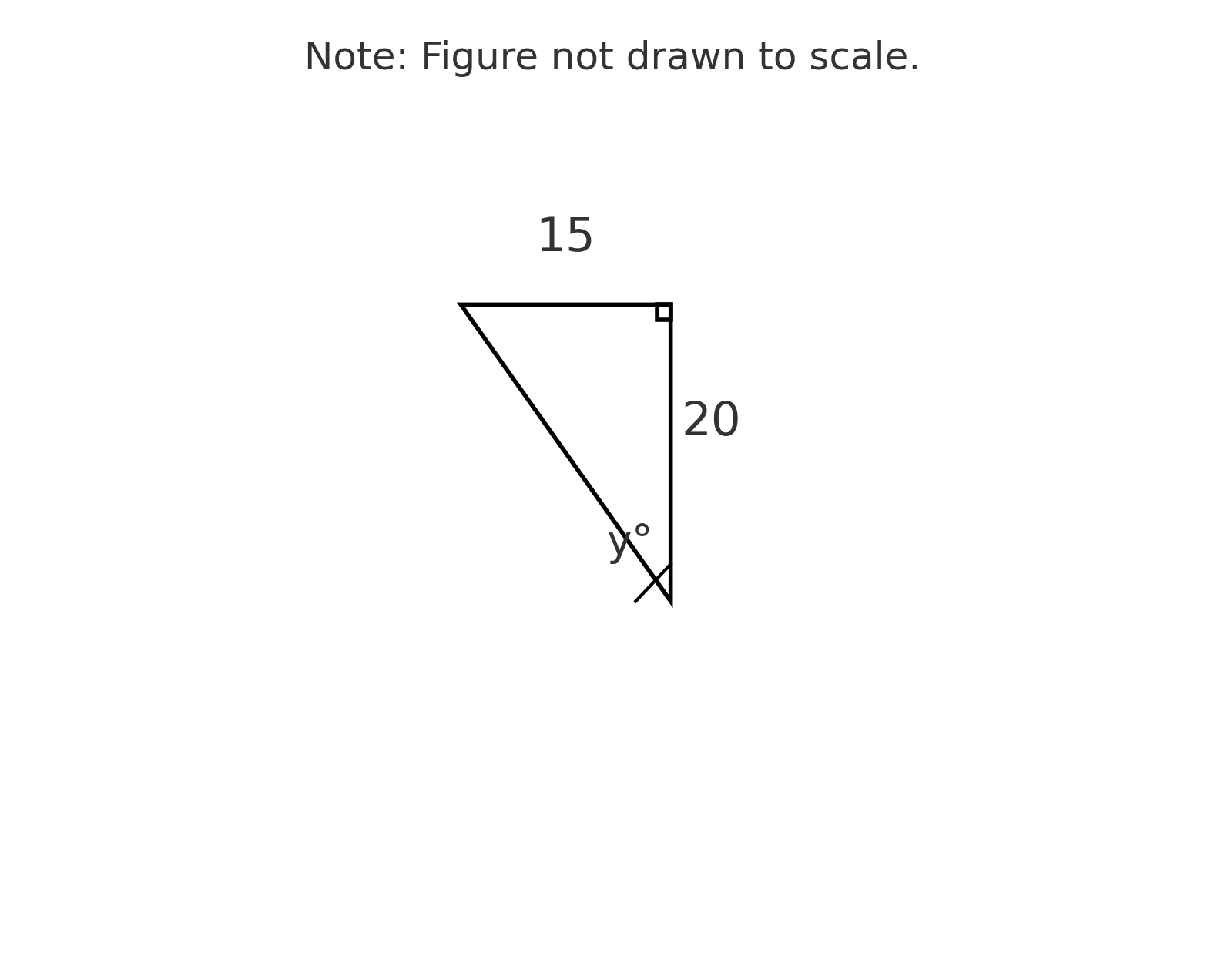
In the triangle shown, what is the value of \(\mathrm{tan\ y°}\)?
1. TRANSLATE the diagram information
From the diagram, we can identify:
- Horizontal top side: length = 15
- Vertical right side: length = 20
- Right angle location: top-right corner
- Angle of interest: \(\mathrm{y°}\) at the bottom vertex
2. INFER which sides are opposite and adjacent to angle \(\mathrm{y°}\)
This is the crucial step! We need to identify the sides relative to angle \(\mathrm{y°}\).
Think about angle \(\mathrm{y°}\) sitting at the bottom vertex. Ask yourself:
- Which side is across from angle \(\mathrm{y°}\) (not touching it)? That's the horizontal top side with length 15. This is the opposite side.
- Which side touches angle \(\mathrm{y°}\) (besides the hypotenuse)? That's the vertical side with length 20. This is the adjacent side.
Key insight: The opposite side is always across from the angle, and the adjacent side always touches the angle.
3. Apply the tangent formula
Now that we know:
- Opposite = 15
- Adjacent = 20
We can use the tangent definition:
\(\tan \mathrm{y°} = \frac{\mathrm{opposite}}{\mathrm{adjacent}} = \frac{15}{20}\)
4. SIMPLIFY the fraction
\(\frac{15}{20} = \frac{3}{4} = 0.75\)
Answer: 0.75 (also acceptable: 3/4 or 0.750)
Why Students Usually Falter on This Problem
Most Common Error Path:
Weak INFER skill: Confusing which side is opposite vs adjacent to angle \(\mathrm{y°}\)
Many students struggle with spatial reasoning in triangles, especially when the triangle isn't in the "standard" orientation (with the right angle at bottom-left). They might look at the triangle and think:
- "The vertical side is 20, and vertical seems 'opposite' to me"
- "The horizontal side is 15, so that's adjacent"
This flawed spatial reasoning leads them to calculate:
\(\tan \mathrm{y°} = \frac{20}{15} = \frac{4}{3} \approx 1.33\)
While 1.33 isn't one of the typical multiple choice options in this problem type, this error causes them to arrive at a completely different answer and leads to confusion and guessing.
Second Most Common Error:
Conceptual confusion: Mixing up the tangent ratio with sine or cosine
Some students remember they need a trigonometric ratio but can't recall which one. They might think:
- \(\tan \mathrm{y°} = \frac{\mathrm{opposite}}{\mathrm{hypotenuse}}\) (this is actually sine)
- \(\tan \mathrm{y°} = \frac{\mathrm{adjacent}}{\mathrm{hypotenuse}}\) (this is actually cosine)
To use these incorrectly, they'd first need to calculate the hypotenuse using the Pythagorean theorem:
\(\mathrm{hypotenuse} = \sqrt{15^2 + 20^2}\)
\(= \sqrt{225 + 400}\)
\(= \sqrt{625}\)
\(= 25\)
Then they might calculate:
- \(\sin \mathrm{y°} = \frac{15}{25} = 0.6\), or
- \(\cos \mathrm{y°} = \frac{20}{25} = 0.8\)
This conceptual confusion causes them to arrive at incorrect values and leads to guessing.
The Bottom Line:
This problem tests whether students can correctly identify opposite and adjacent sides relative to a specific angle in a right triangle, regardless of the triangle's orientation. The key is to always reference sides relative to the angle in question, not based on how the triangle "looks" on the page.