
In the coordinate plane, an absolute value graph is shown. The graph is V-shaped, and two points on the graph,...
GMAT Advanced Math : (Adv_Math) Questions
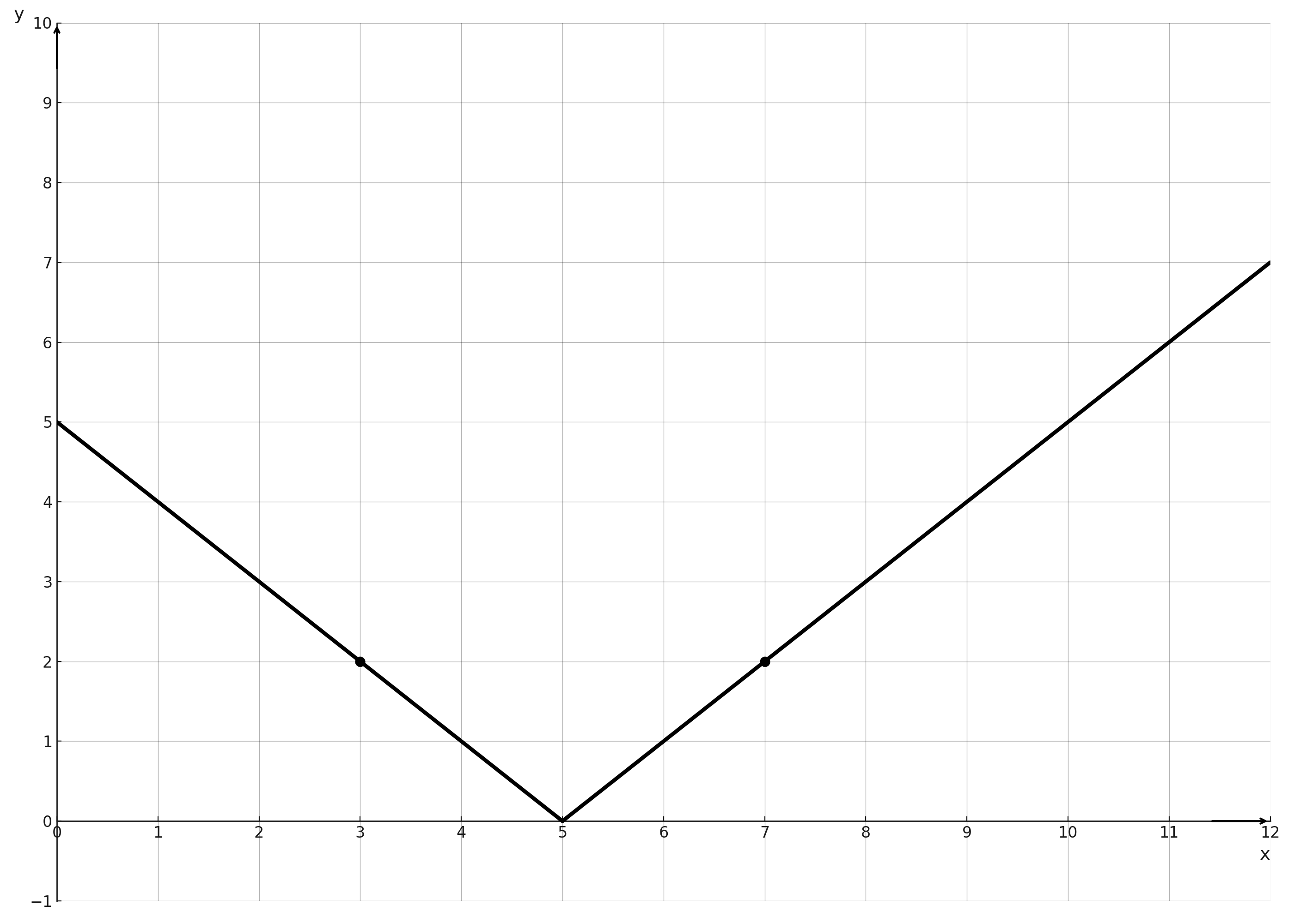
In the coordinate plane, an absolute value graph is shown. The graph is V-shaped, and two points on the graph, \((3, 2)\) and \((7, 2)\), are marked. The vertex of the V lies on the x-axis. The x-intercept of the graph is \((\mathrm{x}, 0)\). What is the value of \(\mathrm{x}\)? (Enter your answer as a number in the grid.)
1. TRANSLATE the information from the graph
Looking at the graph carefully:
- Two points are marked: (3, 2) and (7, 2)
- Both points have the same y-coordinate (\(\mathrm{y = 2}\))
- The graph is V-shaped (absolute value function)
- The vertex of the V lies on the x-axis
2. INFER the symmetry property
Since this is an absolute value graph, it has a vertical axis of symmetry passing through the vertex. The key insight is:
- The two marked points (3, 2) and (7, 2) have the same y-coordinate
- This means they are equidistant from the axis of symmetry
- The axis of symmetry must be exactly halfway between \(\mathrm{x = 3}\) and \(\mathrm{x = 7}\)
3. SIMPLIFY to find the axis of symmetry
Calculate the midpoint of the two x-coordinates:
- \(\mathrm{x = (3 + 7) / 2}\)
- \(\mathrm{x = 10 / 2}\)
- \(\mathrm{x = 5}\)
The axis of symmetry is the vertical line \(\mathrm{x = 5}\).
4. INFER the location of the x-intercept
- The vertex lies on the axis of symmetry (\(\mathrm{x = 5}\))
- We're told the vertex lies on the x-axis (\(\mathrm{y = 0}\))
- Therefore, the vertex is at the point \(\mathrm{(5, 0)}\)
- For an absolute value function, the vertex is the x-intercept
Answer: 5
Why Students Usually Falter on This Problem
Most Common Error Path:
Weak INFER skill: Not recognizing that points with equal y-coordinates are symmetric about the axis of symmetry.
Some students see the two marked points but don't make the connection that equal y-values mean these points are symmetric. Without understanding this symmetry property, they may try to work backward from the absolute value function form \(\mathrm{f(x) = a|x - h| + k}\), attempting to set up equations with the two points. This approach is much more complicated and often leads to confusion and guessing.
Second Most Common Error:
Poor TRANSLATE reasoning: Misreading the coordinates from the graph.
Students might misidentify the coordinates as (3, 2) and (8, 2) or (2, 2) and (7, 2) due to hasty graph reading. If they correctly apply the symmetry concept but with wrong coordinates, they'll calculate an incorrect midpoint. For example, if they read (3, 2) and (8, 2), they would get \(\mathrm{x = (3 + 8) / 2 = 5.5}\) instead of 5.
The Bottom Line:
This problem tests whether students understand the fundamental symmetry property of absolute value functions. The elegant solution comes from recognizing that symmetric points reveal the axis of symmetry, rather than trying to construct and solve equations. The key is connecting the geometric property (symmetry) to the algebraic result (location of the vertex).