
The graph shows a system consisting of an absolute value function and a linear function. These two functions intersect at...
GMAT Advanced Math : (Adv_Math) Questions
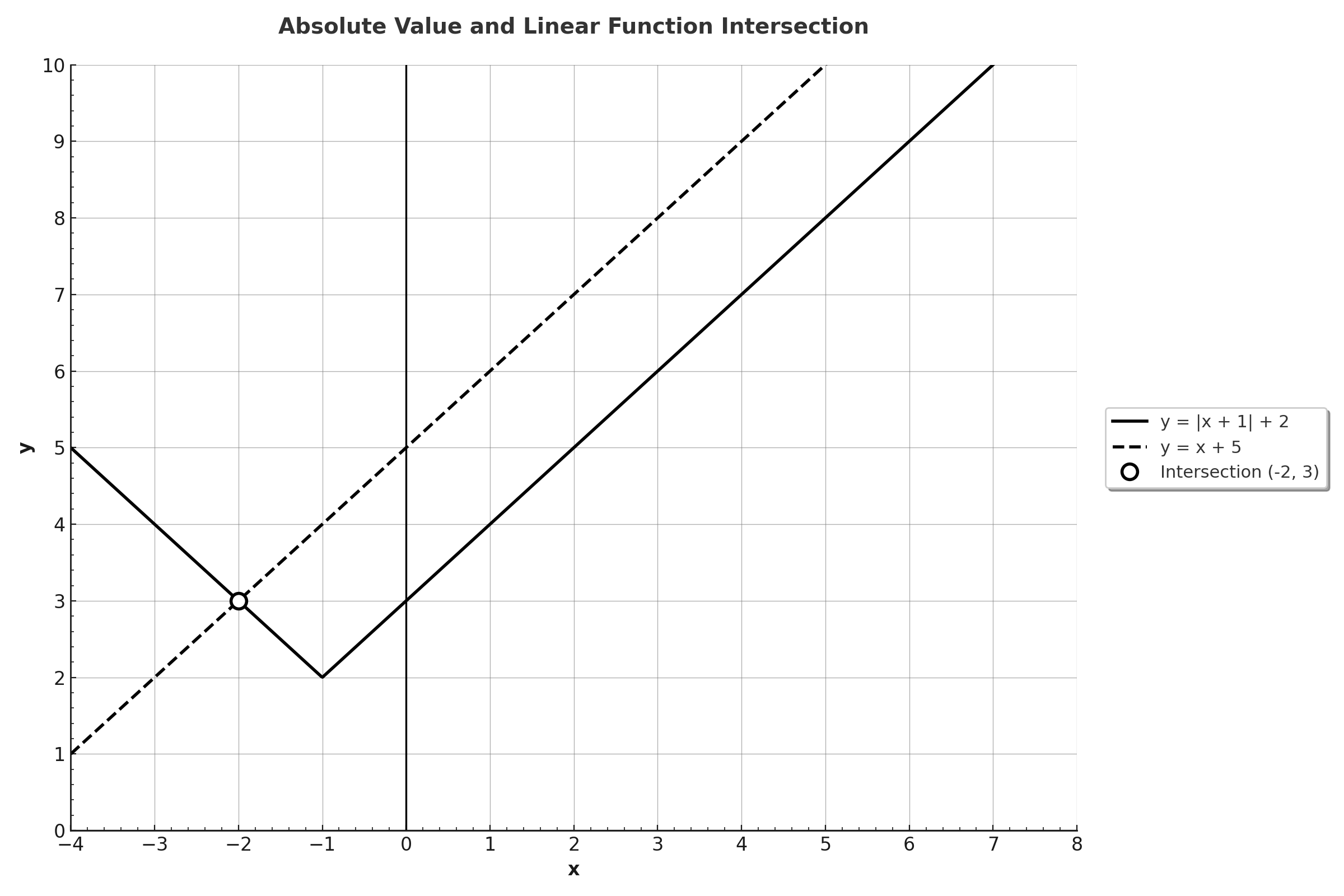
The graph shows a system consisting of an absolute value function and a linear function. These two functions intersect at exactly one point. What are the coordinates \(\mathrm{(x, y)}\) of this intersection point?
\((-3, 4)\)
\((-2, 3)\)
\((-1, 2)\)
\((0, 5)\)
1. VISUALIZE the problem setup
Looking at the graph, you need to identify:
- The solid line represents the absolute value function: \(\mathrm{y = |x + 1| + 2}\) (V-shaped)
- The dashed line represents the linear function: \(\mathrm{y = x + 5}\) (straight diagonal line)
- One point where both lines cross (marked with a circle)
2. VISUALIZE the intersection point
- The intersection is the single point where both functions have the same value
- Look for where the solid V-shaped line and the dashed straight line meet
- There's a circle marking this intersection point on the graph
3. TRANSLATE the visual coordinates to numerical values
- Starting from the intersection point, trace down to the x-axis
- The x-coordinate is -2
- Starting from the intersection point, trace left to the y-axis
- The y-coordinate is 3
4. Express the answer as an ordered pair
- Coordinates are always written as \(\mathrm{(x, y)}\)
- The intersection point is \(\mathrm{(-2, 3)}\)
Answer: \(\mathrm{(-2, 3)}\), which is Choice B
Why Students Usually Falter on This Problem
Most Common Error Path:
Weak VISUALIZE skill: Students may misidentify which point is the actual intersection. The absolute value function has a vertex at \(\mathrm{(-1, 2)}\), which is clearly visible on the graph. Students might confuse the vertex of the V-shape with the intersection point.
Looking at the graph, the vertex of the absolute value function (the "point" of the V) is at \(\mathrm{(-1, 2)}\). This might catch a student's attention because it's a prominent feature. If they mistake this for the intersection point, they would select Choice C: \(\mathrm{(-1, 2)}\).
Second Most Common Error:
Poor TRANSLATE skill: Students may correctly identify where the lines cross but misread the coordinates from the grid. Common misreading errors include:
- Reading the x-coordinate but getting the y-coordinate wrong
- Confusing negative signs
- Being off by one grid unit
For example, if a student reads x = -3 instead of x = -2, and calculates y from the linear function \(\mathrm{y = x + 5}\), they'd get
\(\mathrm{y = -3 + 5 = 2}\)
However, looking at the answer choices, \(\mathrm{(-3, 4)}\) is offered as Choice A. This suggests students might identify the wrong grid location entirely.
The Bottom Line:
This problem tests your ability to carefully read information from a graph. The key is to focus specifically on the point marked with a circle where both lines cross, not other prominent features like the vertex of the absolute value function. Take your time tracing the point to both axes to ensure accurate coordinate reading.
\((-3, 4)\)
\((-2, 3)\)
\((-1, 2)\)
\((0, 5)\)