
The graph of a system consisting of an absolute value function and a linear function is shown on the coordinate...
GMAT Advanced Math : (Adv_Math) Questions
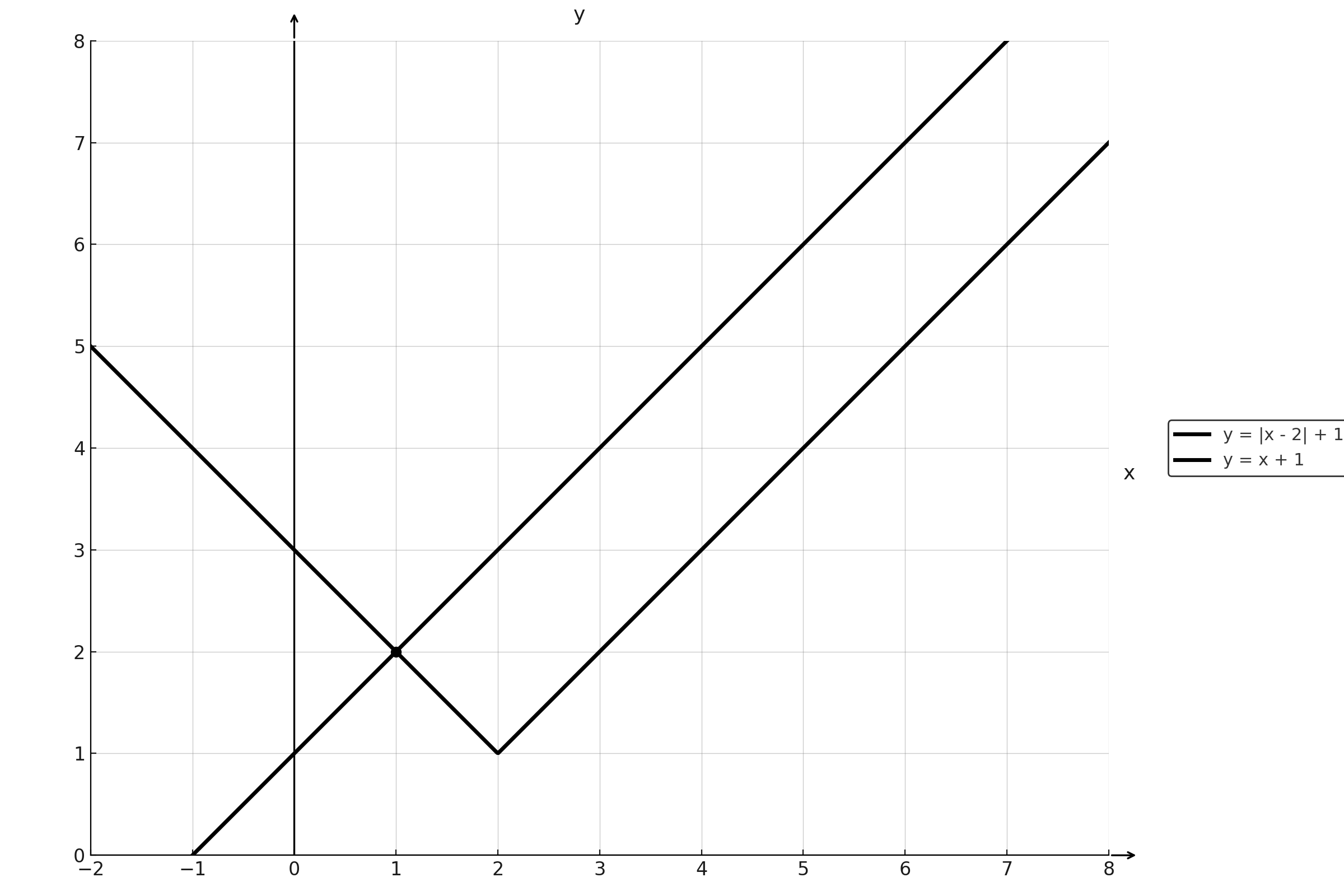
- The graph of a system consisting of an absolute value function and a linear function is shown on the coordinate plane.
- The V-shaped graph is \(\mathrm{y = |x - 2| + 1}\), and the line is \(\mathrm{y = x + 1}\).
- Which ordered pair \(\mathrm{(x, y)}\) is the solution to the system, that is, the point where the two graphs intersect?
\((-1, 2)\)
\((1, 2)\)
\((2, 1)\)
\((3, 4)\)
1. TRANSLATE what the problem is asking
- Given information:
- V-shaped graph: \(\mathrm{y = |x - 2| + 1}\)
- Straight line: \(\mathrm{y = x + 1}\)
- Need to find where they intersect (the solution to the system)
- What this means: We're looking for the point (x, y) that satisfies both equations simultaneously. This is where the two graphs cross.
2. Choose your approach
You have two valid strategies:
Strategy A (Visual): TRANSLATE the coordinates directly from the graph
- Look at where the two graphs cross
- Read the x and y coordinates carefully
Strategy B (Algebraic): Set up an equation to solve
- At the intersection point, both y-values are equal
- So: \(\mathrm{|x - 2| + 1 = x + 1}\)
Let me show you Strategy B (algebraic), which also helps verify what you see.
3. SIMPLIFY the equation
Starting with: \(\mathrm{|x - 2| + 1 = x + 1}\)
Subtract 1 from both sides:
\(\mathrm{|x - 2| = x}\)
Now we have an absolute value equation to solve.
4. CONSIDER ALL CASES for the absolute value
The absolute value \(\mathrm{|x - 2|}\) changes form depending on whether \(\mathrm{(x - 2)}\) is positive or negative.
Case 1: When \(\mathrm{x \geq 2}\)
- Here, \(\mathrm{x - 2 \geq 0}\), so \(\mathrm{|x - 2| = x - 2}\)
- Equation becomes: \(\mathrm{x - 2 = x}\)
- SIMPLIFY: \(\mathrm{x - 2 = x}\) → \(\mathrm{-2 = 0}\) ✗
- This is impossible, so no solution in this region
Case 2: When \(\mathrm{x \lt 2}\)
- Here, \(\mathrm{x - 2 \lt 0}\), so \(\mathrm{|x - 2| = -(x - 2) = 2 - x}\)
- Equation becomes: \(\mathrm{2 - x = x}\)
- SIMPLIFY: \(\mathrm{2 = 2x}\) → \(\mathrm{x = 1}\) ✓
- Since \(\mathrm{1 \lt 2}\), this is valid for our case
5. Find the y-coordinate
Substitute \(\mathrm{x = 1}\) into either original equation:
- Using \(\mathrm{y = x + 1}\): \(\mathrm{y = 1 + 1 = 2}\)
- (You could verify with \(\mathrm{y = |1 - 2| + 1 = |-1| + 1 = 1 + 1 = 2}\) ✓)
6. APPLY CONSTRAINTS by checking the graph
Looking at the graph, the intersection point at \(\mathrm{(1, 2)}\) makes sense visually.
Answer: (1, 2), which is Choice B
Why Students Usually Falter on This Problem
Most Common Error Path:
Weak CONSIDER ALL CASES skill: Students forget to split the absolute value into cases or only solve one case.
Many students might simplify \(\mathrm{|x - 2| = x}\) to just \(\mathrm{x - 2 = x}\) without considering that absolute value requires case analysis. This leads to getting \(\mathrm{-2 = 0}\) and concluding "no solution exists" when actually there IS a solution in the \(\mathrm{x \lt 2}\) region. Alternatively, they might only solve for \(\mathrm{x \lt 2}\) without checking whether \(\mathrm{x \geq 2}\) has solutions, though in this problem that doesn't cause issues.
This leads to confusion and guessing among the answer choices.
Second Most Common Error:
Poor TRANSLATE reasoning or graph misreading: Students misread the intersection point from the graph.
Looking quickly at the graph, students might misidentify which grid point the lines cross at. For instance, they might think the vertex at \(\mathrm{(2, 1)}\) is special and select Choice C: (2, 1), or they might miscount grid lines and identify an incorrect intersection point like Choice A: (-1, 2) or Choice D: (3, 4).
The Bottom Line:
This problem tests whether you can work with absolute value functions systematically. The key challenge is remembering that absolute value expressions split into cases based on whether the inside expression is positive or negative. You must check both cases to find all solutions. Alternatively, careful graph reading provides a quick path to the answer, but you need to precisely identify coordinates on the grid.
\((-1, 2)\)
\((1, 2)\)
\((2, 1)\)
\((3, 4)\)