
The dot plot represents the 15 values in data set A. Data set B is created by adding 56 to...
GMAT Problem-Solving and Data Analysis : (PS_DA) Questions
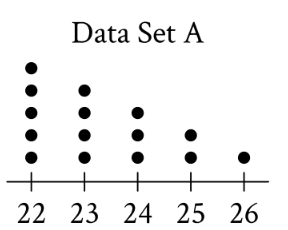
The dot plot represents the \(\mathrm{15}\) values in data set A. Data set B is created by adding \(\mathrm{56}\) to each of the values in data set A. Which of the following correctly compares the medians and the ranges of data sets A and B?
Choose 1 answer:
The median of data set B is equal to the median of data set A, and the range of data set B is equal to the range of data set A.
The median of data set B is equal to the median of data set A, and the range of data set B is greater than the range of data set A.
The median of data set B is greater than the median of data set A, and the range of data set B is equal to the range of data set A.
The median of data set B is greater than the median of data set A, and the range of data set B is greater than the range of data set A.
1. TRANSLATE the dot plot into Data Set A
First, count the dots carefully above each value:
Given information:
- Value 22: 5 dots
- Value 23: 4 dots
- Value 24: 3 dots
- Value 25: 2 dots
- Value 26: 1 dot
- Total: 15 values
2. TRANSLATE the median requirement for Data Set A
Since we have 15 values (an odd number), the median is the middle value.
- What position is the middle? For 15 values, the middle is the 8th value
- What is the 8th value?
- Positions 1-5: value is 22
- Positions 6-9: value is 23
- The 8th position is 23
Median of Data Set A = 23
3. TRANSLATE the range requirement for Data Set A
Range = Maximum value - Minimum value
- Maximum value in Data Set A = 26
- Minimum value in Data Set A = 22
- Range = \(26 - 22 = 4\)
Range of Data Set A = 4
4. TRANSLATE how Data Set B is created
The problem states: "Data set B is created by adding 56 to each of the values in data set A"
This means:
- Every 22 becomes \(22 + 56 = 78\) (5 times)
- Every 23 becomes \(23 + 56 = 79\) (4 times)
- Every 24 becomes \(24 + 56 = 80\) (3 times)
- Every 25 becomes \(25 + 56 = 81\) (2 times)
- Every 26 becomes \(26 + 56 = 82\) (1 time)
5. INFER what happens to the median when adding a constant
Here's the key insight: When you add the same number to every value, the median also increases by that same number.
- The median was the 8th value = 23
- Now the 8th value = 79 (because \(23 + 56 = 79\))
Median of Data Set B = 79
This is greater than the median of Data Set A (\(79 \gt 23\)) ✓
6. INFER what happens to the range when adding a constant
Another key insight: When you add the same number to every value, the range stays the same because the spread between values doesn't change.
Let's verify:
- New maximum = 82
- New minimum = 78
- Range of Data Set B = \(82 - 78 = 4\)
The range is equal to the range of Data Set A (both are 4) ✓
7. APPLY CONSTRAINTS to select the correct comparison
Looking at our findings:
- ✓ Median of B > Median of A (\(79 \gt 23\))
- ✓ Range of B = Range of A (\(4 = 4\))
This matches Choice C exactly.
Answer: C
Why Students Usually Falter on This Problem
Most Common Error Path:
Weak INFER skill: Not recognizing that adding a constant to all values changes the median but not the range.
Students might think that since all values are getting bigger (adding 56), everything about the data set must get bigger—including both the median AND the range. They reason: "If the numbers are all 56 units larger, shouldn't the spread be larger too?"
This may lead them to select Choice D (The median of data set B is greater than the median of data set A, and the range of data set B is greater than the range of data set A).
Second Most Common Error:
TRANSLATE execution error: Miscounting which value is the median position.
Students might count incorrectly and think the median is at position 7 or 9 instead of position 8, or they might confuse finding the median with finding the mean. Even a small error in identifying that the 8th value is 23 (not 22) would propagate through the entire problem. If they think the median of A is 22, they'd calculate the median of B as 78 instead of 79.
This creates confusion when comparing to answer choices and may lead to guessing.
The Bottom Line:
This problem tests whether you understand the fundamental effect of data transformations: adding a constant shifts the center but preserves the spread. The conceptual leap—that range measures the distance between values, which doesn't change when everything moves together by the same amount—is where many students stumble.
The median of data set B is equal to the median of data set A, and the range of data set B is equal to the range of data set A.
The median of data set B is equal to the median of data set A, and the range of data set B is greater than the range of data set A.
The median of data set B is greater than the median of data set A, and the range of data set B is equal to the range of data set A.
The median of data set B is greater than the median of data set A, and the range of data set B is greater than the range of data set A.