
The graph shows the momentum y, in newton-seconds, of an object x seconds after the object started moving, for 0...
GMAT Problem-Solving and Data Analysis : (PS_DA) Questions
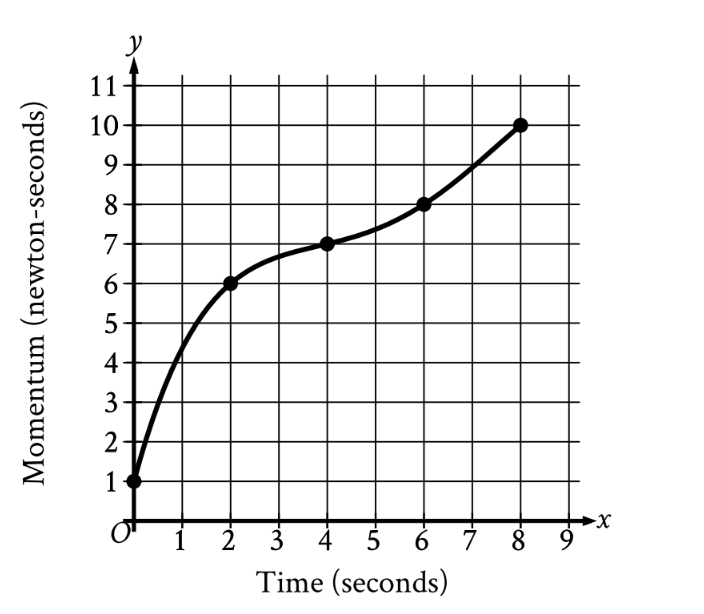
The graph shows the momentum y, in newton-seconds, of an object x seconds after the object started moving, for \(0 \leq \mathrm{x} \leq 8\). What is the average rate of change, in newton-seconds per second, in the momentum of the object from \(\mathrm{x} = 2\) to \(\mathrm{x} = 6\)?
1. TRANSLATE the problem information
- The problem asks for: The average rate of change in momentum from \(x = 2\) to \(x = 6\)
- What this means mathematically: We need to find \((y_2 - y_1)/(x_2 - x_1)\)
- \(x_1 = 2, x_2 = 6\)
- \(y_1\) = momentum at \(x = 2\)
- \(y_2\) = momentum at \(x = 6\)
- Units: The answer will be in newton-seconds per second (the y-axis units divided by the x-axis units)
2. TRANSLATE the graph to extract coordinate values
- Find the y-value when \(x = 2\):
- Locate \(x = 2\) on the horizontal axis
- Trace up to the curve
- Read across to the y-axis: \(y = 6\) newton-seconds
- Find the y-value when \(x = 6\):
- Locate \(x = 6\) on the horizontal axis
- Trace up to the curve
- Read across to the y-axis: \(y = 8\) newton-seconds
3. SIMPLIFY to calculate the average rate of change
- Apply the formula:
Average rate of change = \((y_2 - y_1)/(x_2 - x_1)\) - Substitute the values:
\(= (8 - 6)/(6 - 2)\)
\(= 2/4\)
\(= 1/2\) - Include the units: \(1/2\) newton-seconds per second
Answer: 1/2 (or 0.5 or 0.50)
Why Students Usually Falter on This Problem
Most Common Error Path:
Weak TRANSLATE skill - Misreading graph values: Students may misidentify the y-values from the graph, especially since the curve doesn't always land exactly on grid intersections. For example, a student might read \(y = 5\) at \(x = 2\) instead of \(y = 6\), or might estimate \(y = 7\) at \(x = 6\) instead of \(y = 8\).
If they read \(y = 5\) at \(x = 2\) and \(y = 7\) at \(x = 6\), they would calculate:
\((7 - 5)/(6 - 2) = 2/4 = 1/2\)
Interestingly, this particular error still yields \(1/2\), but other misreadings would produce incorrect answers. For instance, reading \(y = 6\) at \(x = 2\) and \(y = 9\) at \(x = 6\) would give \((9-6)/(6-2) = 3/4\).
Second Most Common Error:
Weak TRANSLATE skill - Reversing the subtraction order: Students might correctly read the graph values but incorrectly set up the formula, using \((x_1 - x_2)/(y_2 - y_1)\) or \((y_1 - y_2)/(x_2 - x_1)\).
For example, calculating \((6 - 8)/(6 - 2) = -2/4 = -1/2\) would give a negative rate of change. Since the graph is clearly increasing, a negative answer should signal an error, but students might enter "-1/2" or "-.5" without recognizing the sign error.
Third Most Common Error:
Missing conceptual knowledge - Not knowing the average rate of change formula: Some students may not recall that average rate of change is calculated as \(\Delta y/\Delta x\). They might try to find a slope using other methods, or they might simply subtract the x-values or y-values without dividing. This leads to confusion and guessing among various answer possibilities.
The Bottom Line:
This problem primarily tests careful graph reading and proper application of the average rate of change formula. The calculation itself is straightforward, but accuracy in extracting coordinate values from the graph is critical. Students must also remember that order matters in subtraction - the change in y goes in the numerator, and the change in x goes in the denominator, both measured consistently from the starting point to the ending point.