
The bar graph shows the distribution of the number of students in each of four extracurricular activities at a high...
GMAT Problem-Solving and Data Analysis : (PS_DA) Questions
The bar graph shows the distribution of the number of students in each of four extracurricular activities at a high school.
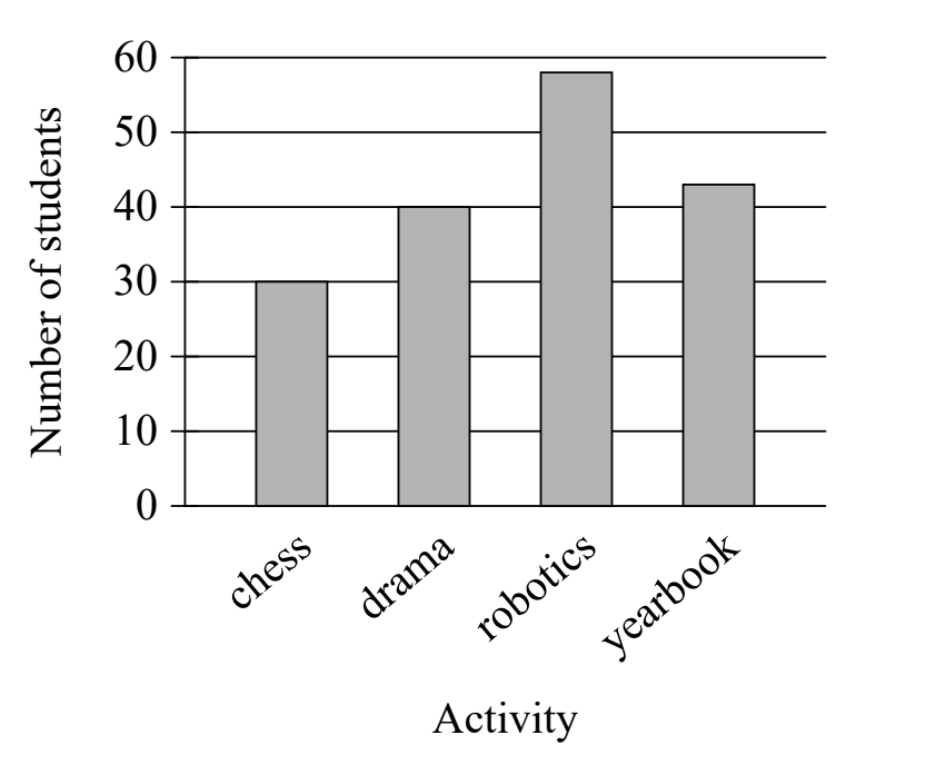
[Bar graph showing Number of students (y-axis, 0-60) vs Activity (x-axis: chess, drama, robotics, yearbook). The bars show: chess = 30 students, drama = 40 students, robotics = 58 students, yearbook = 43 students]
How many more students are in drama than in chess?
1. TRANSLATE the question into a mathematical operation
The question asks: "How many more students are in drama than in chess?"
The phrase "how many more... than..." is asking you to compare two quantities and find the difference.
- TRANSLATE this language: "How many more in drama than chess" → \(\mathrm{(drama\ students) - (chess\ students)}\)
This is a comparison question requiring subtraction, not just reading a single value.
2. TRANSLATE the bar graph values into numbers
Now you need to read the heights of the bars from the graph:
- The drama bar extends up to 40 on the vertical axis → \(\mathrm{drama = 40\ students}\)
- The chess bar extends up to 30 on the vertical axis → \(\mathrm{chess = 30\ students}\)
3. Calculate the difference
Perform the subtraction to find how many more students are in drama than chess:
\(\mathrm{40 - 30 = 10}\)
There are 10 more students in drama than in chess.
Answer: A. 10
Why Students Usually Falter on This Problem
Most Common Error Path:
Weak TRANSLATE skill: Misunderstanding what "how many more" means
Some students read "how many more students are in drama than in chess" and think the question is simply asking "how many students are in drama?" They TRANSLATE only part of the question, reading one value from the graph and stopping there.
This may lead them to select Choice C (40) if they focus on the drama value, or Choice B (30) if they misread which activity is being asked about.
Second Most Common Error:
Weak TRANSLATE skill: Interpreting "how many more" as "how many total"
Some students see the word "more" and associate it with addition rather than comparison. They TRANSLATE "more" as "add together" rather than "find the difference," leading them to calculate: \(\mathrm{40 + 30 = 70}\).
This may lead them to select Choice D (70).
The Bottom Line:
The key to this problem is correctly TRANSLATING comparison language. The phrase "how many more X than Y" always means "find the difference" and translates to \(\mathrm{(X - Y)}\). This is not asking for a single value from the graph or a sum—it's asking for a comparison that requires subtraction.