
Circle M shown is defined by the equation \((x + 4)^2 + (y - 1)^2 = 12\). Circle N (not...
GMAT Geometry & Trigonometry : (Geo_Trig) Questions
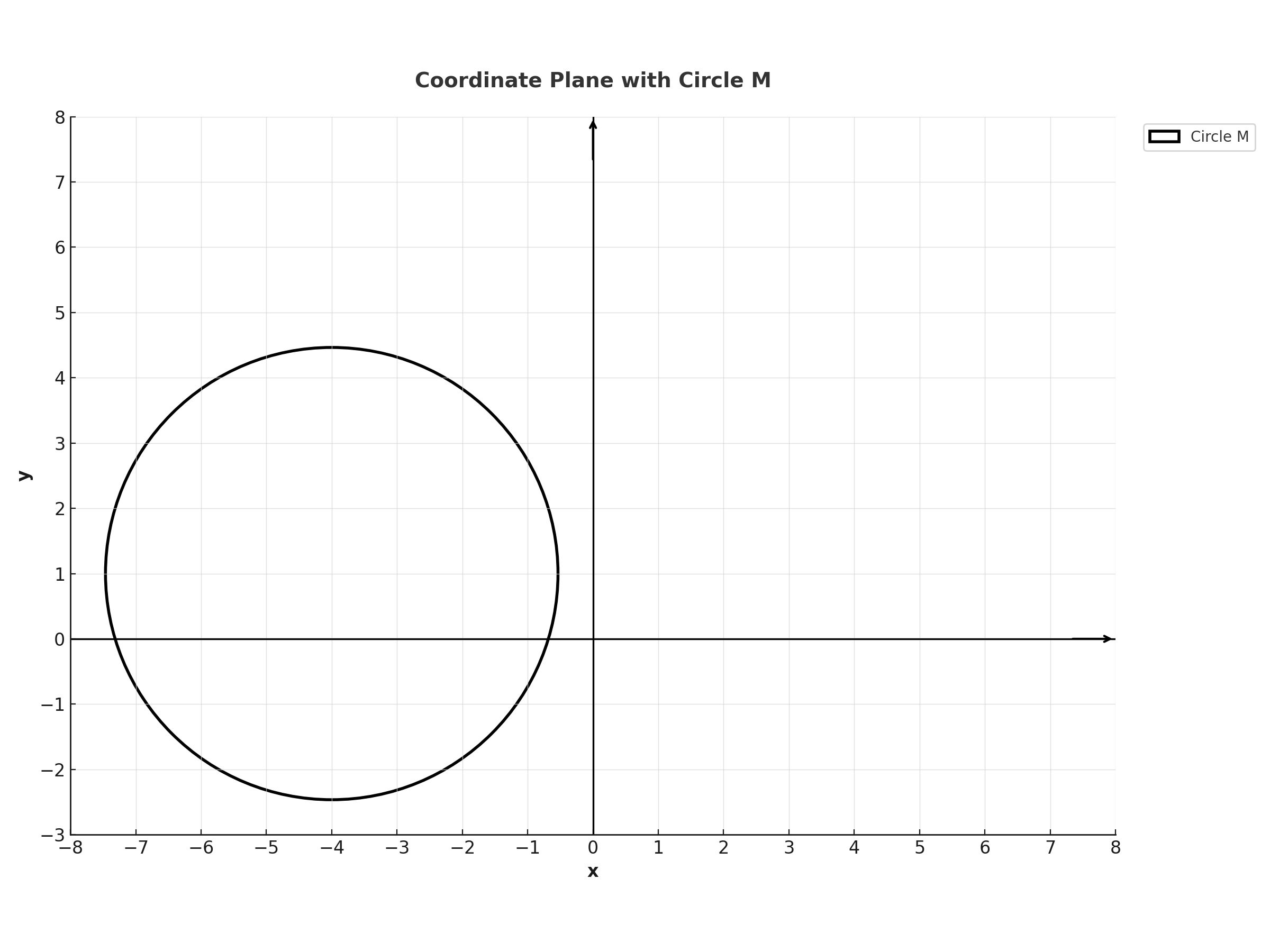
Circle M shown is defined by the equation \((x + 4)^2 + (y - 1)^2 = 12\). Circle N (not shown) has half the radius of circle M and is positioned so that its center has the same y-coordinate as circle M but lies on the vertical line \(x = 10\). If the equation of circle N is \((x - p)^2 + (y - q)^2 = r\), where \(p\), \(q\), and \(r\) are constants, what is the value of \(p + q - r\)?
1. TRANSLATE Circle M's equation into useful information
Given equation: \((x + 4)^2 + (y - 1)^2 = 12\)
Comparing to standard form \((x - h)^2 + (y - k)^2 = r^2\):
- Center of Circle M: \((-4, 1)\)
- Remember: \((x + 4) = (x - (-4))\), so \(h = -4\)
- Radius squared: \(r^2 = 12\)
- Radius: \(r = \sqrt{12} = \sqrt{4 \cdot 3} = 2\sqrt{3}\)
2. INFER what we need to find Circle N's equation
The problem asks for Circle N in the form \((x - p)^2 + (y - q)^2 = r\). To write this equation, we need:
- Circle N's center coordinates (which give us p and q)
- Circle N's radius squared (which gives us r)
3. TRANSLATE Circle N's radius from the problem statement
The problem states "Circle N has half the radius of Circle M."
- Circle M's radius = \(2\sqrt{3}\)
- Circle N's radius = \(\frac{1}{2}(2\sqrt{3}) = \sqrt{3}\)
Critical point: "Half the radius" means we halve the radius itself, not the radius squared!
4. SIMPLIFY to find Circle N's radius squared
Since Circle N's radius = \(\sqrt{3}\):
- Radius squared: \(r = (\sqrt{3})^2 = 3\)
This is the value of r in the equation \((x - p)^2 + (y - q)^2 = r\).
5. TRANSLATE Circle N's center from the problem statement
The problem tells us two things about Circle N's center:
- "Same y-coordinate as Circle M" → \(y = 1\)
- "Lies on vertical line \(x = 10\)" → \(x = 10\)
- Circle N's center: \((10, 1)\)
6. INFER the values of p and q
Writing Circle N's equation with center \((10, 1)\) and \(r = 3\):
\((x - 10)^2 + (y - 1)^2 = 3\)
Comparing to \((x - p)^2 + (y - q)^2 = r\):
- \(p = 10\)
- \(q = 1\)
- \(r = 3\)
7. SIMPLIFY the final calculation
\(p + q - r = 10 + 1 - 3 = 8\)
Answer: 8
Why Students Usually Falter on This Problem
Most Common Error Path:
Process Skill Gap (INFER): Confusing "half the radius" with "half the radius squared"
Students may see that Circle M has \(r^2 = 12\) and incorrectly think:
- "Half the radius" means \(r^2 = \frac{12}{2} = 6\) for Circle N
This skips the crucial step of finding the actual radius first \((\sqrt{12} = 2\sqrt{3})\) before halving it. Using \(r = 6\) instead of \(r = 3\) in the final calculation:
- \(p + q - r = 10 + 1 - 6 = 5\)
This leads to an incorrect answer of 5 instead of 8.
Second Most Common Error:
Process Skill Gap (TRANSLATE): Misinterpreting which coordinate the vertical line determines
Students may confuse vertical and horizontal lines:
- Thinking "vertical line \(x = 10\)" determines the y-coordinate instead of the x-coordinate
- Using center \((1, 10)\) or \((1, 1)\) instead of \((10, 1)\)
If they use center \((1, 1)\), they get \(p = 1\), leading to:
- \(p + q - r = 1 + 1 - 3 = -1\)
This confusion causes them to arrive at an incorrect negative answer.
The Bottom Line:
This problem requires careful attention to the distinction between radius and radius squared throughout the solution. The phrase "half the radius" must be interpreted at the radius level \((2\sqrt{3} \div 2 = \sqrt{3})\), not at the radius-squared level \((12 \div 2 = 6)\). Additionally, correctly identifying the center coordinates from verbal descriptions requires understanding geometric terms like "vertical line."