
A circle with equation \(\mathrm{(x + 2)^2 + y^2 = 9}\) is shown in the xy-plane. A second circle, Circle...
GMAT Geometry & Trigonometry : (Geo_Trig) Questions
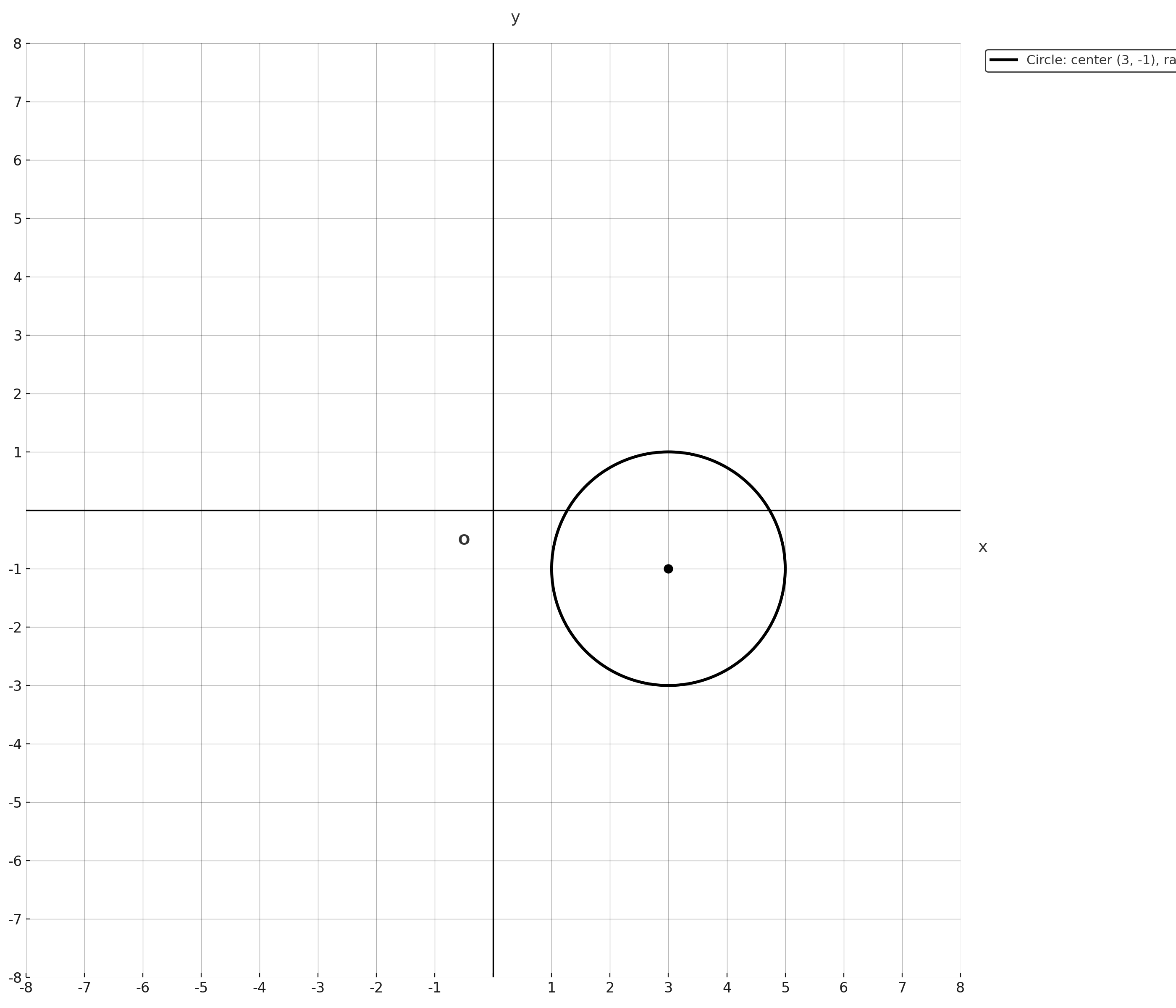
A circle with equation \(\mathrm{(x + 2)^2 + y^2 = 9}\) is shown in the xy-plane. A second circle, Circle D, is created by reflecting the first circle across the y-axis. The area of Circle D is 2 times the area of the first circle. The equation for Circle D can be written as \(\mathrm{(x - h)^2 + (y - k)^2 = R}\). What is the value of \(\mathrm{h + R}\)?
1. TRANSLATE the first circle's equation into standard form
Given: \((x + 2)^2 + y^2 = 9\)
The standard form of a circle equation is \((x - h)^2 + (y - k)^2 = r^2\)
- Rewrite the equation to match the pattern:
- \((x + 2)^2 = (x - (-2))^2\)
- \(y^2 = (y - 0)^2\)
- \(9 = 3^2\)
- So we have: \((x - (-2))^2 + (y - 0)^2 = 3^2\)
- TRANSLATE this to extract the parameters:
- Center: \((h, k) = (-2, 0)\)
- Radius: \(r = 3\)
2. INFER how reflection across the y-axis affects the circle
- A reflection across the y-axis transforms any point \((x, y)\) to \((-x, y)\)
- INFER what this means for the center:
- Original center: \((-2, 0)\)
- Reflected center: \((-(-2), 0) = (2, 0)\)
- Therefore, for Circle D: \(h = 2\) and \(k = 0\)
3. INFER the relationship between area and radius
The problem states the area of Circle D is 2 times the area of the first circle.
- Area of first circle: \(A_1 = \pi(3)^2 = 9\pi\)
- Area of Circle D: \(A_D = 2 \times 9\pi = 18\pi\)
- INFER the key insight: Since \(A = \pi r^2\), we have:
- \(\pi r^2_D = 18\pi\)
- \(r^2_D = 18\)
4. TRANSLATE the meaning of R in the equation
This is the critical step where students often falter!
- The equation for Circle D is given as: \((x - h)^2 + (y - k)^2 = R\)
- TRANSLATE carefully: Compare this to standard form \((x - h)^2 + (y - k)^2 = r^2\)
- Notice that R is in the position where \(r^2\) appears, NOT where r appears
- Therefore: \(R = r^2 = 18\) (not \(r = 18\))
5. SIMPLIFY to find the final answer
- We found: \(h = 2\) and \(R = 18\)
- Calculate: \(h + R = 2 + 18 = 20\)
Answer: 20
Why Students Usually Falter on This Problem
Most Common Error Path:
Weak TRANSLATE skill: Students misinterpret what R represents in the equation \((x - h)^2 + (y - k)^2 = R\).
Many students assume R represents the radius r itself, not \(r^2\). Following this faulty reasoning:
- They correctly find the area of Circle D is \(18\pi\)
- They set \(\pi r^2 = 18\pi\) and get \(r^2 = 18\)
- But then they think \(r = \sqrt{18} \approx 4.24\)
- They believe \(R = \sqrt{18}\) (the radius), not \(R = 18\) (radius squared)
- Final incorrect calculation: \(h + R = 2 + \sqrt{18} \approx 2 + 4.24 = 6.24\)
This leads to confusion when they see the answer is 20, and they may second-guess their entire approach.
Second Most Common Error:
Weak INFER skill about area scaling: Students incorrectly reason that if the area doubles, the radius doubles.
Following this misconception:
- Area of first circle is \(9\pi\), so they think area doubling means something simple about the radius
- They might think: "radius = 3, so new radius = 6" (incorrectly doubling the radius)
- Then \(R = 6^2 = 36\)
- Final incorrect calculation: \(h + R = 2 + 36 = 38\)
This leads to an answer that's nowhere near correct, causing confusion and potentially guessing.
The Bottom Line:
This problem tests whether you can carefully TRANSLATE mathematical notation. The unusual form \((x - h)^2 + (y - k)^2 = R\) (using R instead of \(r^2\)) is deliberately testing if you understand what each symbol represents in the equation structure, not just pattern-matching. Always ask: "What does this symbol represent in this specific context?"