
The graph above shows the distance traveled d, in feet, by a product on a conveyor belt m minutes after...
GMAT Algebra : (Alg) Questions
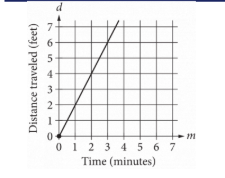
The graph above shows the distance traveled \(\mathrm{d}\), in feet, by a product on a conveyor belt \(\mathrm{m}\) minutes after the product is placed on the belt. Which of the following equations correctly relates \(\mathrm{d}\) and \(\mathrm{m}\)?
[Graph shows distance \(\mathrm{d}\) (feet) on y-axis from 0-7 and time \(\mathrm{m}\) (minutes) on x-axis from 0-6, with a linear relationship starting at origin]
1. TRANSLATE the graph information
Looking at the graph carefully:
- The line is straight (linear relationship)
- The line passes through the origin: point \((0, 0)\)
- The line goes upward from left to right (positive slope)
TRANSLATE specific points from the graph:
- When m = 1 minute, d = 2 feet → point \((1, 2)\)
- When m = 2 minutes, d = 4 feet → point \((2, 4)\)
- When m = 3 minutes, d = 6 feet → point \((3, 6)\)
2. INFER the equation form
Since the line passes through the origin \((0, 0)\), this means:
- There is NO y-intercept (\(\mathrm{b = 0}\))
- The equation must be in the form: \(\mathrm{d = km}\)
- We just need to find the value of \(\mathrm{k}\) (the slope)
This insight immediately rules out Choices C and D, which both have \(\mathrm{+ 2}\) (meaning a y-intercept of 2).
3. SIMPLIFY to find the slope k
Use any point on the line (other than the origin) and substitute into \(\mathrm{d = km}\).
Using point \((2, 4)\):
- \(\mathrm{4 = k(2)}\)
- \(\mathrm{k = 4/2 = 2}\)
We can verify with another point \((1, 2)\):
- \(\mathrm{2 = k(1)}\)
- \(\mathrm{k = 2}\) ✓
4. Write the final equation
Substituting \(\mathrm{k = 2}\) into \(\mathrm{d = km}\):
\(\mathrm{d = 2m}\)
This matches Choice A.
Answer: A
Why Students Usually Falter on This Problem
Most Common Error Path:
Weak TRANSLATE skill: Misreading the scale or coordinates on the graph
Students sometimes misread where the line crosses grid lines. For example:
- They might think at m = 2, the distance is \(\mathrm{d = 1}\) instead of \(\mathrm{d = 4}\)
- Or they confuse the x and y values, reading horizontally instead of vertically
If they incorrectly read point \((2, 1)\) instead of \((2, 4)\):
- They calculate: \(\mathrm{1 = k(2)}\), so \(\mathrm{k = 1/2}\)
- This leads them to select Choice B (\(\mathrm{d = 1/2\, m}\))
Second Most Common Error:
Weak INFER skill: Not recognizing that a line through the origin has no constant term
Some students see the number "2" in the problem (either from the slope or from coordinates) and think it must appear as a \(\mathrm{+ 2}\) in the equation. They don't recognize that:
- A line through \((0, 0)\) means the y-intercept \(\mathrm{b = 0}\)
- The equation cannot have a constant term added
This confusion might lead them to select Choice D (\(\mathrm{d = 2m + 2}\)), which has the correct slope but an incorrect y-intercept.
The Bottom Line:
This problem tests whether students can accurately extract information from a visual representation (the graph) and connect it to the algebraic form of a linear equation. The key insight is recognizing that passing through the origin means the equation is simply \(\mathrm{d = km}\) with no additional constant.