
The coordinate plane shows a single straight line.Based on the graph, which equation represents the line?
GMAT Algebra : (Alg) Questions
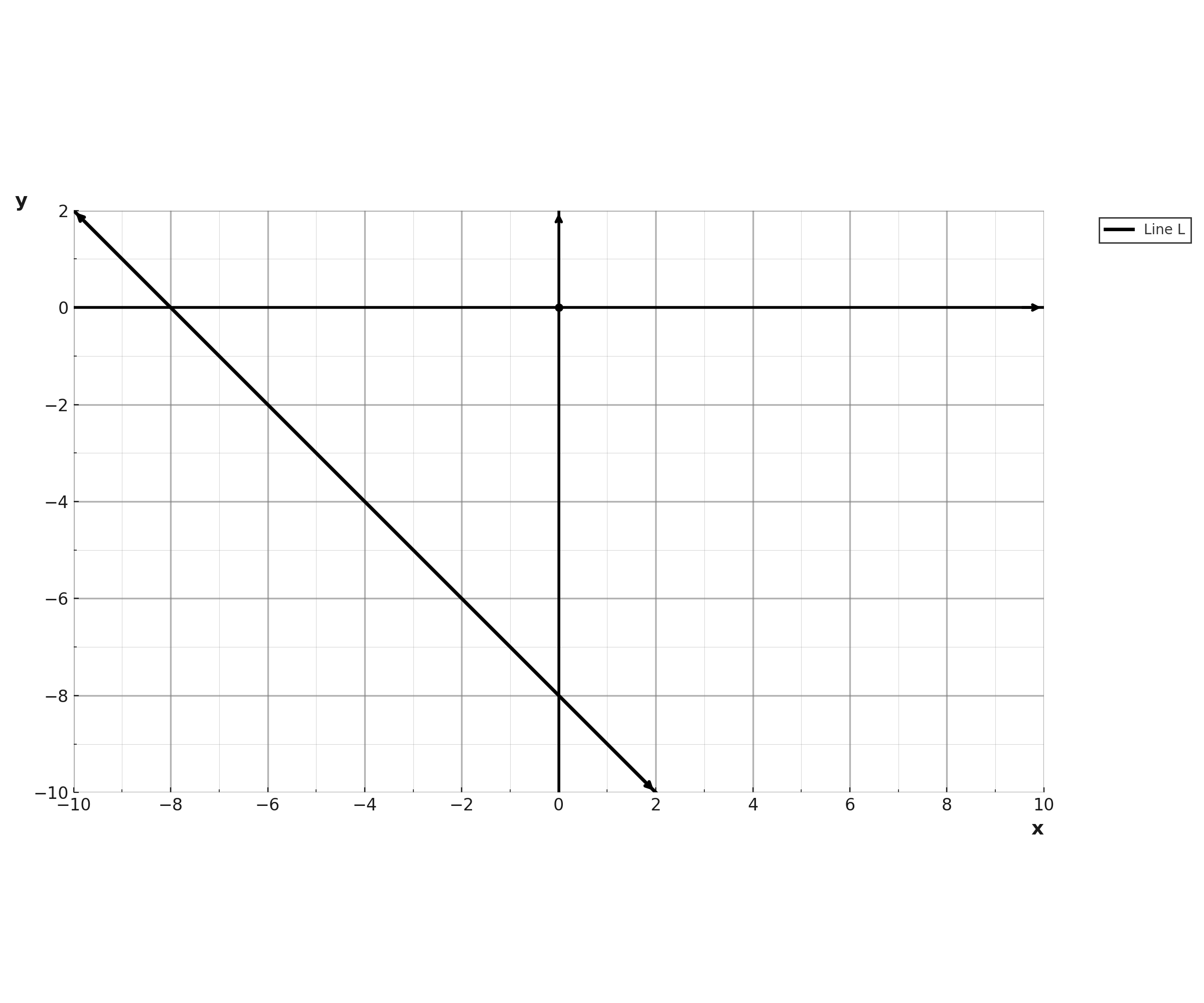
- The coordinate plane shows a single straight line.
- Based on the graph, which equation represents the line?
1. TRANSLATE the graph into mathematical information
From the coordinate plane, identify clear points where the line crosses the axes:
- Y-intercept: The line crosses the y-axis at the point (0, 4)
- This immediately tells us that \(\mathrm{b = 4}\) in the equation \(\mathrm{y = mx + b}\)
- X-intercept: The line crosses the x-axis at the point (-2, 0)
- This gives us a second point to calculate the slope
2. INFER the most efficient approach
Since we have two clear points, including the y-intercept, we can:
- Calculate the slope using the two intercepts
- Use the y-intercept we already identified to write the equation directly
This is more efficient than trying to read other points from the graph, which might be less precise.
3. SIMPLIFY to find the slope
Using the slope formula with points (0, 4) and (-2, 0):
\(\mathrm{m = \frac{y_2 - y_1}{x_2 - x_1}}\)
\(\mathrm{m = \frac{4 - 0}{0 - (-2)}}\)
\(\mathrm{m = \frac{4}{2}}\)
\(\mathrm{m = 2}\)
Important: Be careful with the subtraction in the denominator: 0 - (-2) = 0 + 2 = 2
4. Write the equation in slope-intercept form
Now we have:
- Slope: \(\mathrm{m = 2}\)
- Y-intercept: \(\mathrm{b = 4}\)
Therefore: \(\mathrm{y = 2x + 4}\)
5. INFER which answer choice matches
Looking at the choices:
- (A) \(\mathrm{y = -2x + 4}\) → Wrong slope (negative)
- (B) \(\mathrm{y = 2x + 4}\) → Matches our equation ✓
- (C) \(\mathrm{y = -x + 4}\) → Wrong slope (negative)
- (D) \(\mathrm{y = x - 4}\) → Wrong y-intercept (negative)
Answer: B
Why Students Usually Falter on This Problem
Most Common Error Path:
Weak TRANSLATE skill: Misreading the coordinates of the intercepts from the graph
Students may misidentify the x-intercept as (2, 0) instead of (-2, 0), or misread the y-intercept as a different value. If they think the x-intercept is at (2, 0) and use points (0, 4) and (2, 0):
\(\mathrm{m = \frac{4 - 0}{0 - 2} = \frac{4}{-2} = -2}\)
This would lead them to an equation of \(\mathrm{y = -2x + 4}\).
This may lead them to select Choice A (\(\mathrm{y = -2x + 4}\))
Second Most Common Error:
Poor SIMPLIFY execution: Sign errors when calculating the slope
When computing 0 - (-2) in the denominator, students might incorrectly simplify this as:
- 0 - (-2) = -2 (forgetting that subtracting a negative means adding)
This gives \(\mathrm{m = \frac{4}{-2} = -2}\) instead of \(\mathrm{m = \frac{4}{2} = 2}\), resulting in a negative slope.
This may lead them to select Choice A (\(\mathrm{y = -2x + 4}\))
Third Common Error:
Inadequate INFER skill: Confusing the slope sign with the line's direction
Students may look at the line and incorrectly judge its direction, thinking it has a negative slope when it actually has a positive slope, or vice versa. Without carefully calculating using the actual coordinates, they might guess based on visual impression.
This leads to confusion and guessing between choices with positive versus negative slopes.
The Bottom Line:
This problem requires careful, accurate reading of coordinates from a graph combined with precise arithmetic, especially when dealing with negative numbers. The key is to trust your calculated values rather than rough visual impressions of the line's steepness or direction.