
In the coordinate plane shown, three points are plotted. If a triangle is formed by connecting the three points, what...
GMAT Geometry & Trigonometry : (Geo_Trig) Questions
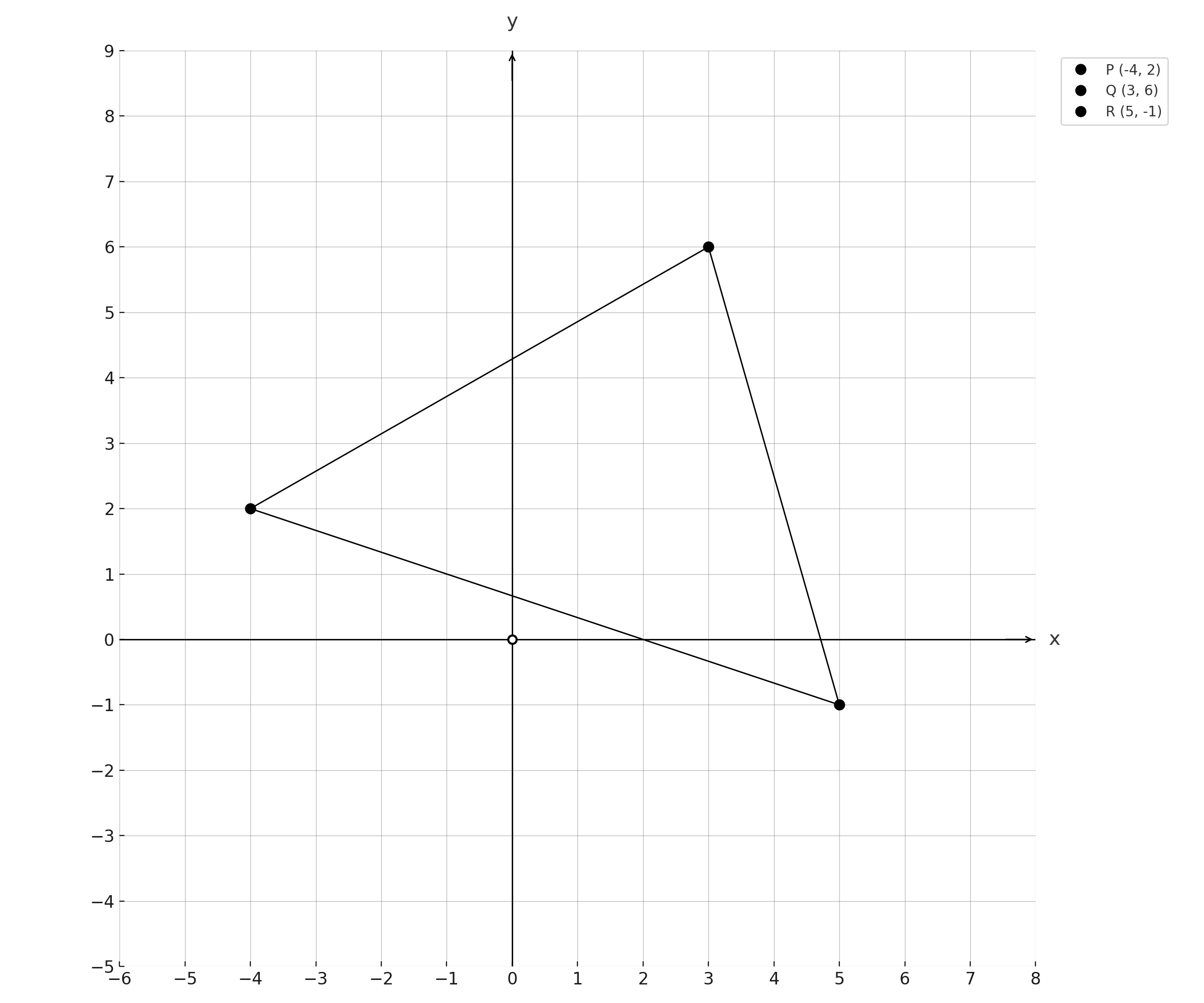
In the coordinate plane shown, three points are plotted. If a triangle is formed by connecting the three points, what is the area of the triangle, in square units? (Enter your answer as a decimal or a simplified fraction.)
1. TRANSLATE the graph information into coordinates
Looking carefully at the coordinate plane:
- Point P is at \((-4, 2)\) — 4 units left of the origin, 2 units up
- Point Q is at \((3, 6)\) — 3 units right of the origin, 6 units up
- Point R is at \((5, -1)\) — 5 units right of the origin, 1 unit down
Critical: Take your time reading these coordinates. Count grid squares carefully, especially for negative values.
2. INFER the approach for finding area
Since we have three vertices with coordinates, we need a formula that uses coordinate points directly. The shoelace formula (also called the determinant formula) is perfect here:
Area = \(\frac{1}{2}|\mathrm{x}_1(\mathrm{y}_2 - \mathrm{y}_3) + \mathrm{x}_2(\mathrm{y}_3 - \mathrm{y}_1) + \mathrm{x}_3(\mathrm{y}_1 - \mathrm{y}_2)|\)
This formula works for any triangle when you know the three vertices.
3. TRANSLATE coordinates into formula notation
Let me assign:
- \((\mathrm{x}_1, \mathrm{y}_1) = \mathrm{P}(-4, 2)\)
- \((\mathrm{x}_2, \mathrm{y}_2) = \mathrm{Q}(3, 6)\)
- \((\mathrm{x}_3, \mathrm{y}_3) = \mathrm{R}(5, -1)\)
4. SIMPLIFY by calculating each term of the formula
First term: \(\mathrm{x}_1(\mathrm{y}_2 - \mathrm{y}_3)\)
\(\mathrm{y}_2 - \mathrm{y}_3 = 6 - (-1) = 6 + 1 = 7\)
\(\mathrm{x}_1(\mathrm{y}_2 - \mathrm{y}_3) = (-4)(7) = -28\)
Second term: \(\mathrm{x}_2(\mathrm{y}_3 - \mathrm{y}_1)\)
\(\mathrm{y}_3 - \mathrm{y}_1 = -1 - 2 = -3\)
\(\mathrm{x}_2(\mathrm{y}_3 - \mathrm{y}_1) = 3(-3) = -9\)
Third term: \(\mathrm{x}_3(\mathrm{y}_1 - \mathrm{y}_2)\)
\(\mathrm{y}_1 - \mathrm{y}_2 = 2 - 6 = -4\)
\(\mathrm{x}_3(\mathrm{y}_1 - \mathrm{y}_2) = 5(-4) = -20\)
5. SIMPLIFY further to find the sum
\(\mathrm{Sum} = -28 + (-9) + (-20) = -57\)
6. SIMPLIFY by applying absolute value and dividing by 2
\(\mathrm{Area} = \frac{1}{2}|-57| = \frac{1}{2}(57) = \frac{57}{2} = 28.5\)
Answer: 28.5 (or \(\frac{57}{2}\))
Why Students Usually Falter on This Problem
Most Common Error Path:
Weak SIMPLIFY skill with negative numbers: Students make sign errors when subtracting coordinates, especially when dealing with negative values.
For example, when calculating \(\mathrm{y}_2 - \mathrm{y}_3 = 6 - (-1)\), they might incorrectly compute this as \(6 - 1 = 5\) instead of \(6 + 1 = 7\). This single error propagates through:
- \(\mathrm{x}_1(\mathrm{y}_2 - \mathrm{y}_3) = (-4)(5) = -20\) (instead of \(-28\))
- This leads to \(\mathrm{sum} = -20 + (-9) + (-20) = -49\)
- Final area = \(\frac{49}{2} = 24.5\)
This leads to confusion when their answer doesn't match expected format, causing them to doubt their work and potentially guess.
Second Most Common Error:
Poor SIMPLIFY execution—forgetting absolute value: Students correctly calculate the sum as \(-57\) but then divide by 2 without taking absolute value first.
They compute: \(\mathrm{Area} = \frac{-57}{2} = -28.5\)
Since area cannot be negative, they might realize something is wrong but not identify the missed step. They might then write 28.5 anyway without understanding why, or become confused about whether to take absolute value of the final answer vs. taking it before dividing.
This conceptual confusion about when to apply absolute value reflects incomplete understanding of the formula structure.
The Bottom Line:
This problem tests careful arithmetic with signed numbers across multiple steps. The shoelace formula itself isn't complicated conceptually, but it requires precision in handling negative coordinates and remembering the absolute value step. Success depends on methodical, careful calculation at each stage.