
The cost y, in dollars, for a manufacturer to make x rings is represented by the line shown. What is...
GMAT Algebra : (Alg) Questions
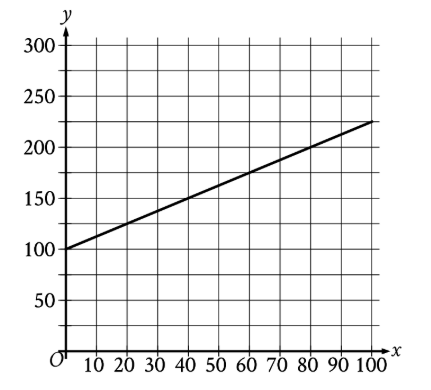
The cost \(\mathrm{y}\), in dollars, for a manufacturer to make \(\mathrm{x}\) rings is represented by the line shown. What is the cost, in dollars, for the manufacturer to make 60 rings?
\(\mathrm{100}\)
\(\mathrm{125}\)
\(\mathrm{175}\)
\(\mathrm{225}\)
1. TRANSLATE the question into a graph-reading task
The question asks: "What is the cost, in dollars, for the manufacturer to make 60 rings?"
- Given information:
- x represents the number of rings made
- y represents the cost in dollars
- The line shows the relationship between x and y
- What this means:
- We need to find the y-value (cost) when \(\mathrm{x = 60}\) (rings)
- This is the same as finding the y-coordinate of the point on the line where \(\mathrm{x = 60}\)
2. VISUALIZE the location on the graph
- Locate \(\mathrm{x = 60}\) on the horizontal axis:
- Start at the origin \(\mathrm{(0,0)}\)
- Count along the x-axis to 60
- The gridlines represent increments of 10
- Follow the vertical line upward from \(\mathrm{x = 60}\) until you reach the given line
3. VISUALIZE the y-coordinate at this point
- Once you've found where \(\mathrm{x = 60}\) intersects the line, read horizontally to the y-axis
- Looking at the y-axis scale:
- The gridlines represent increments of 25 (going 0, 25, 50, 75, 100, 125, 150, 175, 200, 225, 250...)
- At \(\mathrm{x = 60}\), the line crosses at \(\mathrm{y = 175}\)
- This means the cost for 60 rings is $175
Answer: C. 175
Why Students Usually Falter on This Problem
Most Common Error Path:
Weak VISUALIZE skill: Misreading the graph at a different x-value
Students may locate the wrong position on the x-axis and read the y-value at that incorrect position instead. Common mistakes include:
- Reading at \(\mathrm{x = 20}\) instead of \(\mathrm{x = 60}\), which gives \(\mathrm{y = 125}\)
- Reading at \(\mathrm{x = 100}\) instead of \(\mathrm{x = 60}\), which gives \(\mathrm{y = 225}\)
These errors occur when students don't carefully count the gridlines or confuse the scale divisions.
This may lead them to select Choice B (125) if they read at \(\mathrm{x = 20}\), or Choice D (225) if they read at \(\mathrm{x = 100}\).
Second Most Common Error:
Poor TRANSLATE reasoning: Confusing which variable to find
Students might understand that they need to use the graph but confuse what they're looking for. For example, they might try to find "what value of x gives a cost of 60" instead of "what cost corresponds to \(\mathrm{x = 60}\) rings." This confusion about which variable is given and which needs to be found can cause them to look at the problem incorrectly.
This leads to confusion and guessing among the answer choices.
The Bottom Line:
This problem tests whether students can accurately translate a word problem into a graph-reading task and then execute that reading precisely. The key is careful attention to the graph scale and accurately locating \(\mathrm{x = 60}\) before reading the corresponding y-value. Many students rush through graph reading and don't verify they're looking at the correct location.
\(\mathrm{100}\)
\(\mathrm{125}\)
\(\mathrm{175}\)
\(\mathrm{225}\)