
An object is shaped like a cylinder with a hemisphere on top, as shown in the figure. The radius of...
GMAT Geometry & Trigonometry : (Geo_Trig) Questions
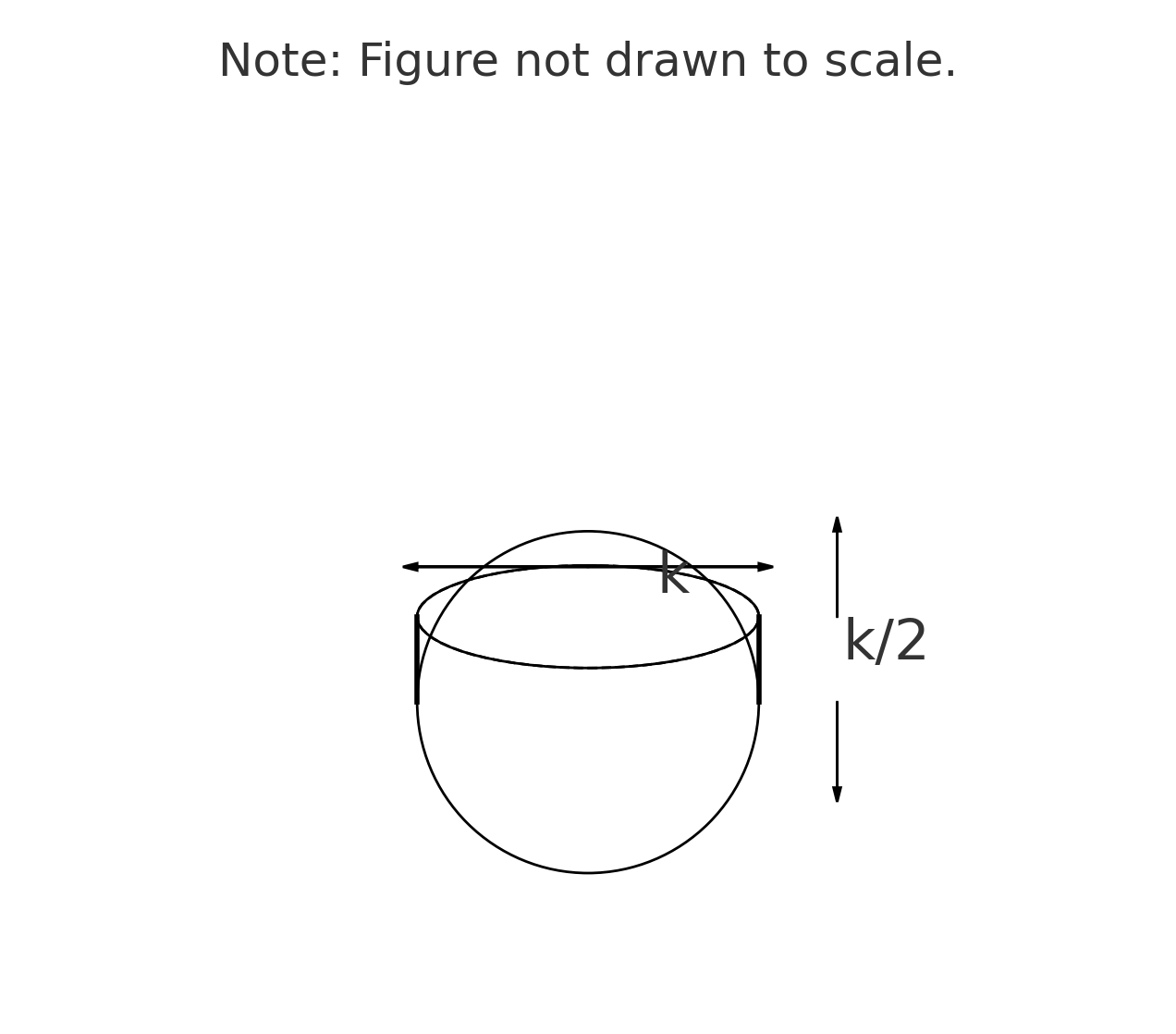
An object is shaped like a cylinder with a hemisphere on top, as shown in the figure. The radius of the cylinder and the hemisphere is \(\mathrm{k}\), and the height of the cylinder is \(\frac{\mathrm{k}}{2}\), where \(\mathrm{k}\) is a positive constant in inches. The formula for the exposed surface area \(\mathrm{A}\) of the object is \(\mathrm{A = 3πk^2}\). If the object's exposed surface area is approximately \(\mathrm{603.2}\) square inches, what is the value of \(\mathrm{k}\)?
1. TRANSLATE the problem information into an equation
You're given:
- The formula for exposed surface area: \(\mathrm{A = 3\pi k^2}\)
- The actual surface area: approximately 603.2 square inches
- You need to find the value of k
Set up your equation by substituting the known surface area value into the formula:
\(\mathrm{3\pi k^2 = 603.2}\)
2. SIMPLIFY to isolate k²
To solve for k, you need to get k² by itself first. Divide both sides by 3π:
\(\mathrm{k^2 = \frac{603.2}{3\pi}}\)
3. Calculate the numerical value
Now compute the right side (use calculator):
\(\mathrm{k^2 = \frac{603.2}{3 \times 3.14159}}\)
\(\mathrm{k^2 = \frac{603.2}{9.42478}}\)
\(\mathrm{k^2 \approx 64}\)
4. SIMPLIFY to find k
Take the square root of both sides:
\(\mathrm{k = \sqrt{64}}\)
\(\mathrm{k = 8}\)
Since k represents a physical dimension (radius), we use the positive value.
Answer: 8
Why Students Usually Falter on This Problem
Most Common Error Path:
Weak SIMPLIFY skill: Calculation errors in division
When dividing 603.2 by 3π, students may:
- Round π too early (using 3.14 instead of more precise value)
- Make arithmetic errors in dividing 603.2 by 9.42478
- Get \(\mathrm{k^2 \approx 65}\) or \(\mathrm{k^2 \approx 60}\) instead of 64
This leads to taking the square root of a non-perfect square, resulting in a decimal answer like 8.06 or 7.75, causing them to question their work and potentially round incorrectly or guess a different value.
Second Most Common Error:
Poor SIMPLIFY execution: Algebraic manipulation errors
Some students may:
- Divide by 3 first, then by π separately, accumulating rounding errors
- Forget to divide by both 3 AND π, computing \(\mathrm{k^2 = \frac{603.2}{3} \approx 201}\)
- This gives \(\mathrm{k = \sqrt{201} \approx 14.2}\)
This incorrect value doesn't match the expected answer, leading to confusion and potential guessing.
The Bottom Line:
This problem tests whether students can execute a straightforward "plug and solve" scenario accurately. The key challenge is maintaining precision through the arithmetic steps, particularly when working with π, to arrive at the clean perfect square (64) that signals the correct answer (8).