
In the coordinate plane, two points A and B are plotted as shown in the figure.Point A has coordinates \((-1,...
GMAT Geometry & Trigonometry : (Geo_Trig) Questions
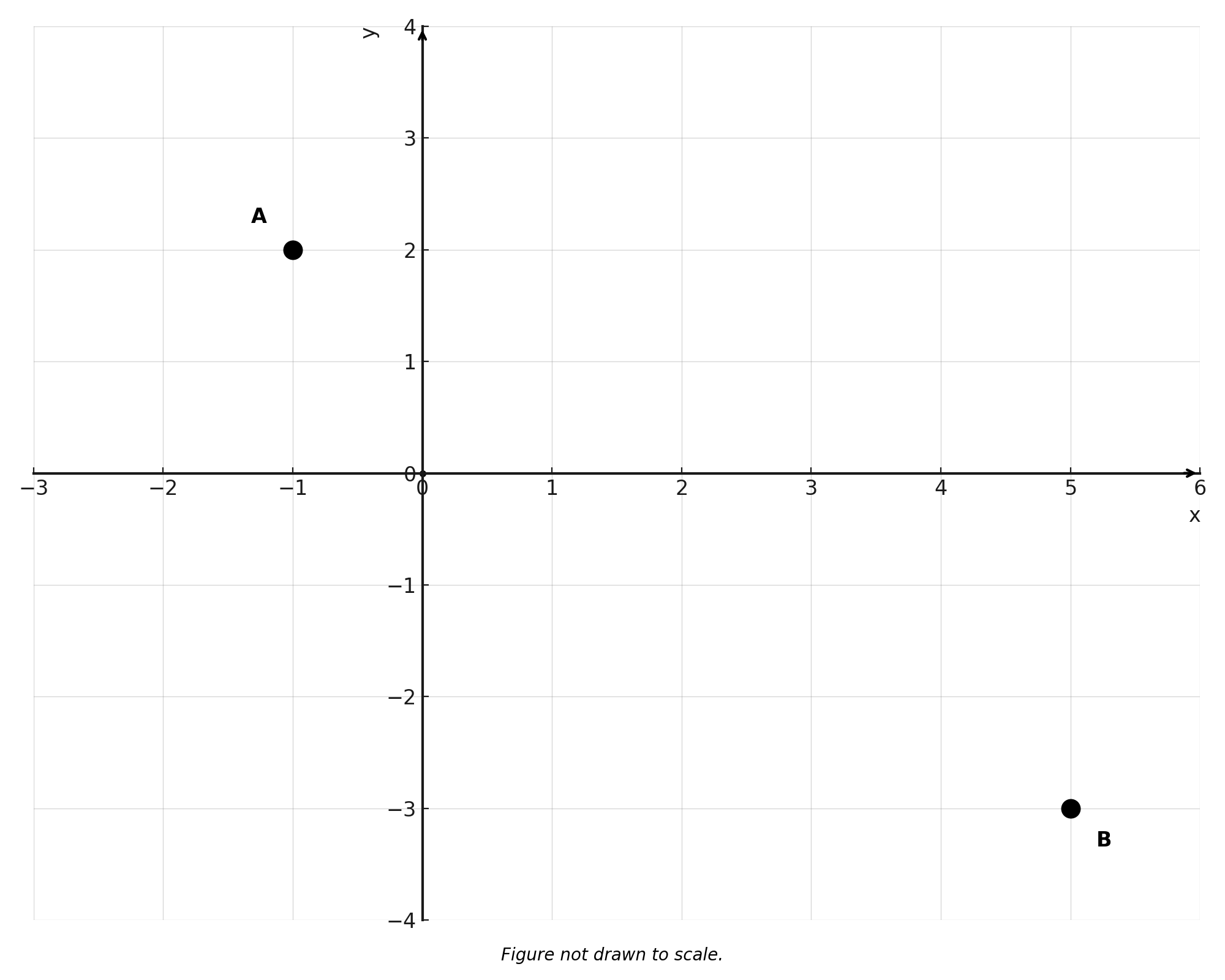
- In the coordinate plane, two points A and B are plotted as shown in the figure.
- Point A has coordinates \((-1, 2)\) and point B has coordinates \((5, -3)\).
- Which of the following is closest to the distance \(\mathrm{AB}\)?
1. TRANSLATE the problem information
From the graph and problem statement:
- Point A has coordinates \((-1, 2)\)
- Point B has coordinates \((5, -3)\)
- We need to find the distance between these two points
2. INFER the appropriate strategy
The distance between two points in the coordinate plane can be found using the distance formula, which comes from the Pythagorean theorem. Think of it this way: if you draw a right triangle with the line segment AB as the hypotenuse, the horizontal leg is the change in x-coordinates and the vertical leg is the change in y-coordinates.
Distance formula: \(\mathrm{d = \sqrt{(x_2 - x_1)^2 + (y_2 - y_1)^2}}\)
3. SIMPLIFY to find the horizontal change
Calculate \(\Delta\mathrm{x}\) (change in x-coordinates):
- \(\Delta\mathrm{x} = \mathrm{x_2 - x_1} = 5 - (-1)\)
- \(\Delta\mathrm{x} = 5 + 1 = 6\)
Watch out! When subtracting a negative number, it becomes addition: \(5 - (-1) = 5 + 1\)
4. SIMPLIFY to find the vertical change
Calculate \(\Delta\mathrm{y}\) (change in y-coordinates):
- \(\Delta\mathrm{y} = \mathrm{y_2 - y_1} = -3 - 2\)
- \(\Delta\mathrm{y} = -5\)
5. SIMPLIFY using the distance formula
Now substitute into the formula:
- \(\mathrm{d} = \sqrt{(6)^2 + (-5)^2}\)
- \(\mathrm{d} = \sqrt{36 + 25}\)
- \(\mathrm{d} = \sqrt{61}\)
Note: \((-5)^2 = 25\) (positive), not -25
6. SIMPLIFY to approximate the square root
We need to find \(\sqrt{61}\) (use calculator):
- \(\sqrt{61} \approx 7.81\)
Alternatively, estimate: Since \(\sqrt{64} = 8\) and 61 is slightly less than 64, \(\sqrt{61}\) should be slightly less than 8.
7. APPLY CONSTRAINTS to select the closest answer
Compare 7.81 to the answer choices:
- (A) 6.2 — too far below
- (B) 7.1 — about 0.7 away
- (C) 7.8 — only 0.01 away ✓
- (D) 9.2 — way too high
Answer: C (7.8)
Why Students Usually Falter on This Problem
Most Common Error Path:
Weak SIMPLIFY skill: Sign errors with negative numbers
When calculating \(\Delta\mathrm{x} = 5 - (-1)\), students may incorrectly compute this as:
- \(5 - 1 = 4\) (forgetting that subtracting a negative becomes addition)
Or when calculating \(\Delta\mathrm{y} = -3 - 2\), they might get:
- \(-3 - 2 = -1\) (incorrect arithmetic with negatives)
If a student uses \(\Delta\mathrm{x} = 4\) and \(\Delta\mathrm{y} = -5\):
- \(\mathrm{Distance} = \sqrt{(4)^2 + (-5)^2}\)
- \(= \sqrt{16 + 25}\)
- \(= \sqrt{41} \approx 6.4\)
This may lead them to select Choice A (6.2) as the closest value.
Second Most Common Error:
Weak SIMPLIFY skill: Squaring negative numbers incorrectly
When squaring \((-5)\), students might incorrectly calculate:
- \((-5)^2 = -25\) (forgetting that negative times negative equals positive)
This creates confusion because you cannot take the square root of a negative number in this context, leading them to make additional errors or guess. Even if they proceed with \(\sqrt{36 - 25} = \sqrt{11} \approx 3.3\), this doesn't match any answer choice well, causing confusion and potentially leading to a random selection like Choice B (7.1).
The Bottom Line:
This problem tests whether students can carefully execute multi-step calculations involving negative numbers. The conceptual part (knowing the distance formula) is straightforward, but the execution requires attention to detail with sign conventions. Most errors stem from rushing through the arithmetic rather than from not knowing the formula.