
Points P and Q are shown in the xy-plane above. Which of the following expressions represents the distance between points...
GMAT Geometry & Trigonometry : (Geo_Trig) Questions
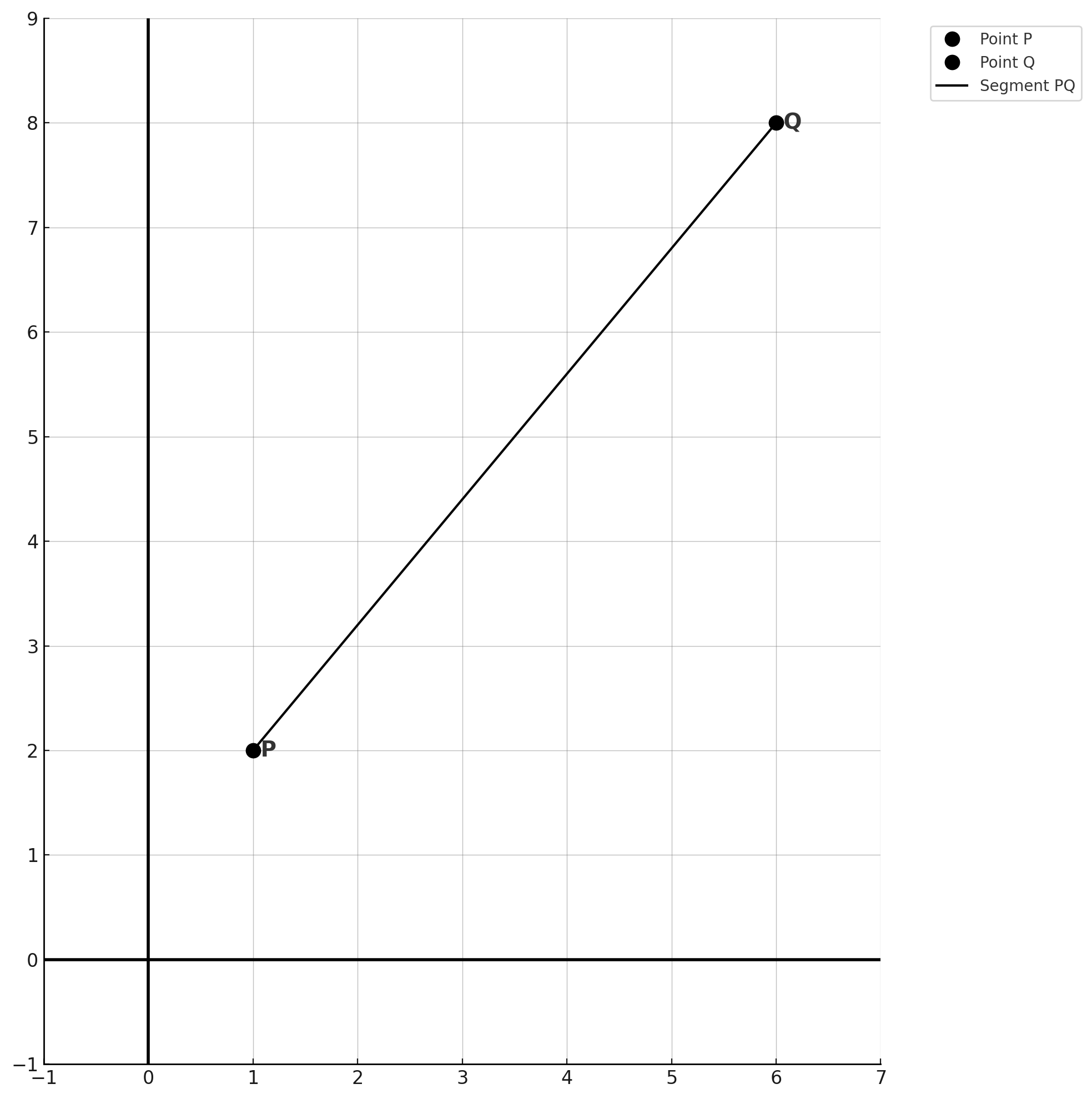
Points P and Q are shown in the xy-plane above. Which of the following expressions represents the distance between points P and Q?
1. TRANSLATE the coordinates from the graph
Look at the graph carefully:
- Point P is located at:
- x-coordinate = 1 (one unit to the right of the origin)
- y-coordinate = 2 (two units up from the origin)
- So \(\mathrm{P = (1, 2)}\)
- Point Q is located at:
- x-coordinate = 6 (six units to the right of the origin)
- y-coordinate = 8 (eight units up from the origin)
- So \(\mathrm{Q = (6, 8)}\)
2. INFER what mathematical tool you need
The question asks for the distance between two points in the coordinate plane. This immediately tells you to use the distance formula.
The distance formula comes from the Pythagorean theorem applied to a right triangle where:
- One leg is the horizontal difference between points: \(\mathrm{(x_2 - x_1)}\)
- The other leg is the vertical difference: \(\mathrm{(y_2 - y_1)}\)
- The hypotenuse is the distance between the points
3. TRANSLATE the distance formula with your coordinates
The distance formula is:
\(\mathrm{d = \sqrt{(x_2 - x_1)^2 + (y_2 - y_1)^2}}\)
Substitute your coordinates:
- \(\mathrm{x_1 = 1, y_1 = 2}\) (Point P)
- \(\mathrm{x_2 = 6, y_2 = 8}\) (Point Q)
\(\mathrm{d = \sqrt{(6 - 1)^2 + (8 - 2)^2}}\)
4. INFER that the question wants the expression, not the value
Notice that the question asks "which expression represents the distance"—not "what is the distance." This means you don't need to calculate the actual numerical value. You're looking for the formula with the numbers plugged in.
5. Compare your expression with the answer choices
Your expression: \(\mathrm{\sqrt{(6 - 1)^2 + (8 - 2)^2}}\)
This matches Choice D exactly.
Answer: D
Why Students Usually Falter on This Problem
Most Common Error Path:
Conceptual Gap - Distance Formula Structure: Students who don't fully remember the distance formula structure might confuse which operations to apply and in what order.
For example:
- Thinking distance is just adding the differences: \(\mathrm{(6 - 1) + (8 - 2)}\) → This leads to selecting Choice A
- Remembering to square but forgetting the square root: \(\mathrm{(6 - 1)^2 + (8 - 2)^2}\) → This leads to selecting Choice C
- Remembering the square root but forgetting to square first: \(\mathrm{\sqrt{(6 - 1) + (8 - 2)}}\) → This leads to selecting Choice B
The distance formula has a specific structure: square the differences, add them together, then take the square root of the sum. Missing any part gives you an incorrect expression.
Second Most Common Error:
Weak TRANSLATE skill: Misreading the coordinates from the graph—perhaps switching x and y values or misidentifying which gridline a point falls on—leads to coordinates that don't match any of the answer choices. This causes confusion and may lead to guessing or assuming there's a mistake in the problem.
The Bottom Line:
This problem tests whether you've truly memorized the distance formula structure, not just vaguely remember "something with squares and square roots." The answer choices are specifically designed to catch partial knowledge—knowing only pieces of the formula isn't enough. You must know the complete structure: \(\mathrm{\sqrt{(x_2 - x_1)^2 + (y_2 - y_1)^2}}\).