
The graph represents the total charge, in dollars, by an electrician for x hours of work. The electrician charges a...
GMAT Algebra : (Alg) Questions
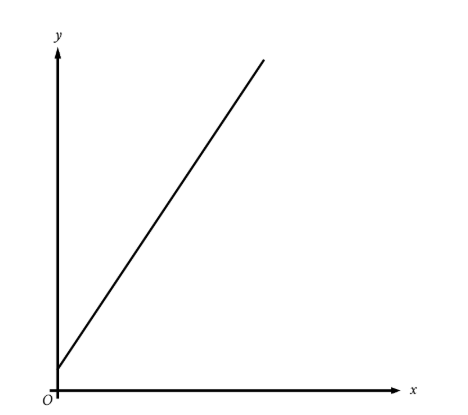
The graph represents the total charge, in dollars, by an electrician for \(\mathrm{x}\) hours of work. The electrician charges a onetime fee plus an hourly rate. What is the best interpretation of the slope of the graph?
The electrician's hourly rate
The electrician's onetime fee
The maximum amount that the electrician charges
The total amount that the electrician charges
1. TRANSLATE the problem information
Given information:
- The graph shows total charge (y-axis) vs. hours of work (x-axis)
- The electrician charges a one-time fee plus an hourly rate
- The graph is linear (a straight line)
What we need: The interpretation of the slope
2. TRANSLATE the pricing structure into mathematical form
The electrician's pricing has two parts:
- One-time fee: A constant amount charged regardless of hours
- Hourly rate: An amount that multiplies by the number of hours
This translates to:
- Total charge = (hourly rate × hours) + one-time fee
- Or in equation form: \(\mathrm{y = (hourly\ rate) \cdot x + (one\text{-}time\ fee)}\)
3. INFER which part of the equation matches which graph feature
Compare this to the standard linear form: \(\mathrm{y = mx + b}\)
Where:
- \(\mathrm{m}\) is the slope (coefficient of x)
- \(\mathrm{b}\) is the y-intercept (constant term)
Matching our equation to this form:
- Slope (\(\mathrm{m}\)) = hourly rate
- Y-intercept (\(\mathrm{b}\)) = one-time fee
4. INFER what the slope represents
The slope tells us the rate of change—how much the total charge increases for each additional hour of work.
Since the total charge increases by the hourly rate for each hour worked, the slope must be the hourly rate.
Answer: A. The electrician's hourly rate
Why Students Usually Falter on This Problem
Most Common Error Path:
Weak INFER skill: Confusing slope with y-intercept
Students sometimes focus on the first component mentioned in the problem ("one-time fee") and incorrectly associate it with the first parameter they think of (slope). They don't carefully think through which mathematical component (slope vs. y-intercept) corresponds to which pricing component (hourly rate vs. one-time fee).
The one-time fee is a constant amount that doesn't change with hours—this is the y-intercept, not the slope. The slope represents change per unit, which is the hourly rate.
This may lead them to select Choice B (The electrician's one-time fee).
Second Most Common Error:
Inadequate TRANSLATE: Misunderstanding what "slope" means in context
Some students may not connect the abstract concept of "slope" to the concrete idea of "rate of change per hour." They might think the slope represents some total or maximum amount rather than understanding it shows how much is added per hour.
Without this connection, they might guess or select Choice C (The maximum amount that the electrician charges) or Choice D (The total amount that the electrician charges).
The Bottom Line:
This problem tests whether you can map real-world pricing structures to linear equation components. The key is recognizing that slope = rate of change = amount per hour (hourly rate), while the y-intercept = starting value = one-time fee.
The electrician's hourly rate
The electrician's onetime fee
The maximum amount that the electrician charges
The total amount that the electrician charges