
Ellipse P (shown) is defined by the equation \(\frac{(\mathrm{x} - 3)^2}{16} + \frac{(\mathrm{y} + 1)^2}{4} = 1\). Ellipse Q (not...
GMAT Geometry & Trigonometry : (Geo_Trig) Questions
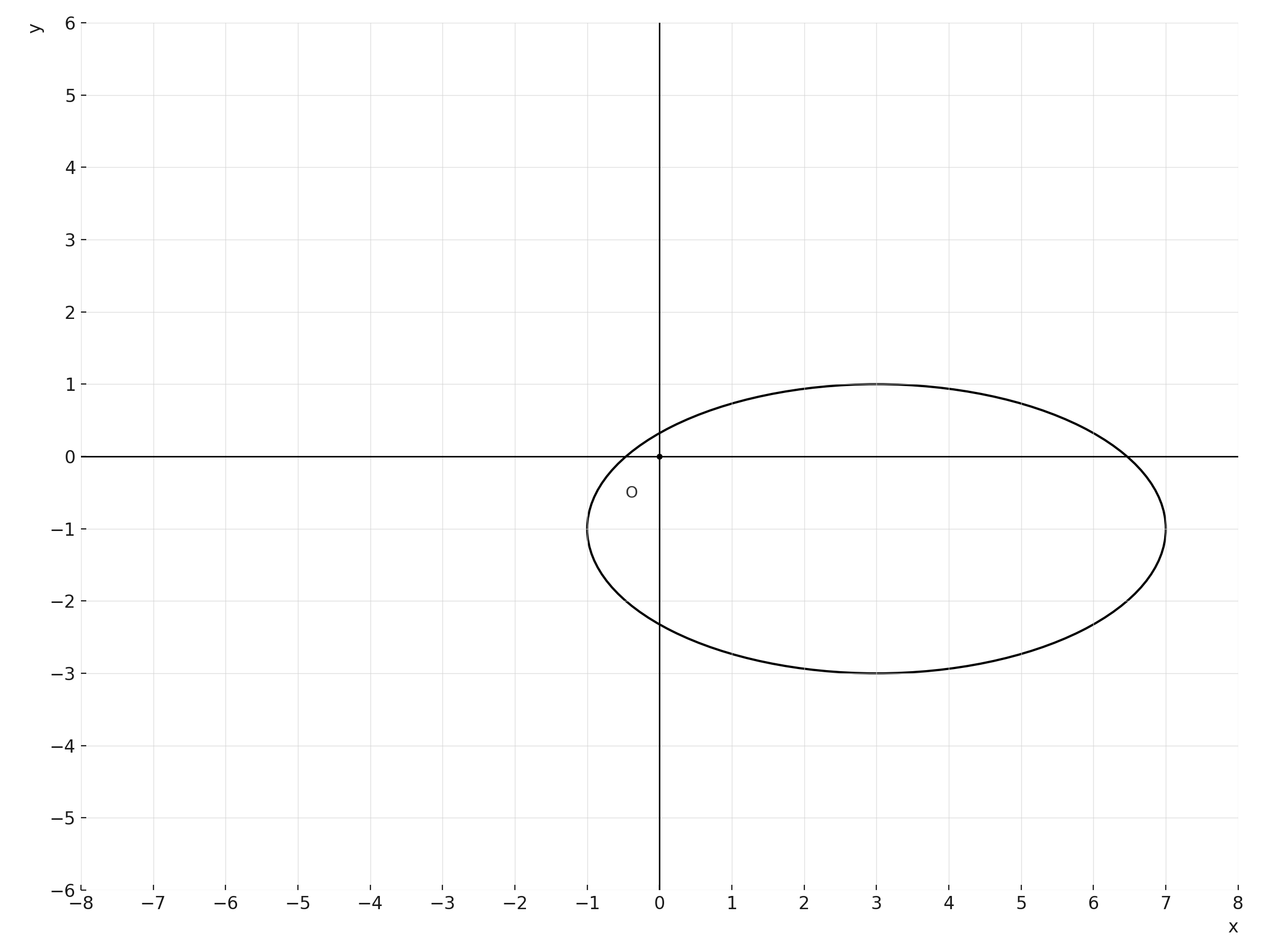
Ellipse P (shown) is defined by the equation \(\frac{(\mathrm{x} - 3)^2}{16} + \frac{(\mathrm{y} + 1)^2}{4} = 1\). Ellipse Q (not shown) is created by shifting ellipse P left 5 units and vertically stretching it so that the vertical semi-axis of ellipse Q is 3 times the vertical semi-axis of ellipse P. If the equation of ellipse Q can be written in the form \(\frac{(\mathrm{x} - \mathrm{h})^2}{\mathrm{a}} + \frac{(\mathrm{y} - \mathrm{k})^2}{\mathrm{b}} = 1\), what is the value of \(\mathrm{h} + \mathrm{b}\)?
1. TRANSLATE the given ellipse equation
Given: Ellipse P has equation \(\frac{(x - 3)^2}{16} + \frac{(y + 1)^2}{4} = 1\)
From the standard form \(\frac{(x - h)^2}{a} + \frac{(y - k)^2}{b} = 1\), we can identify:
- Center: \((h, k) = (3, -1)\)
- Horizontal semi-axis: \(\sqrt{16} = 4\)
- Vertical semi-axis: \(\sqrt{4} = 2\)
2. TRANSLATE the transformations into mathematical operations
The problem tells us two things about Ellipse Q:
- "Shifted left 5 units" → Subtract 5 from the x-coordinate of the center
- "Vertical semi-axis... is 3 times the vertical semi-axis of ellipse P" → Multiply the vertical semi-axis by 3
3. INFER which parameters change and which stay the same
This is crucial: Not everything changes when we transform an ellipse!
What changes:
- Horizontal shift affects the x-coordinate of center: \(3 - 5 = -2\)
- So new center is \((-2, -1)\)
- Vertical stretch affects the vertical semi-axis: \(2 \times 3 = 6\)
What doesn't change:
- The y-coordinate of center stays -1 (no vertical shift mentioned)
- The horizontal semi-axis stays 4 (no horizontal stretch mentioned)
4. Calculate the denominators for the equation
Remember: The denominators in the ellipse equation are the squares of the semi-axes.
- For the x-term: horizontal semi-axis = 4, so denominator = \(4^2 = 16\)
- For the y-term: vertical semi-axis = 6, so denominator = \(6^2 = 36\)
5. Write the equation of Ellipse Q
Center is \((-2, -1)\), so:
\(\frac{(x - (-2))^2}{16} + \frac{(y - (-1))^2}{36} = 1\)
This simplifies to:
\(\frac{(x + 2)^2}{16} + \frac{(y + 1)^2}{36} = 1\)
6. TRANSLATE from our equation to the form requested
The problem asks for the form \(\frac{(x - h)^2}{a} + \frac{(y - k)^2}{b} = 1\)
Our equation: \(\frac{(x + 2)^2}{16} + \frac{(y + 1)^2}{36} = 1\)
Be careful with signs!
- \((x + 2)^2 = (x - (-2))^2\), so \(h = -2\) (not +2!)
- \((y + 1)^2 = (y - (-1))^2\), so \(k = -1\)
- \(a = 16\)
- \(b = 36\)
7. Calculate the final answer
\(h + b = -2 + 36 = 34\)
Answer: 34
Why Students Usually Falter on This Problem
Most Common Error Path:
Weak TRANSLATE skill: Mishandling the sign of h
When students see the equation \(\frac{(x + 2)^2}{16} + \frac{(y + 1)^2}{36} = 1\), they might think \(h = 2\) instead of \(h = -2\).
The confusion comes from not carefully comparing \((x + 2)^2\) with the standard form \((x - h)^2\). Since \((x + 2)^2 = (x - (-2))^2\), we need \(h = -2\).
If they incorrectly use \(h = 2\), they would calculate:
\(h + b = 2 + 36 = 38\) ← Wrong answer
Second Most Common Error:
Conceptual confusion: Using semi-axis instead of its square for b
Students might correctly find that the vertical semi-axis of Ellipse Q is 6, but then forget that b represents the denominator (which is \(6^2 = 36\)), not the semi-axis itself.
If they incorrectly use \(b = 6\), they would calculate:
\(h + b = -2 + 6 = 4\) ← Wrong answer
The Bottom Line:
This problem tests whether you can carefully track transformations through multiple steps while maintaining precision about what each parameter in the standard form represents. The key challenges are: (1) correctly applying transformation rules, (2) remembering that denominators are squares of semi-axes, and (3) handling the signs correctly when comparing forms.