
Which of the following is an equation of the graph shown in the xy-plane above?
GMAT Algebra : (Alg) Questions
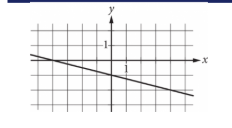
Which of the following is an equation of the graph shown in the xy-plane above?
1. TRANSLATE the graph information
- TRANSLATE the y-intercept from the graph:
- Look where the line crosses the y-axis (the vertical axis)
- This occurs at the point \(\mathrm{(0, -1)}\)
- The y-intercept \(\mathrm{b = -1}\)
2. TRANSLATE a second point from the graph
- Choose another clear point where the line passes through a grid intersection:
- The line clearly passes through \(\mathrm{(4, -2)}\)
- We now have two points: \(\mathrm{(0, -1)}\) and \(\mathrm{(4, -2)}\)
3. INFER that we need to calculate the slope
- To write the equation \(\mathrm{y = mx + b}\), we need both \(\mathrm{m}\) (slope) and \(\mathrm{b}\) (y-intercept)
- We already have \(\mathrm{b = -1}\)
- We need to find \(\mathrm{m}\) using the two points we identified
4. SIMPLIFY to calculate the slope
- Apply the slope formula:
- \(\mathrm{m = \frac{y_2 - y_1}{x_2 - x_1}}\)
- \(\mathrm{m = \frac{-2 - (-1)}{4 - 0}}\)
- \(\mathrm{m = \frac{-2 + 1}{4}}\)
- \(\mathrm{m = -\frac{1}{4}}\)
5. INFER how to construct the complete equation
- We have:
- slope \(\mathrm{m = -\frac{1}{4}}\)
- y-intercept \(\mathrm{b = -1}\)
- In slope-intercept form: \(\mathrm{y = mx + b}\)
- Substitute our values: \(\mathrm{y = -\frac{1}{4}x + (-1)}\)
- Simplified: \(\mathrm{y = -\frac{1}{4}x - 1}\)
6. APPLY CONSTRAINTS to match with answer choices
- Compare our equation \(\mathrm{y = -\frac{1}{4}x - 1}\) with the choices
- This exactly matches Choice A
Answer: A. y = -1/4 x - 1
Why Students Usually Falter on This Problem
Most Common Error Path:
Weak SIMPLIFY skill: Incorrectly calculating the slope, particularly with the negative numbers
Students may calculate:
- \(\mathrm{m = \frac{-1 - (-2)}{0 - 4} = \frac{1}{-4} = -\frac{1}{4}}\) (correct by reversing the order)
- OR \(\mathrm{m = \frac{-2 - (-1)}{0 - 4} = \frac{-1}{-4} = \frac{1}{4}}\) (wrong - forgot one negative)
If they get \(\mathrm{m = -4}\) by computing \(\mathrm{\frac{4}{-1}}\) or making other calculation errors, they might select Choice D (y = -4x - 1).
Second Most Common Error:
Poor INFER reasoning: Confusing which calculated value represents the slope versus the y-intercept
After correctly calculating \(\mathrm{slope = -\frac{1}{4}}\), students might incorrectly think:
- "The slope is -1 and the y-intercept is -1/4"
- This backwards thinking leads them to select Choice C (y = -x - 1/4)
Third Most Common Error:
Inadequate TRANSLATE execution: Misreading coordinates from the graph
Students might:
- Misidentify the y-intercept as \(\mathrm{(0, -4)}\) instead of \(\mathrm{(0, -1)}\)
- Or choose poor points that don't lie exactly on grid intersections
- This can lead to \(\mathrm{slope = -1}\) with y-intercept = -4, selecting Choice B (y = -x - 4)
The Bottom Line:
This problem tests your ability to accurately extract visual information (coordinates) from a graph and then systematically apply the slope formula. The key is being methodical: first identify the y-intercept clearly, then choose a second clear point, calculate slope carefully with attention to negative signs, and finally match your values correctly to the slope-intercept form.