
A sample of radioactive material is observed over time, and its mass is recorded at regular intervals. The scatterplot shows...
GMAT Problem-Solving and Data Analysis : (PS_DA) Questions
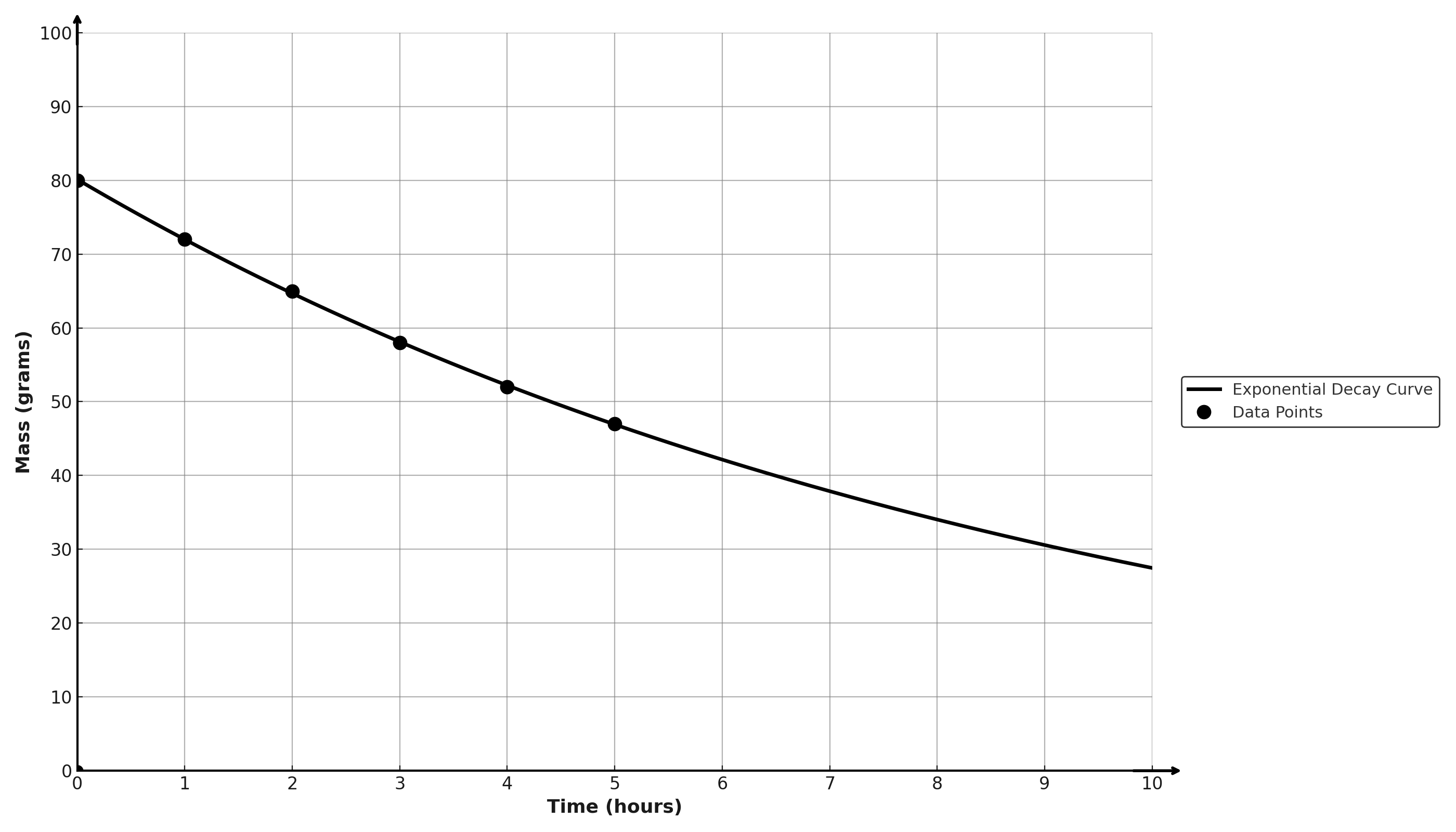
A sample of radioactive material is observed over time, and its mass is recorded at regular intervals. The scatterplot shows the relationship between time \(\mathrm{t}\) (in hours) and mass \(\mathrm{m}\) (in grams). An equation for the exponential decay model shown can be written as \(\mathrm{m = c(d)^t}\), where \(\mathrm{c}\) and \(\mathrm{d}\) are positive constants. Which of the following is closest to the value of \(\mathrm{d}\)?
1. TRANSLATE the problem information
Looking at the graph and the model \(\mathrm{m = c(d)^t}\):
- We have data points we can read from the scatterplot
- We need to find the constant d (the decay factor)
- We know c and d are positive constants
Key insight from the equation: When \(\mathrm{t = 0}\), the exponent makes \(\mathrm{d^0 = 1}\), so \(\mathrm{m = c(1) = c}\)
2. TRANSLATE the y-intercept to find c
Reading from the graph at \(\mathrm{t = 0}\):
- \(\mathrm{m \approx 80}\) grams
Since \(\mathrm{m = c}\) when \(\mathrm{t = 0}\):
- \(\mathrm{c = 80}\)
Our model is now: \(\mathrm{m = 80(d)^t}\)
3. INFER the strategy to find d
Now that we know c, we need to find d. The strategic approach:
- Pick another data point from the graph
- Substitute the values into \(\mathrm{m = 80(d)^t}\)
- Solve for d
Why \(\mathrm{t = 1}\) is the best choice: At \(\mathrm{t = 1}\), the equation becomes \(\mathrm{m = 80d}\), which makes solving for d straightforward (no exponent rules needed).
4. TRANSLATE another data point
Reading from the graph at \(\mathrm{t = 1}\):
- \(\mathrm{m \approx 72}\) grams
5. SIMPLIFY to solve for d
Substitute into \(\mathrm{m = 80(d)^t}\):
\(\mathrm{72 = 80(d)^1}\)
\(\mathrm{72 = 80d}\)
\(\mathrm{d = \frac{72}{80}}\)
\(\mathrm{d = \frac{9}{10}}\)
\(\mathrm{d = 0.90}\)
6. Verify your answer (optional but recommended)
Check with \(\mathrm{t = 2}\) where \(\mathrm{m \approx 65}\) from the graph:
- \(\mathrm{m = 80(0.90)^2 = 80(0.81) = 64.8 \approx 65}\) ✓
Looking at the answer choices, \(\mathrm{d = 0.90}\) matches choice (A).
Answer: (A) 0.90
Why Students Usually Falter on This Problem
Most Common Error Path:
Weak INFER skill: Students don't recognize the strategic two-step approach (find c first, then use c to find d). Instead, they try to find d directly without determining c, or they attempt to use two arbitrary points without recognizing the efficiency of using \(\mathrm{t = 0}\).
This leads to confusion with setting up equations, getting stuck, and guessing among the answer choices.
Second Most Common Error:
Poor SIMPLIFY execution: Students make arithmetic errors when computing \(\mathrm{72 \div 80}\). Common mistakes include:
- Getting \(\mathrm{\frac{72}{80} = 0.80}\) (confusing the calculation)
- Getting \(\mathrm{\frac{8}{7} \approx 1.14}\) by flipping the fraction
If they calculate \(\mathrm{d = 0.80}\), they might choose a nearby answer or get confused since 0.80 isn't listed. If they flip to get \(\mathrm{\frac{80}{72} \approx 1.11}\), this may lead them to select Choice (B) (1.10).
Third Common Error:
Conceptual confusion about exponential decay: Students might not apply constraint reasoning about what d should represent. They might select:
- Choice (C) (8.00) thinking it relates to "80" from the initial mass
- Choice (D) (80.0) by confusing d with c
Students who understand that d must be less than 1 for decay (since \(\mathrm{0 \lt d \lt 1}\)) can eliminate choices (B), (C), and (D) immediately.
The Bottom Line:
This problem tests whether students can connect the abstract exponential model to concrete graph data systematically. The key is recognizing that \(\mathrm{t = 0}\) gives you c "for free," then using that to unlock d from the next data point. Students who jump in without a clear strategy, or who make arithmetic errors, will select incorrect choices.