
The coordinate plane shows the graph of the linear equation \(\mathrm{y = 3g(x) + 6}\).The line passes through grid points...
GMAT Algebra : (Alg) Questions
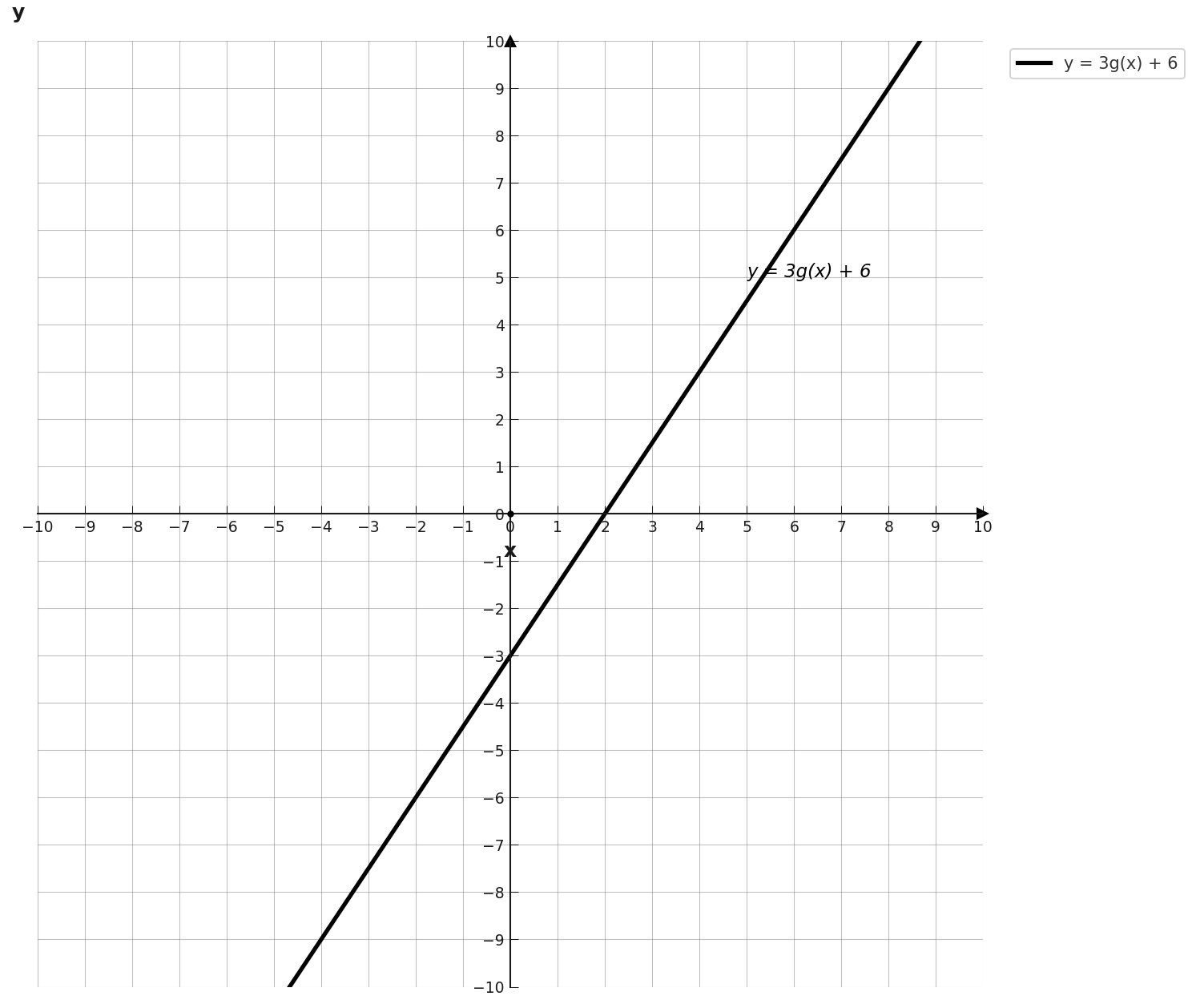
- The coordinate plane shows the graph of the linear equation \(\mathrm{y = 3g(x) + 6}\).
- The line passes through grid points that can be read from the graph.
- Which equation defines the function g?
1. TRANSLATE the graph into mathematical information
- TRANSLATE two clear points from the graphed line:
- Point 1: Where the line crosses the y-axis at \(\mathrm{(0, -3)}\)
- Point 2: Where the line crosses the x-axis at \(\mathrm{(2, 0)}\)
2. SIMPLIFY to find the equation of the graphed line
- Calculate the slope:
- \(\mathrm{\text{Slope} = \frac{0 - (-3)}{2 - 0} = \frac{3}{2}}\)
- The y-intercept is -3 (from point \(\mathrm{(0, -3)}\))
- Therefore, the graphed line has equation:
- \(\mathrm{y} = \frac{3}{2}\mathrm{x} - 3\)
3. INFER the strategy to find g(x)
- The key insight: The graph shows \(\mathrm{y} = 3\mathrm{g(x)} + 6\)
- We found that the same graph represents \(\mathrm{y} = \frac{3}{2}\mathrm{x} - 3\)
- These two expressions must be equal for all x
- So we need to set them equal and solve for g(x)
4. SIMPLIFY through algebraic manipulation
- Set the expressions equal:
- \(3\mathrm{g(x)} + 6 = \frac{3}{2}\mathrm{x} - 3\)
- Subtract 6 from both sides:
- \(3\mathrm{g(x)} = \frac{3}{2}\mathrm{x} - 3 - 6\)
- \(3\mathrm{g(x)} = \frac{3}{2}\mathrm{x} - 9\)
- Divide everything by 3:
- \(\mathrm{g(x)} = \frac{1}{2}\mathrm{x} - 3\)
5. Verify the answer
- INFER that we should check our work by substituting back
- If \(\mathrm{g(x)} = \frac{1}{2}\mathrm{x} - 3\), then:
- \(3\mathrm{g(x)} + 6 = 3\left[\frac{1}{2}\mathrm{x} - 3\right] + 6\)
- \(= \frac{3}{2}\mathrm{x} - 9 + 6\)
- \(= \frac{3}{2}\mathrm{x} - 3\) ✓
This matches our graphed equation!
Answer: A
Why Students Usually Falter on This Problem
Most Common Error Path:
Weak INFER skill: Not recognizing that the graphed line represents the transformed function y = 3g(x) + 6, not g(x) itself
Students see the equation \(\mathrm{y} = 3\mathrm{g(x)} + 6\) and might think they need to find an equation for the line shown and call that g(x). They correctly find that the graphed line is \(\mathrm{y} = \frac{3}{2}\mathrm{x} - 3\), but then mistakenly conclude that \(\mathrm{g(x)} = \frac{3}{2}\mathrm{x} - 3\).
This may lead them to select Choice (C): \(\mathrm{g(x)} = \frac{3}{2}\mathrm{x} - 3\)
Second Most Common Error:
Poor SIMPLIFY execution: Making sign errors when isolating g(x)
Students correctly set up \(3\mathrm{g(x)} + 6 = \frac{3}{2}\mathrm{x} - 3\), but then make errors in the algebra:
- They might subtract 6 incorrectly: \(3\mathrm{g(x)} = \frac{3}{2}\mathrm{x} - 3 - 6\), but compute this as \(\frac{3}{2}\mathrm{x} + 3\) (forgetting that -3 - 6 = -9)
- Then dividing by 3 gives: \(\mathrm{g(x)} = \frac{1}{2}\mathrm{x} + 1\), which they might round to match an answer
Or they might forget to subtract 6 and instead just divide the whole equation by 3 immediately, getting \(\mathrm{g(x)} + 2 = \frac{1}{2}\mathrm{x} - 1\), leading to \(\mathrm{g(x)} = \frac{1}{2}\mathrm{x} - 3 + 2 = \frac{1}{2}\mathrm{x} + 1\).
This confusion might lead them to select Choice (B): \(\mathrm{g(x)} = \frac{1}{2}\mathrm{x} + 3\) if they make additional sign errors.
The Bottom Line:
This problem requires students to understand the difference between a function and its transformation. The graph doesn't show g(x); it shows what happens to g(x) after it's been multiplied by 3 and increased by 6. Students must work backward algebraically to "undo" these transformations and find the original function g(x).