
The graph of a function g is shown on a coordinate plane.The curve passes through \((-3, \frac{1}{8})\), \((-1, \frac{1}{2})\), \((0,...
GMAT Problem-Solving and Data Analysis : (PS_DA) Questions
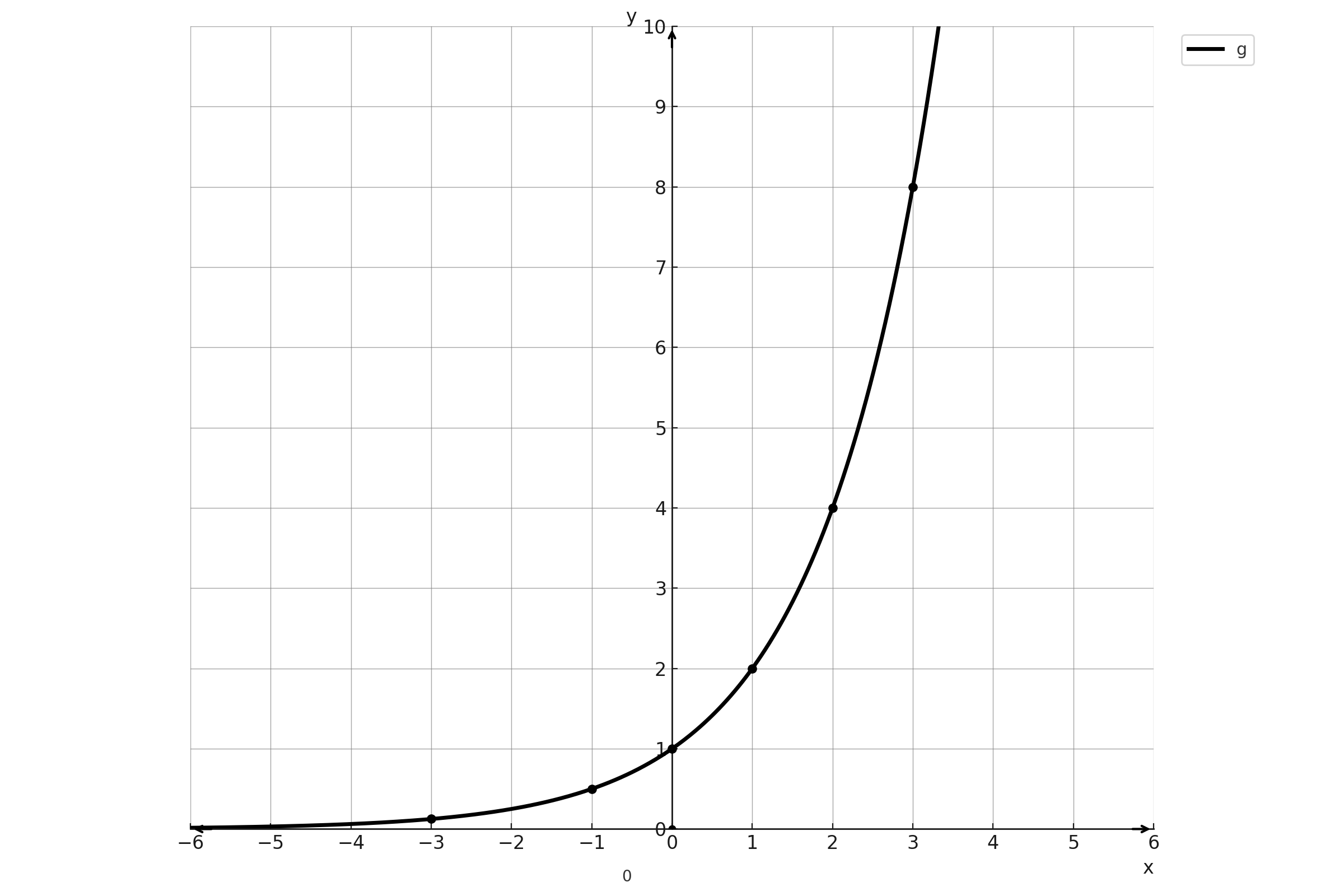
- The graph of a function g is shown on a coordinate plane.
- The curve passes through \((-3, \frac{1}{8})\), \((-1, \frac{1}{2})\), \((0, 1)\), \((1, 2)\), and \((2, 4)\), and continues smoothly beyond these points.
- Which of the following best describes the function g?
Increasing linear
Decreasing linear
Increasing exponential
Decreasing exponential
1. VISUALIZE the graph characteristics
Looking at the graph of function g:
- Shape observation: The curve is smooth but clearly curved, not straight
- Direction: As we move from left to right (increasing x), the curve rises (increasing y)
- Key points I can read from the graph:
- At \(\mathrm{x = -3: y = \frac{1}{8}}\)
- At \(\mathrm{x = -1: y = \frac{1}{2}}\)
- At \(\mathrm{x = 0: y = 1}\)
- At \(\mathrm{x = 1: y = 2}\)
- At \(\mathrm{x = 2: y = 4}\)
- At \(\mathrm{x = 3: y = 8}\) (approximately)
2. INFER the function type by eliminating options
- The answer choices give me four possibilities: increasing/decreasing AND linear/exponential
- Is it linear or curved?
- Linear functions produce straight lines
- This graph is clearly curved (gets steeper as x increases)
- Eliminate choices (A) and (B) - both linear options are out
- Is it increasing or decreasing?
- As x increases (moving right), y increases (moving up)
- This is an increasing function
- Eliminate choice (D) - decreasing exponential is out
3. INFER by checking the exponential pattern
To confirm it's truly exponential (not just curved), I'll check if y-values multiply by a constant factor:
- From x = 0 to x = 1: y goes from 1 to 2 → multiplied by 2
- From x = 1 to x = 2: y goes from 2 to 4 → multiplied by 2
- From x = 2 to x = 3: y goes from 4 to 8 → multiplied by 2
- Going backwards:
- From x = -1 to x = 0: y goes from 1/2 to 1 → multiplied by 2
- From x = -3 to x = -1: y goes from 1/8 to 1/2, which is \(\mathrm{\frac{1}{8} \times 4 = \frac{1}{2}}\)
This constant multiplicative pattern (each unit increase in x multiplies y by 2) is the signature of exponential functions!
The function appears to be \(\mathrm{g(x) = 2^x}\), which confirms it's exponential.
Answer: C (Increasing exponential)
Why Students Usually Falter on This Problem
Most Common Error Path:
Weak INFER skill: Students recognize the curve is increasing but don't distinguish between "curved and increasing" vs "exponential and increasing."
They may think: "The graph goes up, and it's curved, so maybe it's just some increasing function. Both (A) and (C) say increasing..."
Without checking the multiplicative pattern, they might guess between the two increasing options or default to "linear" because it's more familiar. This confusion between recognizing general increase vs. identifying the specific exponential pattern may lead them to select Choice A (Increasing linear).
Second Most Common Error:
Missing conceptual knowledge: Students don't remember that linear functions must be straight lines, so they don't immediately eliminate options (A) and (B).
If they focus only on whether the function is increasing or decreasing (which is easier to see), they narrow down to (A) or (C), but without the linear vs. exponential distinction, they're left guessing. This may lead them to select Choice A (Increasing linear) since "linear" feels more familiar than "exponential."
The Bottom Line:
This problem requires both visual analysis AND pattern recognition. It's not enough to see that the function is increasing—you must identify WHY it's curved (the multiplicative pattern) to distinguish exponential from linear. The key insight is checking whether y-values change by addition (linear) or multiplication (exponential).
Increasing linear
Decreasing linear
Increasing exponential
Decreasing exponential