
The graph of \(\mathrm{y = f(x) + 14}\) is shown. Which equation defines function f?
GMAT Algebra : (Alg) Questions
The graph of \(\mathrm{y = f(x) + 14}\) is shown. Which equation defines function \(\mathrm{f}\)?
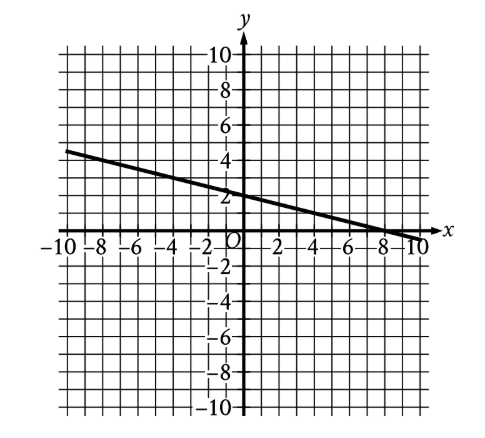
1. TRANSLATE the problem information
The problem states "The graph of \(\mathrm{y = f(x) + 14}\) is shown."
This is crucial: The line you see on the graph is NOT \(\mathrm{f(x)}\). It's \(\mathrm{f(x) + 14}\).
Think of it this way: Someone took the original function \(\mathrm{f(x)}\), added 14 to every output, and graphed the result. We need to work backwards to find the original function.
2. INFER the solution strategy
To find \(\mathrm{f(x)}\), we need to:
- First, find the equation of the line shown in the graph
- Then, use the relationship "line shown = \(\mathrm{f(x) + 14}\)" to solve for \(\mathrm{f(x)}\)
3. TRANSLATE information from the graph
Reading from the graph:
- The y-intercept (where the line crosses the y-axis) is at \(\mathrm{(0, 2)}\)
- The line also passes through \(\mathrm{(4, 1)}\)
4. Calculate the slope
Using the slope formula with points \(\mathrm{(0, 2)}\) and \(\mathrm{(4, 1)}\):
\(\mathrm{m = \frac{y_2 - y_1}{x_2 - x_1}}\)
\(\mathrm{= \frac{1 - 2}{4 - 0}}\)
\(\mathrm{= -\frac{1}{4}}\)
5. Write the equation of the line shown
Using slope-intercept form \(\mathrm{y = mx + b}\):
- Slope \(\mathrm{m = -\frac{1}{4}}\)
- Y-intercept \(\mathrm{b = 2}\)
The line shown has equation: \(\mathrm{y = -\frac{1}{4}x + 2}\)
6. Set up the relationship
We know the line shown represents \(\mathrm{y = f(x) + 14}\)
So: \(\mathrm{f(x) + 14 = -\frac{1}{4}x + 2}\)
7. SIMPLIFY to solve for f(x)
Subtract 14 from both sides:
\(\mathrm{f(x) = -\frac{1}{4}x + 2 - 14}\)
\(\mathrm{f(x) = -\frac{1}{4}x - 12}\)
Answer: A. \(\mathrm{f(x) = -\frac{1}{4}x - 12}\)
Why Students Usually Falter on This Problem
Most Common Error Path:
Weak TRANSLATE skill: Students misinterpret "the graph of \(\mathrm{y = f(x) + 14}\) is shown" and think the line displayed IS the function \(\mathrm{f(x)}\) itself.
When they find the equation of the line shown as \(\mathrm{y = -\frac{1}{4}x + 2}\), they incorrectly conclude that \(\mathrm{f(x) = -\frac{1}{4}x + 2}\).
This may lead them to select Choice C (\(\mathrm{f(x) = -\frac{1}{4}x + 2}\)).
Second Most Common Error:
Poor SIMPLIFY execution: Students correctly set up \(\mathrm{f(x) + 14 = -\frac{1}{4}x + 2}\) but make an arithmetic error when subtracting 14 from 2. Common mistakes include:
- Computing \(\mathrm{2 - 14 = 16}\) (confusing subtraction with addition)
- Computing \(\mathrm{2 - 14 = -16}\) (doubling the 14 instead of subtracting it)
These errors may lead them to select Choice B (\(\mathrm{f(x) = -\frac{1}{4}x + 16}\)) or Choice D (\(\mathrm{f(x) = -\frac{1}{4}x - 14}\)).
The Bottom Line:
This problem tests whether students can distinguish between a function and its transformation. The key challenge is understanding that when you're shown the graph of a transformed function, you must "undo" the transformation algebraically to find the original function. The "\(\mathrm{+14}\)" in the problem description means the graph has been shifted UP by 14 units, so to find the original, you must shift DOWN by 14 (subtract 14).