
The graph of function f is shown, where \(\mathrm{y=f(x)}\).Which of the following describes function f?
GMAT Problem-Solving and Data Analysis : (PS_DA) Questions
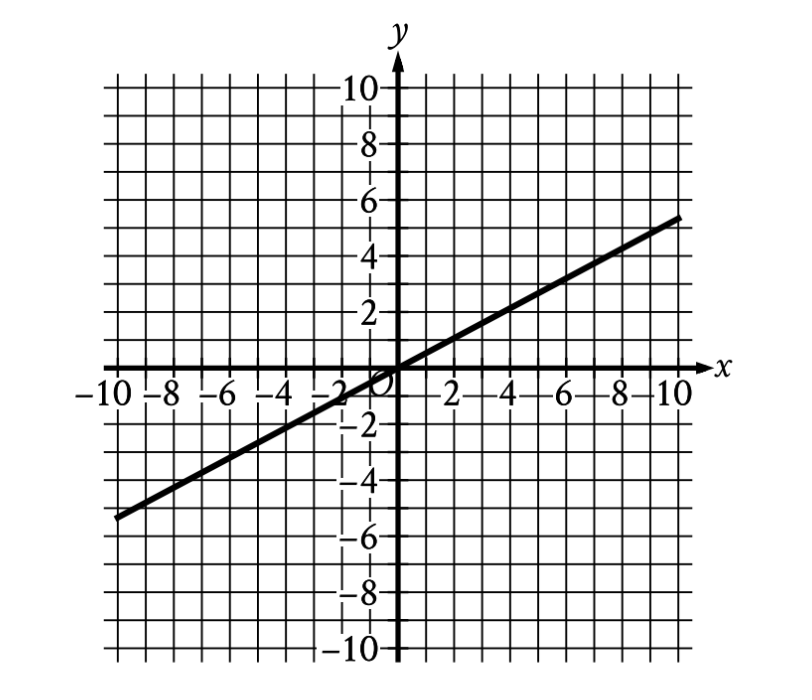
The graph of function f is shown, where \(\mathrm{y=f(x)}\).
Which of the following describes function f?
Increasing linear
Decreasing linear
Increasing exponential
Decreasing exponential
1. VISUALIZE the graph's direction
First, look at how the line behaves as you move from left to right (as x increases):
- Trace the line with your finger from left to right:
- Starting point (left side): approximately \((-8, -5)\)
- Middle point: \((0, 0)\)
- Ending point (right side): approximately \((10, 6)\)
- What do you notice?
- The line is going upward as you move from left to right
- The y-values are getting larger as x gets larger
2. INFER what the direction tells you
- When a graph goes upward from left to right, this means:
- As x increases, \(\mathrm{f(x)}\) also increases
- This is the definition of an increasing function
- When a graph goes downward from left to right, this would mean:
- As x increases, \(\mathrm{f(x)}\) decreases
- That would be a decreasing function
Our graph goes upward → This is an INCREASING function
This eliminates choices B and D (both say "decreasing").
3. VISUALIZE the graph's shape
Now look at the shape of the graph:
- Is it a straight line or curved?
- This graph is a straight line
- It doesn't bend or curve at all
4. INFER what the shape tells you
- Straight line = Linear function
- A straight line has a constant rate of change (same slope everywhere)
- This is the definition of a linear function
- Curved line = Exponential function
- Exponential functions like \(\mathrm{f(x)} = 2^x\) create curves
- They don't have constant rate of change
- The graph gets steeper and steeper (or flatter and flatter)
Our graph is straight → This is a LINEAR function
This eliminates choice C (which says "exponential").
5. Combine your findings
- Direction: INCREASING ✓
- Shape: LINEAR ✓
Answer: A (Increasing linear)
Why Students Usually Falter on This Problem
Most Common Error Path:
Weak VISUALIZE or INFER skills: Students sometimes confuse the direction by reading the graph incorrectly or misremembering what "increasing" means.
Some students focus on the negative y-values on the left side of the graph and think "negative numbers means decreasing." But "increasing" doesn't mean "positive"—it means getting larger as you move left to right. The function goes from -5 to 0 to +6, which is increasing (even though part of it is negative).
This confusion may lead them to select Choice B (Decreasing linear) or Choice D (Decreasing exponential).
Second Most Common Error:
Conceptual confusion about exponential vs. linear: Students may not clearly remember what distinguishes linear from exponential functions graphically.
They might know that exponential functions can increase, and they see this graph increasing, so they think "exponential" without checking whether the graph is straight or curved. The key visual difference is: linear = straight line, exponential = curved line.
This may lead them to select Choice C (Increasing exponential).
The Bottom Line:
This problem tests your ability to extract two pieces of information from a graph: (1) direction (increasing vs. decreasing by reading left to right), and (2) type (linear vs. exponential by checking if it's straight or curved). The most successful approach is to answer each question separately, then combine them.
Increasing linear
Decreasing linear
Increasing exponential
Decreasing exponential