
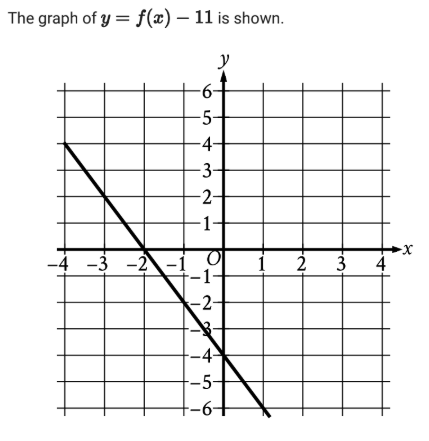
The graph of \(\mathrm{y = f(x) - 11}\) is shown. Which equation defines the linear function f?
GMAT Algebra : (Alg) Questions
The graph of \(\mathrm{y = f(x) - 11}\) is shown. Which equation defines the linear function \(\mathrm{f}\)?
\(\mathrm{f(x) = -13x - 11}\)
\(\mathrm{f(x) = -2x + 7}\)
\(\mathrm{f(x) = -13x + 7}\)
\(\mathrm{f(x) = -2x - 11}\)
1. TRANSLATE the graph information
The key insight here is recognizing what you're looking at: The graph shows y = f(x) - 11, NOT the graph of f(x) itself.
Your first task: Find the equation of the line that IS shown.
- TRANSLATE coordinates from the graph:
- Point 1: (-2, 0)
- Point 2: (-1, -2)
- Point 3: (0, -4)
2. Calculate the slope of the shown line
Using any two points, apply the slope formula. Let's use (-1, -2) and (0, -4):
\(\mathrm{m = \frac{y_2 - y_1}{x_2 - x_1}}\)
\(\mathrm{m = \frac{-4 - (-2)}{0 - (-1)}}\)
\(\mathrm{m = \frac{-2}{1}}\)
\(\mathrm{m = -2}\)
3. Identify the y-intercept
The line crosses the y-axis at the point (0, -4).
Therefore, b = -4
4. Write the equation of the shown line
Using \(\mathrm{y = mx + b}\):
\(\mathrm{y = -2x + (-4)}\)
\(\mathrm{y = -2x - 4}\)
This is the equation of the line you see in the graph.
5. INFER the relationship to find f(x)
Here's the crucial strategic thinking: The graph shows \(\mathrm{y = f(x) - 11}\), and we just found that this graph has equation \(\mathrm{y = -2x - 4}\).
Therefore:
\(\mathrm{f(x) - 11 = -2x - 4}\)
6. SIMPLIFY to solve for f(x)
\(\mathrm{f(x) - 11 = -2x - 4}\)
Add 11 to both sides:
\(\mathrm{f(x) = -2x - 4 + 11}\)
\(\mathrm{f(x) = -2x + 7}\)
Answer: B. f(x) = -2x + 7
Verification Check:
If \(\mathrm{f(x) = -2x + 7}\), then \(\mathrm{f(x) - 11 = -2x + 7 - 11 = -2x - 4}\) ✓
This matches our line!
Why Students Usually Falter on This Problem
Most Common Error Path:
Weak TRANSLATE skill: Misunderstanding what the graph represents
Students often think the graph shows f(x) directly, forgetting that it actually shows f(x) - 11. They find the equation y = -2x - 4 from the graph and then incorrectly conclude that f(x) = -2x - 4.
This leads them to select Choice D (f(x) = -2x - 11) when they try to "match" their equation with answer choices by seeing the -11 and thinking it relates to the graph transformation, or it causes confusion and guessing among the choices.
Second Most Common Error:
Weak SIMPLIFY execution: Sign errors when solving for f(x)
Students correctly set up f(x) - 11 = -2x - 4, but make arithmetic errors when adding 11 to both sides. A common mistake is: -4 + 11 = -15 (incorrectly subtracting instead of recognizing this as adding a positive to a negative).
This incorrect simplification may lead them to select Choice A (f(x) = -13x - 11) if they combine errors, or more likely causes them to get confused and abandon their systematic approach.
The Bottom Line:
This problem tests whether students can distinguish between a function and its transformation. The critical moment is recognizing that finding the equation of the shown line is only the FIRST step-you must then work backwards to find f(x) by undoing the "-11" transformation. Students who treat the graph as showing f(x) directly will never arrive at the correct answer.
\(\mathrm{f(x) = -13x - 11}\)
\(\mathrm{f(x) = -2x + 7}\)
\(\mathrm{f(x) = -13x + 7}\)
\(\mathrm{f(x) = -2x - 11}\)