
The graph of \(\mathrm{y = h(x)}\) is shown in the xy-plane. What is the value of \(\mathrm{h(2)}\)?
GMAT Advanced Math : (Adv_Math) Questions
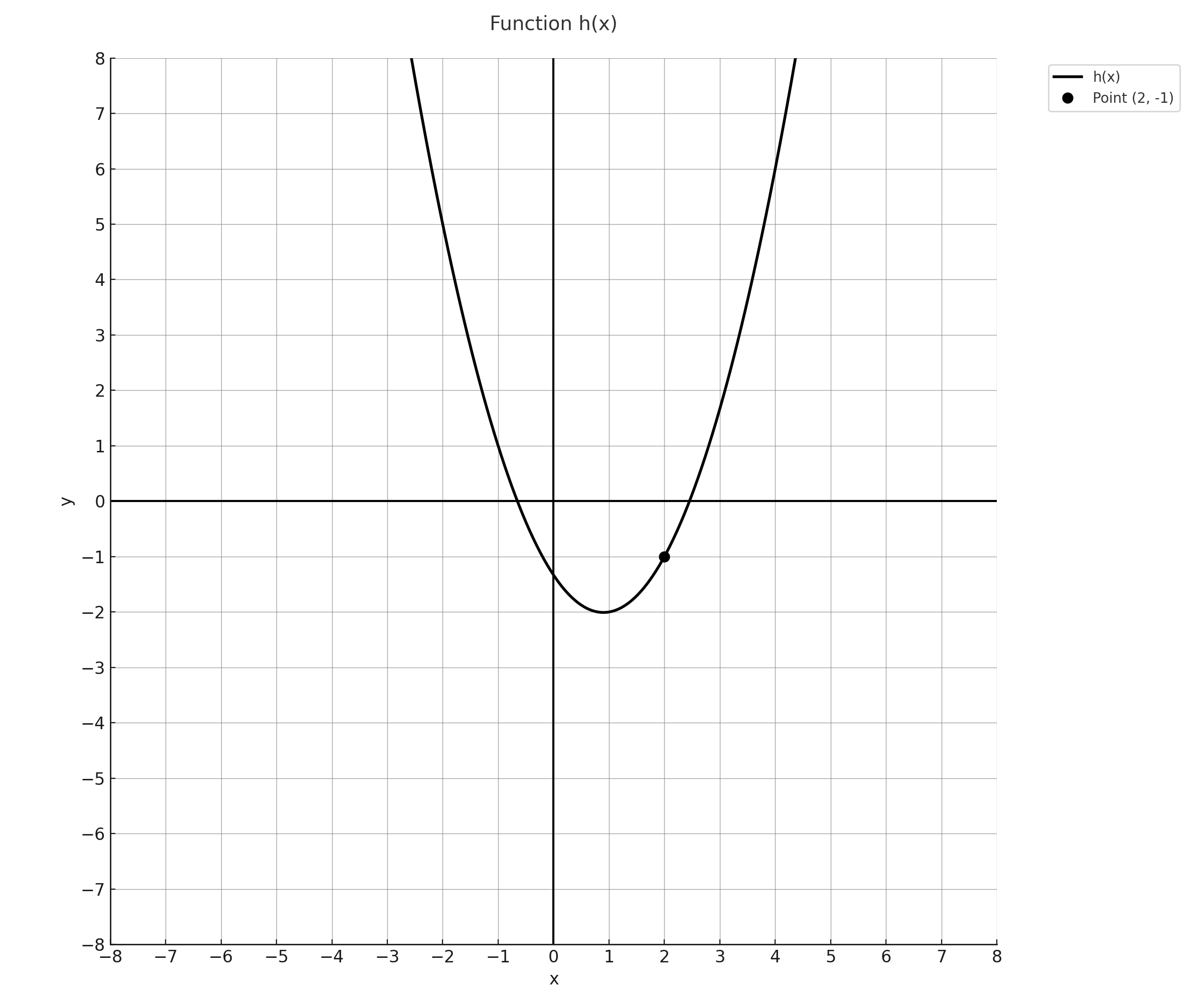
The graph of \(\mathrm{y = h(x)}\) is shown in the xy-plane. What is the value of \(\mathrm{h(2)}\)?
\(\mathrm{-3}\)
\(\mathrm{-1}\)
\(\mathrm{1}\)
\(\mathrm{2}\)
1. TRANSLATE the function notation
When you see \(\mathrm{h(2)}\), this is asking:
- What is the \(\mathrm{y}\)-value (output) when \(\mathrm{x = 2}\) (input)?
This is the key translation: \(\mathrm{h(2)}\) doesn't mean "multiply h by 2" - it means "evaluate the function h at \(\mathrm{x = 2}\)."
2. VISUALIZE the location on the graph
- Locate \(\mathrm{x = 2}\) on the horizontal axis
- Find the number 2 on the \(\mathrm{x}\)-axis
- Draw an imaginary vertical line at \(\mathrm{x = 2}\)
- This line goes straight up and down through \(\mathrm{x = 2}\)
- Find where this vertical line intersects the curve
- The curve crosses this vertical line at exactly one point
- Notice the point is marked on the graph
3. VISUALIZE and read the \(\mathrm{y}\)-coordinate
- Look horizontally from the intersection point to the \(\mathrm{y}\)-axis
- The point sits at height -1 on the vertical axis
- The graph confirms this is the point \(\mathrm{(2, -1)}\)
- The \(\mathrm{y}\)-coordinate is -1
4. State the answer
Since the point \(\mathrm{(2, -1)}\) is on the curve, this means:
- When \(\mathrm{x = 2}\), \(\mathrm{y = -1}\)
- Therefore, \(\mathrm{h(2) = -1}\)
Answer: B) -1
Why Students Usually Falter on This Problem
Most Common Error Path:
TRANSLATE failure: Confusion about function notation
Some students see \(\mathrm{h(2)}\) and don't understand what it's asking for. They might:
- Think it means "2h" or some multiplication
- Not realize they need to find a \(\mathrm{y}\)-value
- Look for "h" somewhere on the graph instead of understanding h is the function itself
This leads to confusion and guessing among the answer choices.
Second Most Common Error:
VISUALIZE error: Reading the wrong coordinate
Students correctly locate the point \(\mathrm{(2, -1)}\) but then:
- Report the \(\mathrm{x}\)-coordinate instead of the \(\mathrm{y}\)-coordinate, thinking "the answer must be 2"
- This may lead them to select Choice D (2)
Alternatively, students might misread the grid:
- Miscount the gridlines or read from the wrong scale
- Confuse positive and negative, potentially reading +1 instead of -1
- This may lead them to select Choice C (1)
The Bottom Line:
This problem tests two fundamental skills: understanding what function notation asks you to find, and accurately reading coordinates from a graph. The notation \(\mathrm{h(2)}\) is pure translation - it tells you to find the output (\(\mathrm{y}\)-value) for input \(\mathrm{x = 2}\). Once you know what you're looking for, it's just careful graph reading with attention to which axis measures what.
\(\mathrm{-3}\)
\(\mathrm{-1}\)
\(\mathrm{1}\)
\(\mathrm{2}\)