
The graph models the relationship between the number of T-shirts, x, and the number of sweatshirts, y, that Kira can...
GMAT Algebra : (Alg) Questions
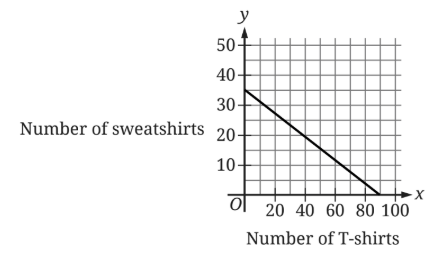
The graph models the relationship between the number of T-shirts, \(\mathrm{x}\), and the number of sweatshirts, \(\mathrm{y}\), that Kira can purchase for a school fundraiser. Which equation could represent this relationship?
\(\mathrm{y = 7x + 18}\)
\(\mathrm{7x + 18y = 630}\)
\(\mathrm{y = 18x + 7}\)
\(\mathrm{18x + 7y = 630}\)
1. TRANSLATE the graph information
Looking at the graph, we need to identify two clear points on the line:
- Point 1 (y-intercept): Where the line crosses the y-axis at \(x = 0\)
The line crosses at \(y = 35\), so the point is \((0, 35)\) - Point 2 (x-intercept): Where the line crosses the x-axis at \(y = 0\)
The line crosses at \(x = 90\), so the point is \((90, 0)\)
2. INFER what equation form to use first
Since we have two points, we can find the slope and then use slope-intercept form \((y = mx + b)\). The y-intercept is already visible as 35.
3. SIMPLIFY to find the slope
Using the slope formula with \((0, 35)\) and \((90, 0)\):
\(m = \frac{y_2 - y_1}{x_2 - x_1}\)
\(m = \frac{0 - 35}{90 - 0}\)
\(m = \frac{-35}{90}\)
Reduce the fraction: \(\frac{-35}{90} = \frac{-7}{18}\)
4. Write the equation in slope-intercept form
We have:
- Slope: \(m = \frac{-7}{18}\)
- Y-intercept: \(b = 35\)
Therefore: \(y = \frac{-7}{18}x + 35\)
5. INFER that we need to convert forms
Looking at the answer choices, none are in slope-intercept form. Choices B and D are in standard form \((Ax + By = C)\). We need to convert our equation.
6. SIMPLIFY by converting to standard form
Starting with: \(y = \frac{-7}{18}x + 35\)
Multiply both sides by 18 to eliminate the fraction:
\(18y = -7x + 630\)
Add \(7x\) to both sides to get standard form:
\(7x + 18y = 630\)
7. TRANSLATE back to verify
Check if our equation works with the original points:
- Point \((0, 35)\): \(7(0) + 18(35) = 0 + 630 = 630\) ✓
- Point \((90, 0)\): \(7(90) + 18(0) = 630 + 0 = 630\) ✓
Answer: B. \(7x + 18y = 630\)
Why Students Usually Falter on This Problem
Most Common Error Path:
Process Skill Error (Weak TRANSLATE): Misreading the intercepts from the graph
Students may misidentify the coordinates, particularly:
- Reading the y-intercept as \((0, 30)\) instead of \((0, 35)\)
- Reading the x-intercept as \((80, 0)\) or \((100, 0)\) instead of \((90, 0)\)
This leads to calculating an incorrect slope and equation that doesn't match any answer choice, causing confusion and guessing.
Second Most Common Error:
Process Skill Error (Inadequate SIMPLIFY execution): Stopping at slope-intercept form without converting
Students correctly derive \(y = \frac{-7}{18}x + 35\) but don't realize they need to convert this to standard form to match the answer choices. They look at the options, don't see their equation, and either:
- Guess randomly among the choices
- Try to "force fit" by assuming Choice A or C might work since they're simpler
- Make arithmetic errors while trying to verify choices
This leads to confusion and guessing, or potentially selecting Choice A \((y = 7x + 18)\) because it has the numbers 7 and 18 from their correct slope.
Third Common Error:
Process Skill Error (Weak SIMPLIFY): Making sign errors during conversion
Students may correctly identify the slope as \(\frac{-7}{18}\) but make errors when converting to standard form:
- Forgetting to add \(7x\) to both sides (leaving it as \(18y = -7x + 630\))
- Placing coefficients on the wrong variables
- Getting \(18x + 7y = 630\) instead of \(7x + 18y = 630\)
This may lead them to select Choice D \((18x + 7y = 630)\), which has the coefficients swapped.
The Bottom Line:
This problem tests multiple skills in sequence: accurate graph reading, calculating slope, understanding equation forms, and algebraic manipulation. Students often succeed at one or two stages but fail to complete the full process, particularly the conversion from slope-intercept to standard form.
\(\mathrm{y = 7x + 18}\)
\(\mathrm{7x + 18y = 630}\)
\(\mathrm{y = 18x + 7}\)
\(\mathrm{18x + 7y = 630}\)