
The graph of the linear function \(\mathrm{y=f(x)+19}\) is shown. If c and d are positive constants, which equation could define...
GMAT Algebra : (Alg) Questions
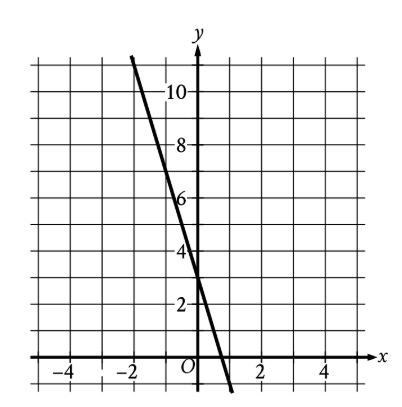
The graph of the linear function \(\mathrm{y=f(x)+19}\) is shown. If c and d are positive constants, which equation could define f?
\(\mathrm{f(x) = -d - cx}\)
\(\mathrm{f(x) = d - cx}\)
\(\mathrm{f(x) = -d + cx}\)
\(\mathrm{f(x) = d + cx}\)
1. TRANSLATE the graph information
Given information:
- The graph shows \(\mathrm{y = f(x) + 19}\) (not \(\mathrm{f(x)}\) directly!)
- The y-intercept appears to be at \(\mathrm{(0, 3)}\)
- The line slopes downward from left to right
- c and d are positive constants
What this tells us:
- We're looking at a transformed version of \(\mathrm{f(x)}\)
- The slope is negative (downward slant)
2. INFER the relationship between the graphs
Key insight: If \(\mathrm{y = f(x) + 19}\) is shown, then:
- Every point on this graph is 19 units HIGHER than the corresponding point on \(\mathrm{y = f(x)}\)
- To find \(\mathrm{f(x)}\), we need to mentally shift this graph DOWN by 19 units
- The slope stays the same (vertical shifts don't affect slope)
3. SIMPLIFY to find the y-intercept of f(x)
The y-intercept of \(\mathrm{y = f(x) + 19}\) is at \(\mathrm{(0, 3)}\), which means:
- When \(\mathrm{x = 0}\): \(\mathrm{f(0) + 19 = 3}\)
- Subtract 19 from both sides: \(\mathrm{f(0) = 3 - 19 = -16}\)
So f(x) has a y-intercept of -16 (negative!)
4. INFER the slope of f(x)
Since vertical translation doesn't change slope:
- \(\mathrm{y = f(x) + 19}\) has negative slope (we can see this)
- Therefore \(\mathrm{f(x)}\) also has negative slope
So f(x) has a negative slope
5. INFER which form matches these requirements
We need an equation where:
- The y-intercept is negative
- The slope is negative
- Using only positive constants c and d
Looking at the structure \(\mathrm{f(x) = (y\text{-}intercept) + (slope)x}\):
- For negative y-intercept from positive d: we need -d
- For negative slope from positive c: we need -cx
Therefore: \(\mathrm{f(x) = -d - cx}\)
Answer: A
Why Students Usually Falter on This Problem
Most Common Error Path:
Weak INFER skill: Students forget that the graph shows \(\mathrm{y = f(x) + 19}\), not \(\mathrm{f(x)}\) itself. They read the y-intercept as 3 directly from the graph and think \(\mathrm{f(x)}\) must have a positive y-intercept.
Since d is positive, they incorrectly think they need \(\mathrm{+d}\) for the y-intercept. But they correctly see the slope is negative, so they use \(\mathrm{-cx}\).
This may lead them to select Choice B (\(\mathrm{f(x) = d - cx}\)).
Second Most Common Error:
Incomplete INFER reasoning: Students correctly determine that \(\mathrm{f(x)}\) needs a negative y-intercept (\(\mathrm{-d}\)), but they confuse the direction of the slope visually. They might misread the downward slant or think "going down" means the x-coefficient should be positive.
They choose \(\mathrm{-d}\) for the y-intercept but \(\mathrm{+cx}\) for the slope term.
This may lead them to select Choice C (\(\mathrm{f(x) = -d + cx}\)).
The Bottom Line:
This problem tests whether you can track through a transformation (the "+19") and correctly identify BOTH the sign of the y-intercept AND the sign of the slope after accounting for that transformation. The constraint that c and d are positive adds an extra layer - you must use negative signs to create negative values.
\(\mathrm{f(x) = -d - cx}\)
\(\mathrm{f(x) = d - cx}\)
\(\mathrm{f(x) = -d + cx}\)
\(\mathrm{f(x) = d + cx}\)