
The graph of function g is shown, where \(\mathrm{y = g(x)}\). Which of the following best describes function g?
GMAT Problem-Solving and Data Analysis : (PS_DA) Questions
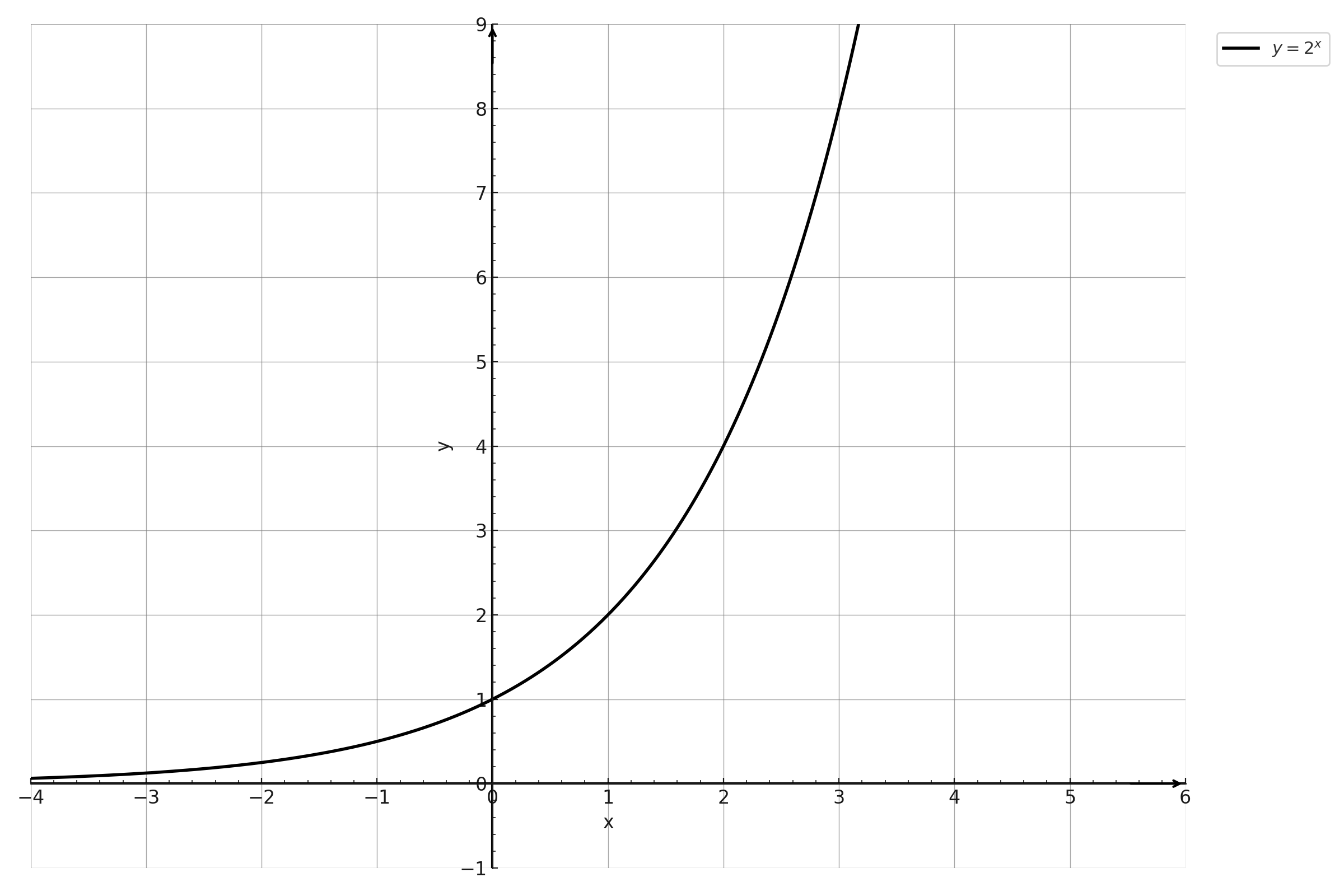
The graph of function g is shown, where \(\mathrm{y = g(x)}\). Which of the following best describes function g?
1. VISUALIZE the key graph features
Looking at the graph, I need to identify important characteristics:
- Point \(\mathrm{(0, 1)}\): The curve passes through this point on the y-axis
- Direction: The curve moves upward from left to right
- Rate of change: The curve increases slowly on the left, then more and more rapidly on the right
- Asymptotic behavior: As x goes far to the left (negative), the curve approaches \(\mathrm{y = 0}\) but never touches it
2. INFER whether this is increasing or decreasing
Since the curve moves upward as we read from left to right, this is an increasing function.
This immediately eliminates:
- Choice (B) Decreasing exponential
- Choice (D) Decreasing polynomial
Now I'm choosing between (A) Increasing exponential and (C) Increasing polynomial.
3. INFER whether this is exponential or polynomial
This is the critical distinction. Let me look at the growth pattern:
Evidence for exponential:
- The curve passes through \(\mathrm{(0, 1)}\), which is characteristic of \(\mathrm{y = 2^x}\) since \(\mathrm{2^0 = 1}\)
- The rate of increase itself increases - this is multiplicative growth
- The curve has a horizontal asymptote at \(\mathrm{y = 0}\) (approaches but never touches)
- The shape shows the classic exponential "J-curve" - starts nearly flat, then rises steeply
Why not polynomial:
- Polynomial functions don't have horizontal asymptotes
- Polynomial growth is additive not multiplicative
- Even though some polynomials increase, they have different curvature patterns
The growth pattern here shows that equal increases in x lead to proportional (multiplicative) increases in y, which is the hallmark of exponential functions.
4. Select the answer
Based on:
- Function is increasing (eliminates B and D)
- Function shows exponential growth pattern (eliminates C)
Answer: (A) Increasing exponential
Why Students Usually Falter on This Problem
Most Common Error Path:
Weak INFER skill - Cannot distinguish exponential from polynomial growth:
Students recognize that the function is increasing but cannot differentiate between exponential and polynomial growth patterns. They see a curve that goes up and think "any increasing curve could be polynomial" without recognizing the distinctive characteristics:
- Exponential functions have constant percentage growth rates
- The "J-curve" shape with horizontal asymptote
- The multiplicative vs additive nature of growth
Without this distinction, students may think an increasing curve automatically could be polynomial since polynomials can also increase.
This may lead them to select Choice C (Increasing polynomial).
Second Most Common Error:
Missing conceptual knowledge - Doesn't remember that exponential functions pass through \(\mathrm{(0,1)}\):
Students who don't recall that \(\mathrm{y = a^x}\) functions (when a > 0) always equal 1 when \(\mathrm{x = 0}\) miss a key diagnostic feature. The point \(\mathrm{(0, 1)}\) is a strong indicator of exponential form \(\mathrm{y = b^x}\). Without recognizing this clue, students lose a quick way to identify the function type and may focus only on whether it's increasing or decreasing, leading to confusion between options A and C.
This causes them to get stuck and guess between the two increasing options.
The Bottom Line:
The core challenge is distinguishing exponential from polynomial growth when both can produce increasing curves. Success requires recognizing the unique signature of exponential functions: the accelerating rate of change, the horizontal asymptote, and the point \(\mathrm{(0,1)}\). Students who only focus on "increasing vs decreasing" complete half the problem but miss the more subtle classification between function types.