
The graph of a system of linear equations is shown in the xy-plane. If \(\mathrm{(x, y)}\) is the solution to...
GMAT Algebra : (Alg) Questions
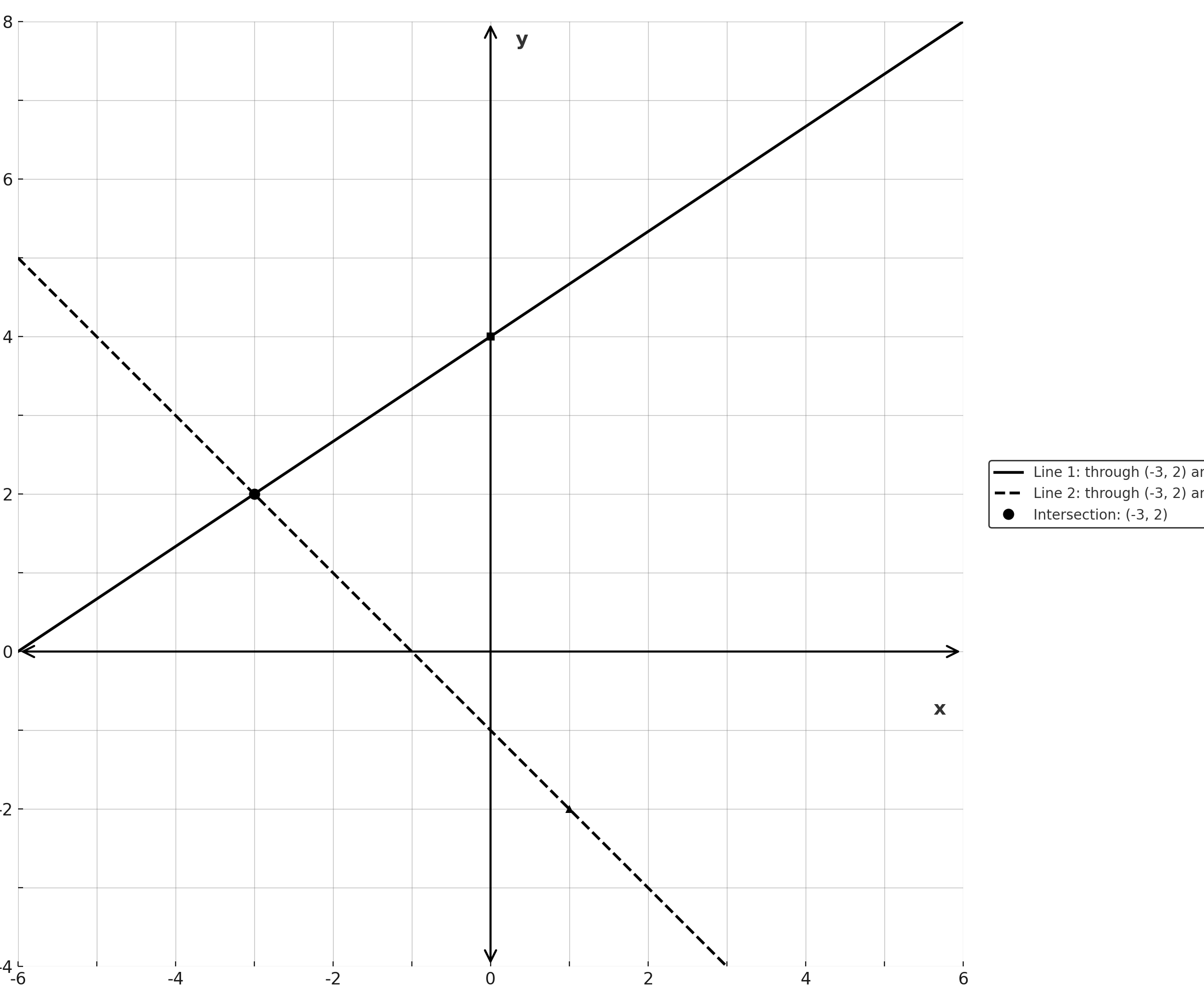
The graph of a system of linear equations is shown in the xy-plane. If \(\mathrm{(x, y)}\) is the solution to the system, what is the value of \(\mathrm{x + 2y}\)?
1. TRANSLATE the problem information
- The problem asks us to find the value of \(\mathrm{x + 2y}\)
- We need to first find \(\mathrm{(x, y)}\), which is the solution to the system of linear equations shown
- Key insight: The solution to a system is where the two lines cross
2. TRANSLATE the intersection point from the graph
- Locate where the solid line and dashed line intersect
- To find the x-coordinate: Look straight down from the intersection point to the x-axis
- The intersection is at \(\mathrm{x = -3}\)
- To find the y-coordinate: Look straight across from the intersection point to the y-axis
- The intersection is at \(\mathrm{y = 2}\)
- Therefore, the solution is \(\mathrm{(x, y) = (-3, 2)}\)
- Note: The graph legend confirms this: "Intersection: (-3, 2)"
3. SIMPLIFY by substituting and evaluating
- Substitute \(\mathrm{x = -3}\) and \(\mathrm{y = 2}\) into the expression \(\mathrm{x + 2y}\):
- \(\mathrm{x + 2y = (-3) + 2(2)}\)
- Follow order of operations (multiply first):
- \(\mathrm{= (-3) + 4}\)
- Add the numbers:
- \(\mathrm{= 1}\)
Answer: B (1)
Why Students Usually Falter on This Problem
Most Common Error Path:
Weak TRANSLATE skill: Students mix up the x and y coordinates when reading from the graph
Many students correctly locate the intersection point but then reverse the coordinates, reading it as \(\mathrm{(2, -3)}\) instead of \(\mathrm{(-3, 2)}\). This happens because they don't systematically look down to the x-axis for the x-coordinate and across to the y-axis for the y-coordinate.
If they use \(\mathrm{(2, -3)}\):
\(\mathrm{x + 2y = (2) + 2(-3)}\)
\(\mathrm{= 2 + (-6)}\)
\(\mathrm{= 2 - 6}\)
\(\mathrm{= -4}\)
This doesn't match any answer choice exactly, leading to confusion and guessing. However, if they make additional errors in calculation, they might arrive at Choice A (-1).
Second Most Common Error:
Poor SIMPLIFY execution: Students make arithmetic errors with negative numbers
Some students correctly identify the intersection as \(\mathrm{(-3, 2)}\) but then make calculation errors:
- Forgetting the negative sign: treating \(\mathrm{-3}\) as \(\mathrm{3}\), giving \(\mathrm{3 + 4 = 7}\) (not an option)
- Forgetting to multiply: calculating \(\mathrm{-3 + 2 + 2 = 1}\) (correct by accident)
- Sign errors: calculating \(\mathrm{-3 + 2 × 2 = -3 - 4 = -7}\) (treating multiplication result as negative)
These arithmetic mistakes can lead to selecting Choice A (-1) or cause confusion that leads to guessing.
The Bottom Line:
This problem tests your ability to accurately read graphical information and work carefully with negative numbers. The key is to be systematic: identify the intersection point, carefully read both coordinates with attention to signs, and methodically apply order of operations when evaluating the expression.