
The graph of a system of a linear equation and a nonlinear equation is shown. What is the solution to...
GMAT Advanced Math : (Adv_Math) Questions
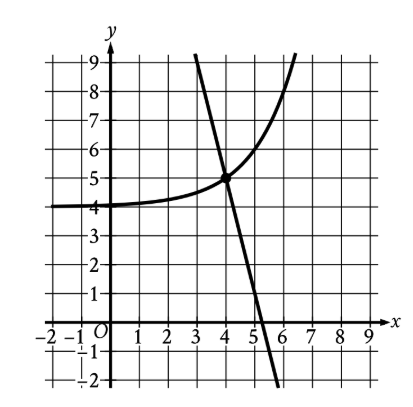
The graph of a system of a linear equation and a nonlinear equation is shown. What is the solution to this system?
1. INFER what the question is really asking
The problem shows you two graphs and asks for "the solution to this system." Here's the critical insight: the solution to a system of equations is the point (or points) where the graphs intersect.
Why? Because at an intersection point, that \((x, y)\) pair satisfies BOTH equations simultaneously - it lies on both graphs. That's exactly what a solution to a system means!
2. TRANSLATE the visual information
- Identify what you're looking at:
- One graph is a straight line (the linear equation)
- One graph is a U-shaped curve (the nonlinear equation - a parabola)
- INFER what to find:
- Look for where these two graphs cross each other
- They intersect at exactly one point
3. TRANSLATE the intersection point to an ordered pair
- Locate the intersection point on the graph
- Read the x-coordinate carefully:
- Find the vertical line through the intersection point
- Trace down to the x-axis
- The value is \(\mathrm{x = 4}\)
- Read the y-coordinate carefully:
- Find the horizontal line through the intersection point
- Trace left to the y-axis
- The value is \(\mathrm{y = 5}\)
- Write as an ordered pair: \((4, 5)\)
Answer: C. \((4, 5)\)
Why Students Usually Falter on This Problem
Most Common Error Path:
Weak INFER skill - Missing conceptual knowledge about graphical solutions: Students may not understand that the intersection point IS the solution. Instead, they might think the solution is:
- Any point on either graph
- A special point like where a graph crosses an axis
- The y-intercept of one of the graphs
Without knowing that "solution = intersection," they might look at the parabola crossing the y-axis at \((0, 4)\) and think that looks important. This may lead them to select Choice B \((0, 4)\) because it's a prominent point on the graph, even though it's not where the two graphs meet.
Second Most Common Error:
Poor TRANSLATE reasoning - Careless coordinate reading: Students who understand that they need the intersection point but don't read carefully might:
- Mix up which coordinate is x and which is y (though this particular error doesn't match any wrong answer choice here)
- Miscount grid lines, being off by one square
- Read coordinates from a point near but not at the intersection
This leads to confusion when their coordinates don't match any answer choice, causing them to second-guess their approach and potentially guess randomly.
The Bottom Line:
This problem has a conceptual barrier (knowing intersection = solution) AND an execution barrier (reading coordinates accurately). Students can fail at either stage. The trickiest part is that other answer choices represent "mathematically significant" points - like \((0, 4)\) being the y-intercept of the parabola, or \((0, 0)\) being the origin - which can distract students who don't have a firm grasp of what "solution to a system" means graphically.