
The graph of y = ax^2 - 12x + c is shown in the xy-plane, where a and c are...
GMAT Advanced Math : (Adv_Math) Questions
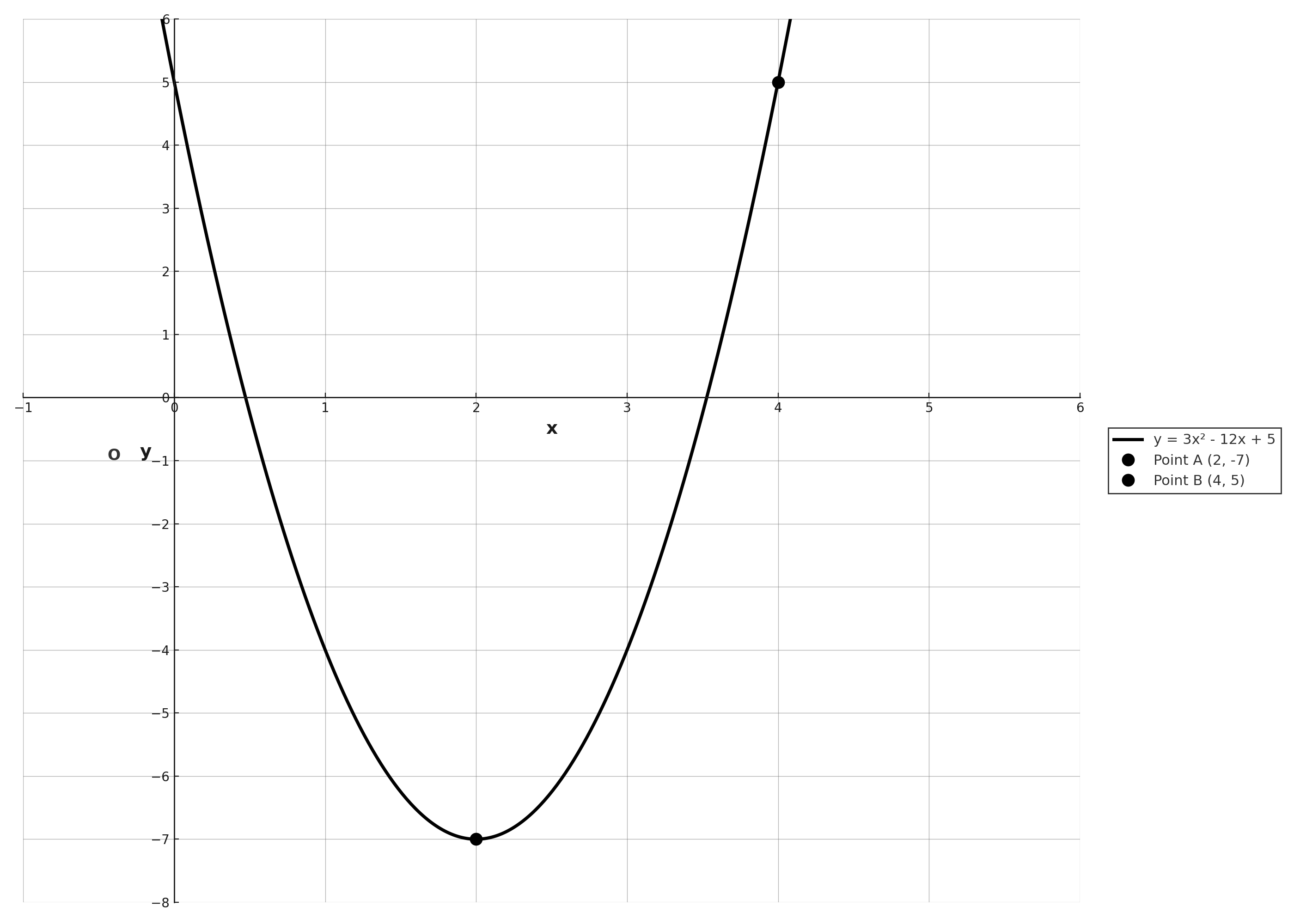
The graph of \(\mathrm{y = ax^2 - 12x + c}\) is shown in the xy-plane, where \(\mathrm{a}\) and \(\mathrm{c}\) are constants. What is the value of \(\mathrm{a + c}\)?
1. TRANSLATE the graph information into mathematical values
From the graph, identify key points:
- Point A (2, -7): This is marked as the vertex of the parabola
- Point B (4, 5): Another point the parabola passes through
- Given equation: \(\mathrm{y = ax^2 - 12x + c}\) (where \(\mathrm{b = -12}\))
2. INFER the solution strategy
Here's the key insight: We have one equation with two unknowns (\(\mathrm{a}\) and \(\mathrm{c}\)), but we have TWO pieces of information from the graph:
- The vertex location gives us information about 'a'
- A point on the curve gives us information about 'c'
Strategy:
- First, use the vertex x-coordinate to find 'a'
- Then, use any point on the parabola to find 'c'
3. SIMPLIFY to find 'a' using the vertex formula
For any parabola \(\mathrm{y = ax^2 + bx + c}\), the x-coordinate of the vertex is:
\(\mathrm{x = \frac{-b}{2a}}\)
Substitute \(\mathrm{b = -12}\):
\(\mathrm{x = \frac{-(-12)}{2a} = \frac{12}{2a}}\)
Since the vertex is at \(\mathrm{x = 2}\):
\(\mathrm{2 = \frac{12}{2a}}\)
Multiply both sides by \(\mathrm{2a}\):
\(\mathrm{4a = 12}\)
Divide by 4:
\(\mathrm{a = 3}\)
4. SIMPLIFY to find 'c' using Point B
Now we know: \(\mathrm{y = 3x^2 - 12x + c}\)
Substitute the coordinates of Point B (4, 5):
\(\mathrm{5 = 3(4)^2 - 12(4) + c}\)
Calculate step by step:
\(\mathrm{5 = 3(16) - 48 + c}\)
\(\mathrm{5 = 48 - 48 + c}\)
\(\mathrm{5 = 0 + c}\)
\(\mathrm{c = 5}\)
5. Calculate the final answer
The question asks for \(\mathrm{a + c}\):
\(\mathrm{a + c = 3 + 5 = 8}\)
Answer: 8
Why Students Usually Falter on This Problem
Most Common Error Path:
Weak TRANSLATE skill: Misidentifying which point is the vertex
Many students might not recognize that Point A (2, -7) is the vertex, or they might confuse it with just another point on the parabola. Some students try to use Point B (4, 5) as the vertex instead.
If they incorrectly use \(\mathrm{x = 4}\) as the vertex x-coordinate:
\(\mathrm{4 = \frac{12}{2a}}\)
\(\mathrm{8a = 12}\)
\(\mathrm{a = 1.5}\)
Then using point (2, -7):
\(\mathrm{-7 = 1.5(4) - 24 + c}\)
\(\mathrm{-7 = 6 - 24 + c}\)
\(\mathrm{-7 = -18 + c}\)
\(\mathrm{c = 11}\)
This gives \(\mathrm{a + c = 1.5 + 11 = 12.5}\), leading to confusion when this doesn't match expected integer answers.
Second Most Common Error:
Poor SIMPLIFY execution: Arithmetic errors when substituting Point B
When evaluating \(\mathrm{5 = 3(4)^2 - 12(4) + c}\), students often make sign errors or calculation mistakes:
Common mistake:
\(\mathrm{5 = 3(16) - 12(4) + c}\)
\(\mathrm{5 = 48 - 12 + c}\) (forgetting to multiply 12 × 4)
\(\mathrm{5 = 36 + c}\)
\(\mathrm{c = -31}\)
This leads to \(\mathrm{a + c = 3 + (-31) = -28}\), a completely wrong answer.
The Bottom Line:
This problem tests whether students can bridge the gap between visual graph information and algebraic formulas. The critical insight is recognizing that the vertex provides special information (through the vertex formula) that's different from just any point on the parabola. Without correctly identifying and using the vertex, the solution path becomes unclear or impossible.