
The graph of \(\mathrm{y = f(x - 5)}\) is shown above. Which of the following equations defines function f?
GMAT Algebra : (Alg) Questions
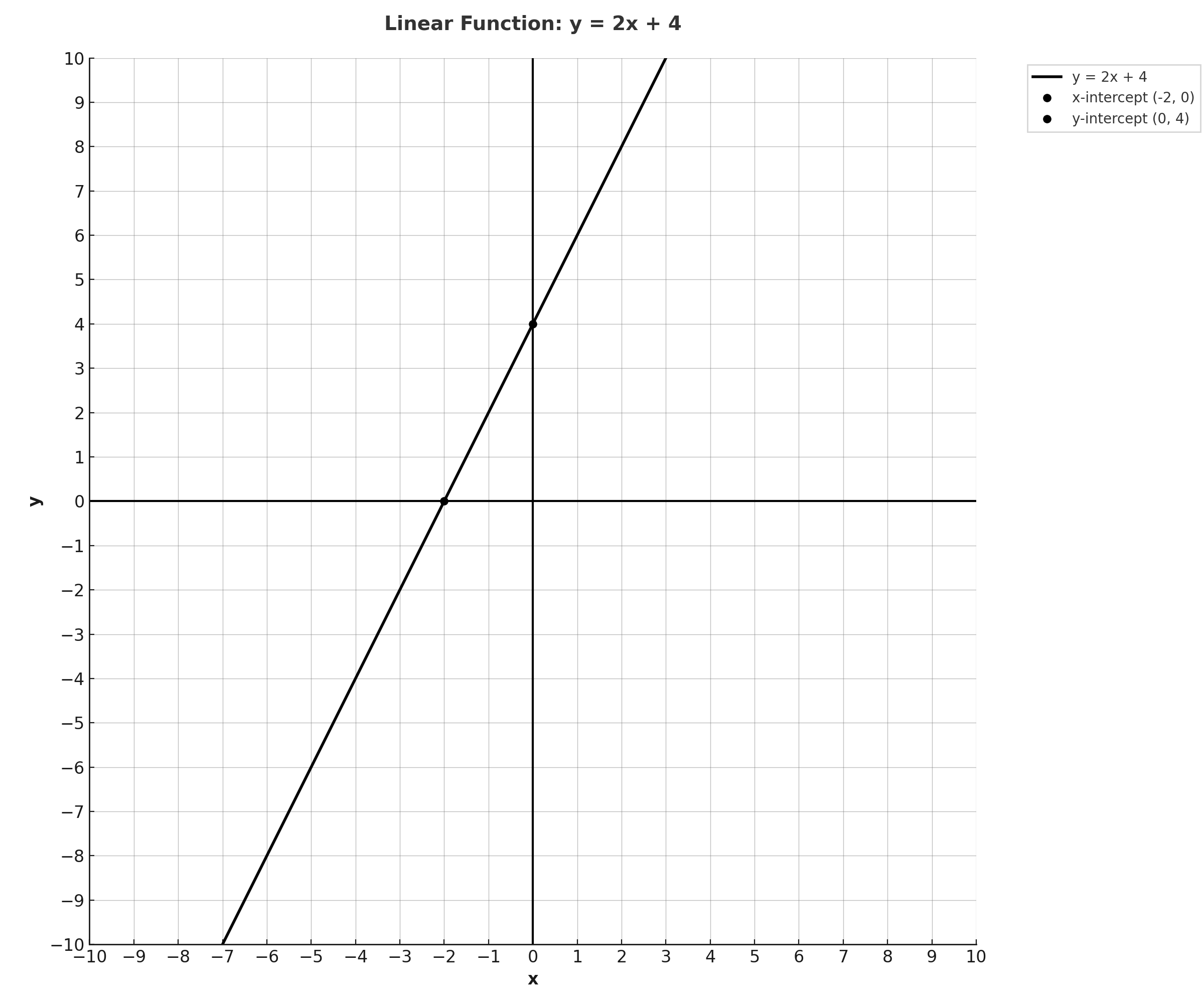
The graph of \(\mathrm{y = f(x - 5)}\) is shown above. Which of the following equations defines function \(\mathrm{f}\)?
1. TRANSLATE the graph into an equation
First, we need to find the equation of the line shown in the graph.
- Identify two clear points on the line:
- x-intercept: \((-2, 0)\)
- y-intercept: \((0, 4)\)
- Calculate the slope:
- \(\mathrm{m} = \frac{\mathrm{y_2 - y_1}}{\mathrm{x_2 - x_1}} = \frac{4 - 0}{0 - (-2)} = \frac{4}{2} = 2\)
- Identify the y-intercept:
- \(\mathrm{b} = 4\) (where the line crosses the y-axis)
- Write the equation:
- The line shown is \(\mathrm{y} = 2\mathrm{x} + 4\)
2. TRANSLATE the problem statement
The problem tells us "the graph of \(\mathrm{y} = \mathrm{f(x - 5)}\) is shown."
This means: \(\mathrm{f(x - 5)} = 2\mathrm{x} + 4\)
This is crucial! The graph doesn't show \(\mathrm{f(x)}\) directly—it shows what happens when we input \(\mathrm{x} - 5\) into function f.
3. INFER the strategy to find f(x)
We have \(\mathrm{f(x - 5)} = 2\mathrm{x} + 4\), but we need \(\mathrm{f(x)}\).
Key strategic insight: Use substitution to "undo" the transformation.
- Let \(\mathrm{u} = \mathrm{x} - 5\)
- This means \(\mathrm{x} = \mathrm{u} + 5\)
- Wherever we see x in our equation, replace it with \(\mathrm{u} + 5\)
4. SIMPLIFY using substitution
Starting with: \(\mathrm{f(x - 5)} = 2\mathrm{x} + 4\)
Since \(\mathrm{u} = \mathrm{x} - 5\), we have \(\mathrm{x} = \mathrm{u} + 5\), so:
\(\mathrm{f(u)} = 2(\mathrm{u} + 5) + 4\)
Expand:
- \(\mathrm{f(u)} = 2\mathrm{u} + 10 + 4\)
- \(\mathrm{f(u)} = 2\mathrm{u} + 14\)
Since u is just a placeholder variable, we can write:
\(\mathrm{f(x)} = 2\mathrm{x} + 14\)
5. Match with answer choices
Looking at our options, \(\mathrm{f(x)} = 2\mathrm{x} + 14\) is choice C.
Answer: C
Why Students Usually Falter on This Problem
Most Common Error Path:
Process Skill Gap - Weak TRANSLATE: Students may misinterpret what the problem is asking. They see the graph shows \(\mathrm{y} = 2\mathrm{x} + 4\) and think "that must be \(\mathrm{f(x)}\)!" They don't properly translate the statement "the graph of \(\mathrm{y} = \mathrm{f(x - 5)}\)" into the mathematical relationship \(\mathrm{f(x - 5)} = 2\mathrm{x} + 4\).
Without recognizing that the graph shows \(\mathrm{f(x - 5)}\), not \(\mathrm{f(x)}\), they immediately select Choice B (\(\mathrm{f(x)} = 2\mathrm{x} + 4\)) because it matches what they see on the graph.
This is the trap answer—it looks right if you miss the transformation in the problem statement.
Second Most Common Error:
Process Skill Gap - Weak INFER/SIMPLIFY: Students correctly identify that \(\mathrm{f(x - 5)} = 2\mathrm{x} + 4\), but then make errors in the substitution or algebraic manipulation.
Common mistakes include:
- Setting \(\mathrm{f(x)} = 2(\mathrm{x} - 5) + 4\), incorrectly thinking they should substitute \(\mathrm{x} - 5\) for x in the original equation, leading to \(\mathrm{f(x)} = 2\mathrm{x} - 10 + 4 = 2\mathrm{x} - 6\), which is Choice A
- Making arithmetic errors when expanding \(2(\mathrm{u} + 5) + 4\), possibly getting \(2\mathrm{u} + 6\) instead of \(2\mathrm{u} + 14\)
These algebraic errors cause students to select incorrect answer choices even though they understood the conceptual approach.
The Bottom Line:
This problem tests whether students can distinguish between a function and its transformation. The critical moment is recognizing that seeing "\(\mathrm{y} = \mathrm{f(x - 5)}\)" means the graph doesn't show the original function—it shows a modified version. Once that translation is clear, the rest is systematic algebra.