
The graph of \(\mathrm{y = g(x)}\) is shown on a coordinate plane.The graph is a straight line that decreases as...
GMAT Algebra : (Alg) Questions
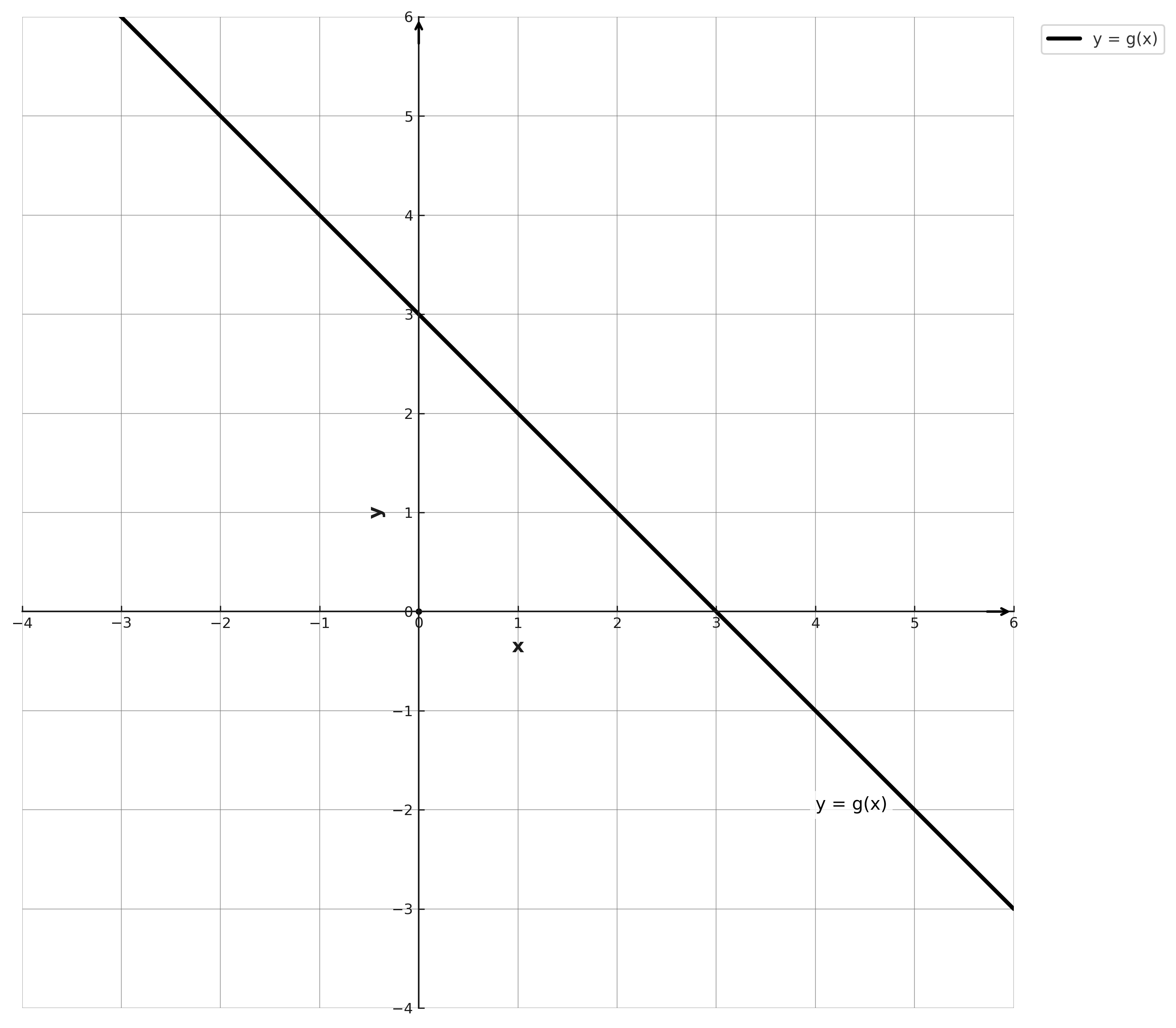
- The graph of \(\mathrm{y = g(x)}\) is shown on a coordinate plane.
- The graph is a straight line that decreases as \(\mathrm{x}\) increases.
- What is the \(\mathrm{x}\)-intercept of the graph? (An \(\mathrm{x}\)-intercept is a point where the graph crosses the \(\mathrm{x}\)-axis.)
\((-3, 0)\)
\((0, 3)\)
\((3, 0)\)
\((0, -3)\)
1. TRANSLATE the problem requirements
The problem asks for the x-intercept, which is defined as 'a point where the graph crosses the x-axis.'
- TRANSLATE this definition into mathematical terms:
- The x-axis is where \(\mathrm{y = 0}\)
- So I need to find the point \(\mathrm{(x, 0)}\) where the line crosses
- The answer will be a coordinate point in the form \(\mathrm{(x, 0)}\)
2. VISUALIZE by examining the graph
- Look at where the line intersects the x-axis (the horizontal axis)
- Follow the line from where it's visible in the upper left
- The line passes through several clear grid points:
- Around \(\mathrm{x = -2}\), the line is above the x-axis
- At \(\mathrm{x = 0}\), the line crosses at \(\mathrm{y = 3}\) (this is the y-intercept, not what we want)
- At \(\mathrm{x = 1}\), the line is at \(\mathrm{y = 2}\)
- At \(\mathrm{x = 2}\), the line is at \(\mathrm{y = 1}\)
- At \(\mathrm{x = 3}\), the line crosses the x-axis \(\mathrm{(y = 0)}\) ← This is what we need!
3. TRANSLATE the visual information into coordinate notation
- At \(\mathrm{x = 3}\), the line crosses the x-axis
- At this point, \(\mathrm{y = 0}\)
- Therefore, the x-intercept is the point \(\mathrm{(3, 0)}\)
4. Check the answer choices
Looking at the options:
- (A) \(\mathrm{(-3, 0)}\) - Wrong x-value
- (B) \(\mathrm{(0, 3)}\) - This is the y-intercept, not the x-intercept
- (C) \(\mathrm{(3, 0)}\) - This matches our answer ✓
- (D) \(\mathrm{(0, -3)}\) - Wrong intercept type and wrong values
Answer: C \(\mathrm{(3, 0)}\)
Why Students Usually Falter on This Problem
Most Common Error Path:
Weak TRANSLATE skill: Confusing x-intercept with y-intercept
Students sometimes mix up the definitions:
- They read 'x-intercept' but mentally think about where the graph crosses the y-axis
- Or they identify the correct crossing point but write the coordinates in the wrong order
- The y-intercept is \(\mathrm{(0, 3)}\), which appears prominently on the graph
This may lead them to select Choice B: \(\mathrm{(0, 3)}\)
Second Most Common Error:
Poor VISUALIZE skill: Misreading the graph or counting grid lines incorrectly
Students may:
- Count grid squares incorrectly when tracing the line
- Confuse which axis is which
- Look at the negative x-direction and think the intercept is at \(\mathrm{x = -3}\) instead of \(\mathrm{x = 3}\)
This may lead them to select Choice A: \(\mathrm{(-3, 0)}\)
The Bottom Line:
This problem tests whether you can correctly TRANSLATE the term 'x-intercept' into 'where the graph crosses the x-axis (where \(\mathrm{y = 0}\))' and then accurately VISUALIZE that location on the graph. The most critical moment is not confusing x-intercept (crossing the x-axis) with y-intercept (crossing the y-axis) - they are different concepts that students often mix up when reading quickly.
\((-3, 0)\)
\((0, 3)\)
\((3, 0)\)
\((0, -3)\)