
Hydrogen is placed inside a container and kept at a constant pressure. The graph shows the estimated volume y, in...
GMAT Algebra : (Alg) Questions
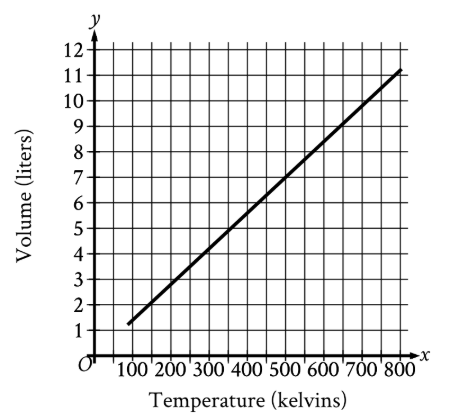
Hydrogen is placed inside a container and kept at a constant pressure. The graph shows the estimated volume \(\mathrm{y}\), in liters, of the hydrogen when its temperature is \(\mathrm{x}\) kelvins. What is the estimated volume, in liters, of the hydrogen when its temperature is \(\mathrm{500}\) kelvins?
\(\mathrm{0}\)
\(\frac{7}{500}\)
\(\mathrm{7}\)
\(\frac{500}{7}\)
1. TRANSLATE the problem information
The question asks: "What is the estimated volume, in liters, of the hydrogen when its temperature is 500 kelvins?"
Let's break down what this means:
- Given: Temperature = 500 kelvins
- Find: Volume in liters
- From the graph:
- X-axis = Temperature (kelvins)
- Y-axis = Volume (liters)
This translates to: Find the y-value when \(\mathrm{x = 500}\)
2. VISUALIZE by reading the graph
To find the volume at 500 kelvins:
- Locate 500 on the x-axis (Temperature axis)
- Look at the bottom horizontal axis
- Find the mark at 500 kelvins (it's in the middle of the scale)
- Trace vertically upward from \(\mathrm{x = 500}\) until you hit the line
- From that point on the line, trace horizontally left to the y-axis
- Read the value on the y-axis
- The y-coordinate is 7
Therefore, when the temperature is 500 kelvins, the volume is 7 liters.
Answer: C. 7
Why Students Usually Falter on This Problem
Most Common Error Path:
TRANSLATE error - Confusing the task with finding a rate or ratio:
Some students see the numbers 7 and 500 on the graph and think they need to calculate a relationship between them, such as the slope or rate of change. They might compute:
- \(\mathrm{7 ÷ 500 = \frac{7}{500}}\)
This is incorrect because the question asks for a specific value (the volume at 500 kelvins), not a rate of change. The answer should be a single number read directly from the graph, not a calculated ratio.
This may lead them to select Choice B (\(\mathrm{\frac{7}{500}}\))
Second Most Common Error:
TRANSLATE error - Inverting the variables:
Some students might confuse which axis represents which variable, or they might invert the relationship, thinking they need to find x when y = 7, then express it as a fraction: \(\mathrm{\frac{500}{7}}\).
Alternatively, they might mistakenly think the answer should be expressed as "kelvins per liter" rather than just "liters," leading them to compute \(\mathrm{\frac{500}{7}}\).
This may lead them to select Choice D (\(\mathrm{\frac{500}{7}}\))
The Bottom Line:
This problem tests your ability to TRANSLATE a word question into a graph-reading task. The key is recognizing that "What is the volume when temperature is 500?" simply means "Find the y-value at \(\mathrm{x = 500}\)"—no calculations needed, just careful graph reading. Don't overthink it by looking for ratios or slopes; the answer is a direct reading from the graph.
\(\mathrm{0}\)
\(\frac{7}{500}\)
\(\mathrm{7}\)
\(\frac{500}{7}\)