
In the xy-plane, the graph of which of the following inequalities is shown?
GMAT Algebra : (Alg) Questions
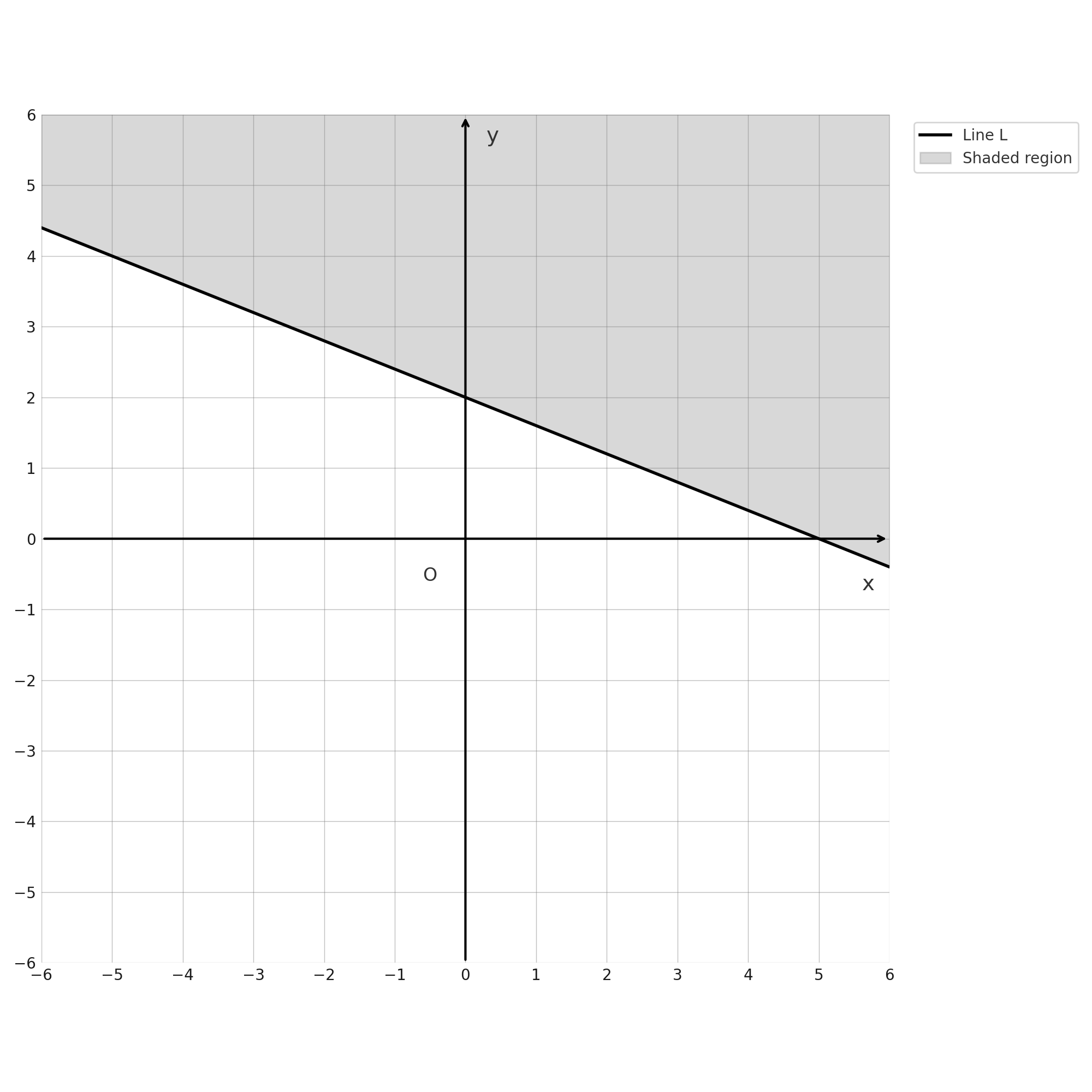
In the xy-plane, the graph of which of the following inequalities is shown?
1. TRANSLATE the graph information
First, TRANSLATE what you see in the graph:
- Line type: The line is solid (not dashed)
- This means the inequality includes the boundary line itself
- Symbol will be \(\geq\) or \(\leq\) (not strict inequalities)
- Key points: Identify where the line crosses the axes:
- y-intercept: \((0, 2)\) — where the line crosses the y-axis
- x-intercept: \((5, 0)\) — where the line crosses the x-axis
- Shaded region: The gray shaded area is above and to the right of the line
2. INFER the equation strategy
Now INFER which method to use for finding the equation:
- Since we have both intercepts clearly visible, the intercept form is efficient:
- General form: \(\frac{x}{a} + \frac{y}{b} = 1\) (where a is x-intercept, b is y-intercept)
3. SIMPLIFY to find the boundary equation
Using the intercept form with \(a = 5\) and \(b = 2\):
\(\frac{x}{5} + \frac{y}{2} = 1\)
SIMPLIFY by multiplying through by 10 (the LCM of denominators 5 and 2):
\(10 \cdot \left(\frac{x}{5}\right) + 10 \cdot \left(\frac{y}{2}\right) = 10 \cdot 1\)
\(2x + 5y = 10\)
This is our boundary line equation. Now we need to determine the inequality symbol.
4. INFER the test point strategy
INFER that we need to test which side of the line is shaded:
- Choose a convenient test point not on the line: \((0, 0)\) is easiest
- The point \((0, 0)\) is clearly in the unshaded region (below the line)
5. Determine the inequality symbol
Substitute \((0, 0)\) into the equation:
\(2(0) + 5(0) = 0\)
Compare to 10: We get 0, and \(0 \lt 10\)
Now INFER the relationship:
- Point \((0, 0)\) gives us 0, which is less than 10
- Point \((0, 0)\) is in the UNshaded region
- So the unshaded region satisfies \(2x + 5y \lt 10\)
- Therefore, the shaded region must satisfy \(2x + 5y \geq 10\)
(We use \(\geq\) not \(\gt\) because the line is solid)
6. APPLY CONSTRAINTS to match answer choices
Looking at the choices with \(2x + 5y\):
- Choice A: \(2x + 5y \leq 10\) (wrong direction)
- Choice B: \(2x + 5y \geq 10\) ✓ (matches our result)
Answer: B) \(2x + 5y \geq 10\)
Why Students Usually Falter on This Problem
Most Common Error Path:
Weak INFER skill — Misinterpreting the test point result:
Many students correctly find that \((0, 0)\) is in the unshaded region and that \(2(0) + 5(0) = 0 \lt 10\). However, they fail to INFER the logical connection: if the test point satisfies \(2x + 5y \lt 10\) and is unshaded, then the shaded region must be the OPPOSITE.
Instead, they might think: "0 < 10, so the answer is \(2x + 5y \leq 10\)"
This may lead them to select Choice A (\(2x + 5y \leq 10\))
Second Most Common Error:
Weak TRANSLATE skill — Misidentifying the intercepts:
Students might misread the graph and identify incorrect intercepts. Common mistakes:
- Reading y-intercept as \((2, 0)\) instead of \((0, 2)\)
- Reading x-intercept as \((0, 5)\) instead of \((5, 0)\)
This leads to equations like \(5x + 2y = 10\) instead of \(2x + 5y = 10\).
Even if they correctly determine the inequality direction, they end up selecting Choice C (\(5x + 2y \leq 10\)) or Choice D (\(5x + 2y \geq 10\))
The Bottom Line:
This problem requires careful graph reading and logical reasoning about inequalities. The key insight is that the test point tells you about the UNSHADED region — you must INFER that the shaded region is the opposite. Students who mechanically apply formulas without thinking about what the test point actually reveals will select the wrong inequality symbol.