
In isosceles triangle PQR, PQ = PR = 15 units and the altitude from P to base QR intersects QR...
GMAT Geometry & Trigonometry : (Geo_Trig) Questions
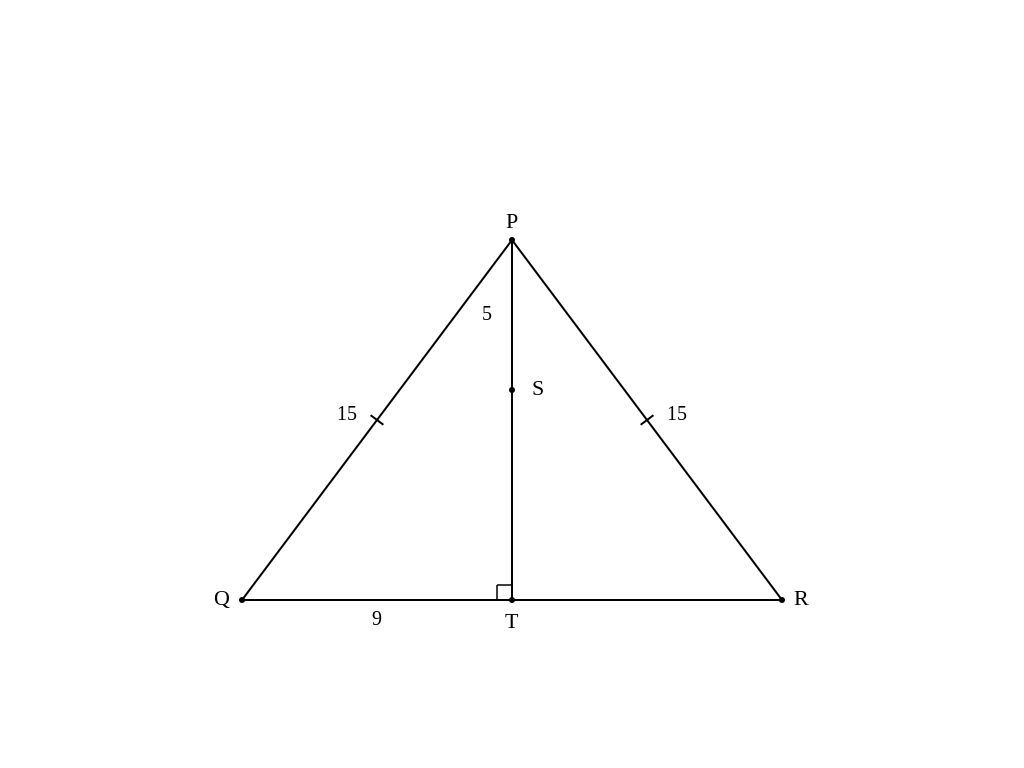
In isosceles triangle PQR, \(\mathrm{PQ = PR = 15}\) units and the altitude from P to base QR intersects QR at point T, where \(\mathrm{QT = 9}\) units. Point S lies on altitude PT such that \(\mathrm{PS = 5}\) units. What is the area, in square units, of triangle QSR?
1. TRANSLATE the problem information
Looking at the diagram and problem statement:
- Triangle PQR is isosceles with \(\mathrm{PQ = PR = 15}\) units
- PT is the altitude from P to base QR
- \(\mathrm{QT = 9}\) units
- Point S is on altitude PT with \(\mathrm{PS = 5}\) units
- We need to find the area of triangle QSR
2. INFER a key property of isosceles triangles
Here's a crucial insight: In an isosceles triangle, the altitude from the vertex angle (P) to the base (QR) always bisects the base. This means T is the midpoint of QR.
Since \(\mathrm{QT = 9}\), we can conclude that \(\mathrm{TR = 9}\) as well, making the full base \(\mathrm{QR = 18}\) units.
3. VISUALIZE using a coordinate system
Let's set up coordinates to organize all this information:
- Place T at the origin: (0, 0)
- Place Q to the left: (-9, 0)
- Place R to the right: (9, 0)
Now we need to find where P is located above T.
4. INFER the need for height and SIMPLIFY using Pythagorean theorem
To find the height PT, we use the right triangle PQT:
- Hypotenuse \(\mathrm{PQ = 15}\)
- Base \(\mathrm{QT = 9}\)
- Height \(\mathrm{PT = ?}\)
Applying Pythagorean theorem:
\(\mathrm{PT^2 + 9^2 = 15^2}\)
\(\mathrm{PT^2 + 81 = 225}\)
\(\mathrm{PT^2 = 144}\)
\(\mathrm{PT = 12}\) units
So P is at coordinates (0, 12).
5. INFER the location of point S
Point S lies on altitude PT (which runs vertically from T at (0,0) to P at (0,12)), and \(\mathrm{PS = 5}\).
Since the total height \(\mathrm{PT = 12}\) and \(\mathrm{PS = 5}\):
\(\mathrm{ST = PT - PS = 12 - 5 = 7}\)
Therefore, S is at coordinates (0, 7).
6. VISUALIZE triangle QSR and SIMPLIFY to find its area
Now we have triangle QSR with vertices:
- Q at (-9, 0)
- S at (0, 7)
- R at (9, 0)
Notice that Q and R both lie on the x-axis, making QR a horizontal base = 18 units.
Point S is 7 units above this base.
\(\mathrm{Area = \frac{1}{2} \times base \times height}\)
\(\mathrm{Area = \frac{1}{2} \times 18 \times 7}\)
\(\mathrm{Area = 63}\) square units
Answer: 63
Why Students Usually Falter on This Problem
Most Common Error Path:
Missing conceptual knowledge / Weak INFER skill: Not recognizing that the altitude in an isosceles triangle bisects the base.
Students might assume TR is different from QT or try to find TR using other methods, leading to confusion about the total base length. Without knowing \(\mathrm{QR = 18}\), they cannot set up the coordinate system correctly or calculate the area properly. This leads to confusion and guessing.
Second Most Common Error:
Weak INFER skill: Confusing which triangle's area to find.
Students might calculate the area of triangle PQR or triangle PSR instead of QSR. For instance:
- Area of \(\mathrm{PQR = \frac{1}{2} \times 18 \times 12 = 108}\), which might be incorrectly selected
- They might also find \(\mathrm{PS \times QR}\) incorrectly, leading to wrong values
This confusion about what the final question asks for causes them to calculate the wrong area, even if their setup is correct.
Third Most Common Error:
Execution error in SIMPLIFY: Misidentifying where S is located.
Some students might think S is 5 units from T (rather than from P), placing S at (0, 5) instead of (0, 7). This would give:
- Area = \(\mathrm{\frac{1}{2} \times 18 \times 5 = 45}\) square units
This misreading of "\(\mathrm{PS = 5}\)" as "\(\mathrm{TS = 5}\)" leads to an incorrect answer.
The Bottom Line:
This problem requires careful tracking of multiple points and distances in a geometric figure. The key challenges are: (1) using isosceles triangle properties to find all necessary measurements, (2) correctly locating point S on the altitude, and (3) identifying which specific triangle's area needs to be calculated. Success depends on methodical organization of information and precise geometric reasoning.