
The graph of a polynomial function is shown in the xy-plane. Which of the following could be an equation for...
GMAT Advanced Math : (Adv_Math) Questions
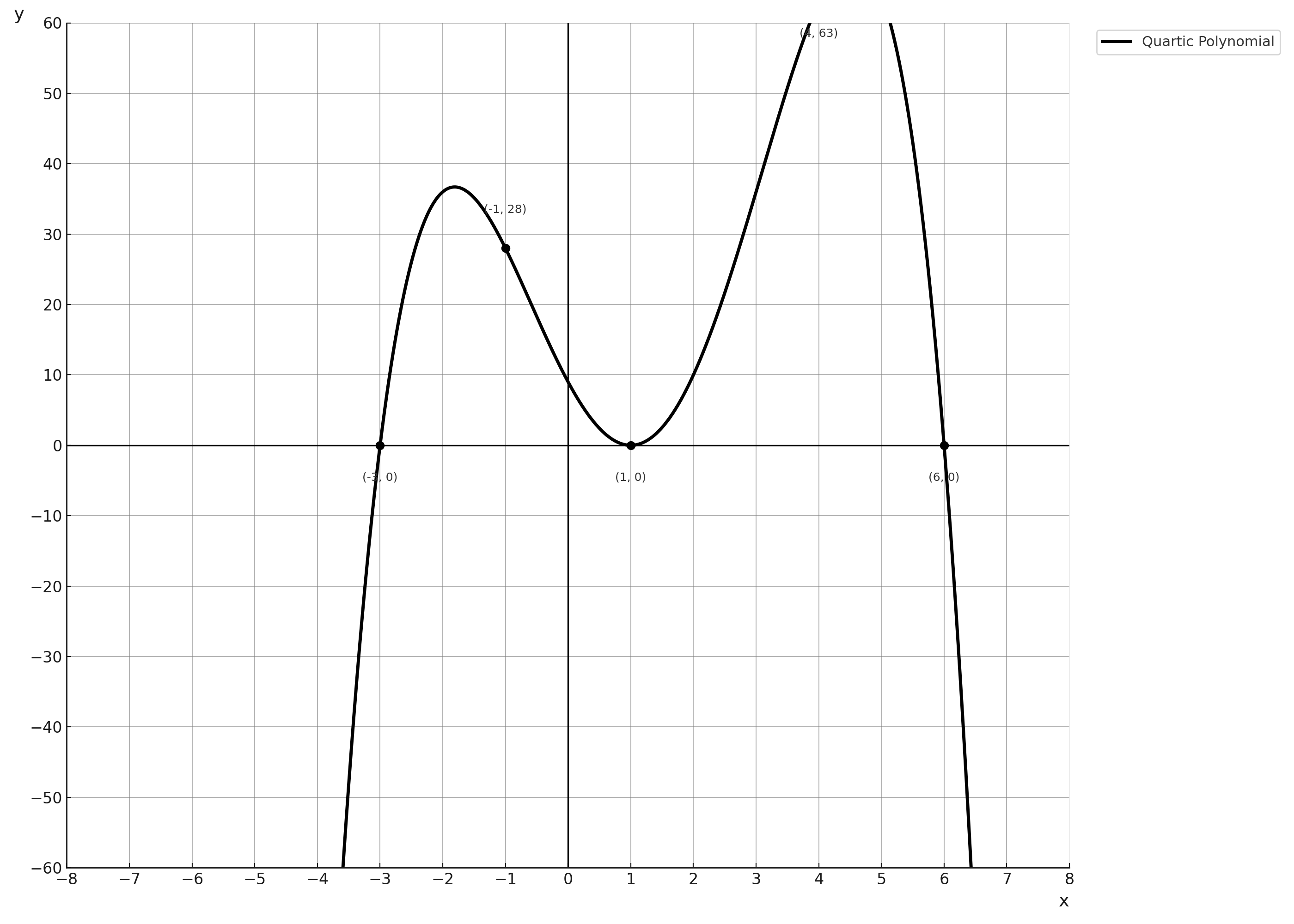
The graph of a polynomial function is shown in the xy-plane. Which of the following could be an equation for this function?
\(\mathrm{y = -\frac{1}{8}(x + 3)(x - 1)(x - 6)}\)
\(\mathrm{y = -\frac{1}{8}(x + 3)(x - 1)^2(x - 6)}\)
\(\mathrm{y = -\frac{1}{8}(x - 3)(x + 1)^2(x + 6)}\)
\(\mathrm{y = -\frac{1}{8}(x - 3)(x + 1)(x + 6)^2}\)
1. TRANSLATE the graph features into mathematical information
From the graph, identify where the curve crosses the x-axis:
- X-intercepts (zeros): \(\mathrm{x = -3}\), \(\mathrm{x = 1}\), and \(\mathrm{x = 6}\)
2. INFER the multiplicity at each zero
This is the crucial step! Look at HOW the graph behaves at each x-intercept:
- At \(\mathrm{x = -3}\): The curve crosses straight through the x-axis
- This indicates odd multiplicity (most likely 1)
- At \(\mathrm{x = 1}\): The curve touches the x-axis but turns around without crossing
- This indicates even multiplicity (most likely 2)
- Think of it like a ball bouncing off the x-axis
- At \(\mathrm{x = 6}\): The curve crosses straight through the x-axis
- This indicates odd multiplicity (most likely 1)
3. INFER the sign of the leading coefficient
Observe the end behavior:
- As x goes far left (negative), y goes down (negative)
- As x goes far right (positive), y also goes down (negative)
- Both ends pointing downward means negative leading coefficient
4. TRANSLATE zeros into factored form
- A zero at \(\mathrm{x = -3}\) means a factor of \(\mathrm{(x + 3)}\)
- A zero at \(\mathrm{x = 1}\) with multiplicity 2 means a factor of \(\mathrm{(x - 1)^2}\)
- A zero at \(\mathrm{x = 6}\) means a factor of \(\mathrm{(x - 6)}\)
So we're looking for: \(\mathrm{y = (negative\,constant)(x + 3)(x - 1)^2(x - 6)}\)
5. APPLY CONSTRAINTS to eliminate wrong answers
- Eliminate C and D immediately: They have zeros at \(\mathrm{x = 3}\), \(\mathrm{x = -1}\), and \(\mathrm{x = -6}\), which don't match our graph
- Compare A and B:
- Choice A: \(\mathrm{y = -\frac{1}{8}(x + 3)(x - 1)(x - 6)}\) → multiplicity 1 at all zeros
- Choice B: \(\mathrm{y = -\frac{1}{8}(x + 3)(x - 1)^2(x - 6)}\) → multiplicity 2 at \(\mathrm{x = 1}\)
- Since the graph clearly shows touching behavior at \(\mathrm{x = 1}\), we need multiplicity 2
Answer: B
Why Students Usually Falter on This Problem
Most Common Error Path:
Weak INFER skill: Not recognizing the difference between crossing and touching behavior at x-intercepts
Many students correctly identify the three x-intercepts but don't carefully analyze HOW the graph interacts with the x-axis at each point. They see that the curve hits \(\mathrm{x = -3}\), \(\mathrm{1}\), and \(\mathrm{6}\), and immediately look for any equation with those three zeros, leading them to select Choice A without considering multiplicities.
The key distinction is subtle but critical: at \(\mathrm{x = 1}\), the graph doesn't cross through—it bounces off the x-axis like a ball hitting the ground. This "bounce" is the visual signature of even multiplicity.
Second Most Common Error:
Weak TRANSLATE skill: Confusing the signs in factored form
Students sometimes mix up whether a zero at \(\mathrm{x = 1}\) corresponds to a factor of \(\mathrm{(x - 1)}\) or \(\mathrm{(x + 1)}\). If they incorrectly translate \(\mathrm{x = 1}\) as requiring \(\mathrm{(x + 1)}\), or \(\mathrm{x = -3}\) as requiring \(\mathrm{(x - 3)}\), they might be drawn toward Choice C or D even though these have completely different x-intercepts visible on the graph.
The Bottom Line:
This problem tests whether you can "read" a polynomial graph by connecting visual features (crossing vs. touching) to algebraic properties (multiplicity). The x-intercepts tell you WHAT the zeros are, but the BEHAVIOR at each intercept tells you the multiplicity—and that's what distinguishes the correct answer.
\(\mathrm{y = -\frac{1}{8}(x + 3)(x - 1)(x - 6)}\)
\(\mathrm{y = -\frac{1}{8}(x + 3)(x - 1)^2(x - 6)}\)
\(\mathrm{y = -\frac{1}{8}(x - 3)(x + 1)^2(x + 6)}\)
\(\mathrm{y = -\frac{1}{8}(x - 3)(x + 1)(x + 6)^2}\)