
In the figure shown, line c intersects parallel lines s and t. What is the value of x?
GMAT Geometry & Trigonometry : (Geo_Trig) Questions
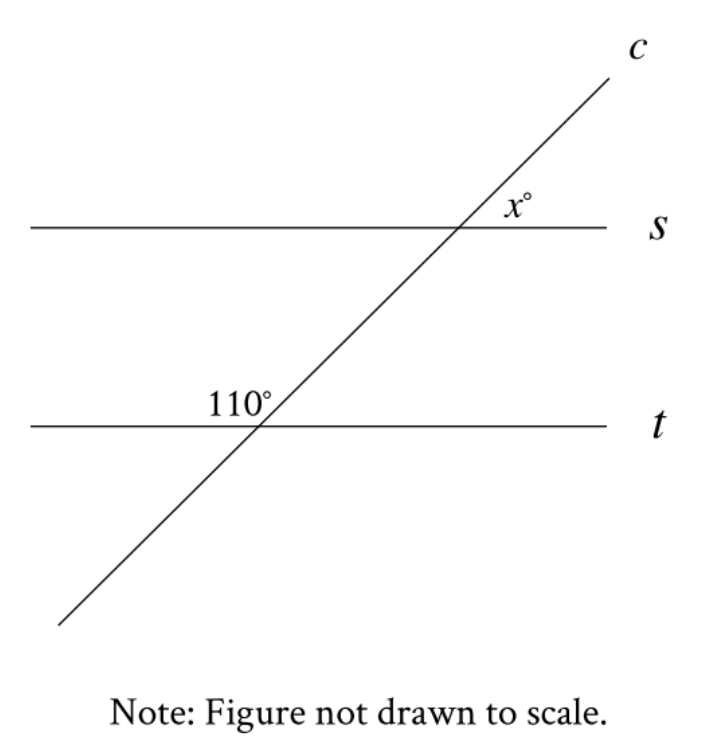
In the figure shown, line c intersects parallel lines s and t. What is the value of \(\mathrm{x}\)?
1. TRANSLATE the problem information
Given information:
- Lines s and t are parallel
- Line c intersects both s and t (c is a transversal)
- One angle measures \(110°\) (at line t, lower left side)
- Another angle measures \(\mathrm{x}°\) (at line s, upper right side)
- We need to find the value of x
2. INFER the angle relationships
Here's the key strategic thinking:
First observation: The \(110°\) angle and the \(\mathrm{x}°\) angle are not at the same intersection point, so they're not vertical angles to each other.
Second observation: Look at the \(\mathrm{x}°\) angle at line s. Every angle has a vertical angle (the angle across from it at the same intersection). The vertical angle to \(\mathrm{x}°\) is also \(\mathrm{x}°\) because vertical angles are always congruent.
Third observation: Now compare this vertical angle to \(\mathrm{x}°\) (which is on the lower left at line s) with the \(110°\) angle (which is at line t). Notice that:
- Both angles are between the parallel lines (they're interior angles)
- Both angles are on the same side of the transversal c (they're same-side angles)
This means they are same-side interior angles (also called co-interior angles or consecutive interior angles).
3. INFER which property to apply
Since s and t are parallel lines, and we've identified same-side interior angles, we can use this property:
Same-side interior angles formed by a transversal crossing parallel lines are supplementary.
This means: \(\mathrm{x} + 110 = 180\)
4. SIMPLIFY to solve for x
Starting with: \(\mathrm{x} + 110 = 180\)
Subtract 110 from both sides:
\(\mathrm{x} = 180 - 110\)
\(\mathrm{x} = 70\)
Answer: 70
Why Students Usually Falter on This Problem
Most Common Error Path:
Weak INFER skill: Misidentifying which angles to compare and what relationship they have.
Many students look at the diagram and think: "I see \(110°\) at one intersection and \(\mathrm{x}°\) at another intersection—these must be corresponding angles or alternate interior angles since the lines are parallel."
If they think the angles are corresponding angles (which are equal when lines are parallel) or alternate interior angles (which are also equal when lines are parallel), they would conclude:
\(\mathrm{x} = 110\)
But this is wrong because \(\mathrm{x}°\) and \(110°\) are NOT corresponding angles or alternate interior angles. The angle that has a special relationship with \(110°\) is the vertical angle to \(\mathrm{x}°\) (which also equals \(\mathrm{x}°\)), and that relationship is same-side interior angles, which are supplementary, not equal.
This error leads them to answer 110 instead of 70.
Second Most Common Error:
Conceptual confusion: Not recognizing that vertical angles need to be considered.
Some students might try to use the \(110°\) angle and the \(\mathrm{x}°\) angle directly without considering the vertical angle relationships first. They might get confused about which angles are actually "interior" and on which "side" of the transversal, leading them to:
- Give up and guess randomly
- Incorrectly subtract: \(\mathrm{x} = 180 - 110 = 70\) (accidentally getting the right answer but for wrong reasoning)
- Think the angles are on opposite sides and assume they're equal
The Bottom Line:
This problem tests whether you can systematically identify angle relationships in a parallel lines diagram. The key challenge is recognizing that you need to think about the vertical angle to \(\mathrm{x}°\) to properly identify the same-side interior angle pair. Students who jump directly to comparing \(\mathrm{x}°\) and \(110°\) without this intermediate step will misidentify the relationship and get the wrong answer.