
In the figure, line l is parallel to line k. What is the value of x?
GMAT Geometry & Trigonometry : (Geo_Trig) Questions
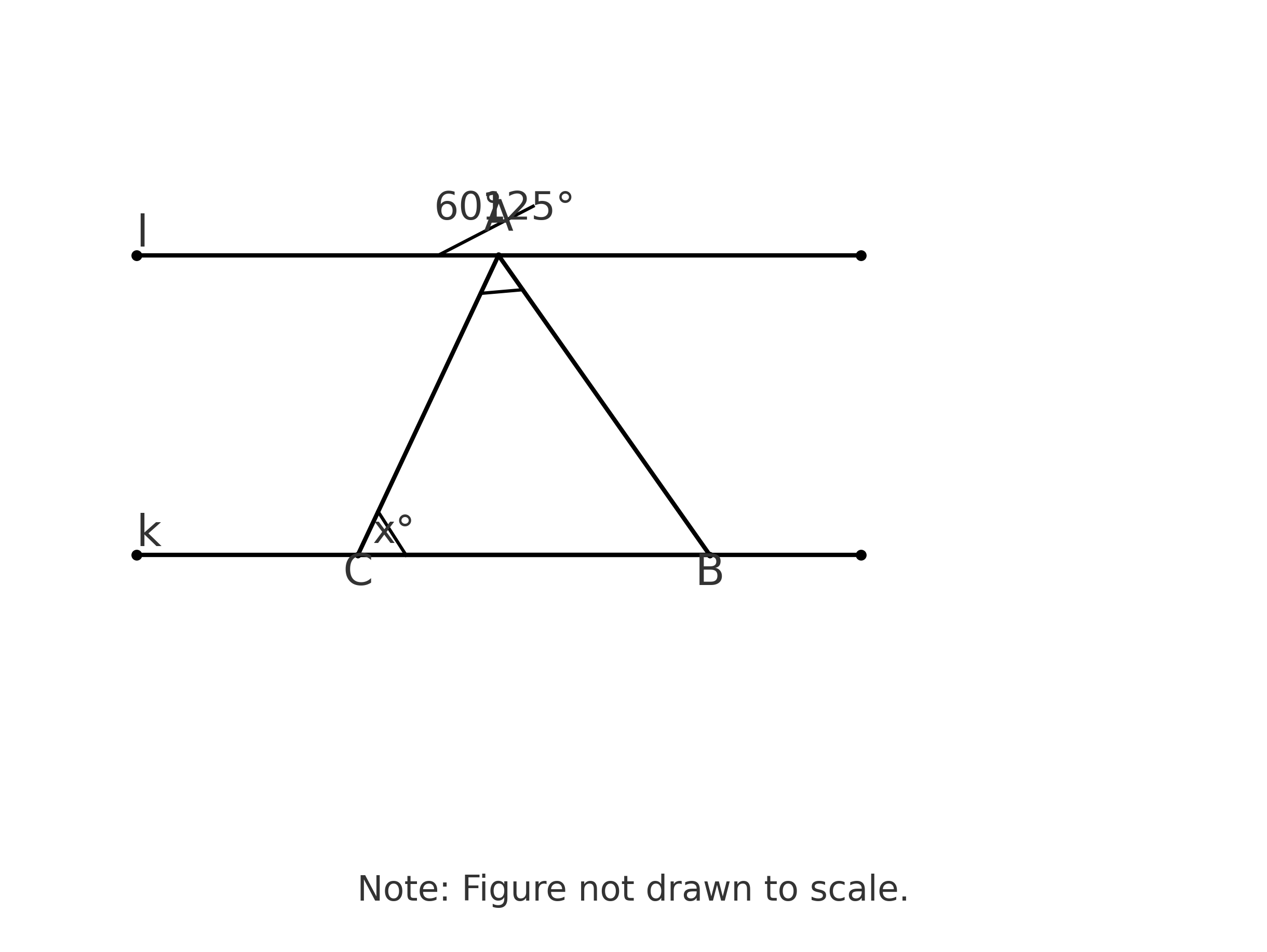
In the figure, line l is parallel to line k. What is the value of \(\mathrm{x}\)?
1. TRANSLATE the problem information
Looking at the figure, I can identify:
- Line l passes through vertex A (top of triangle)
- Line k passes through vertices C and B (base of triangle)
- Lines l and k are parallel (\(l \parallel k\))
- An exterior angle at A measures 125°
- The interior angle of the triangle at vertex A is \(\angle\mathrm{BAC} = 60°\)
- We need to find x, which is the angle \(\angle\mathrm{ACB}\) at vertex C
2. INFER the relationship between the exterior angle and parallel lines
Here's the key strategic insight: I cannot directly find x without knowing the other angles of the triangle. The 125° exterior angle is my gateway to finding these angles.
Since the exterior angle at A is 125°, and angles on a straight line sum to 180°, the angle on line l (on the interior side, between line l and side AC) must be:
\(180° - 125° = 55°\)
3. INFER how to use the parallel lines property
Now I need to connect this 55° angle to the triangle. Since \(l \parallel k\), and side AB acts as a transversal cutting through both parallel lines:
- The 55° angle at A (on line l, interior side)
- The angle \(\angle\mathrm{ABC}\) at B (on line k)
- These are alternate interior angles, which are equal when lines are parallel
Therefore: \(\angle\mathrm{ABC} = 55°\)
4. APPLY the triangle angle sum theorem
Now I have two angles of the triangle:
- \(\angle\mathrm{BAC} = 60°\)
- \(\angle\mathrm{ABC} = 55°\)
- \(\angle\mathrm{ACB} = x°\) (what we're finding)
SIMPLIFY the equation:
\(60 + 55 + x = 180\)
\(115 + x = 180\)
\(x = 180 - 115\)
\(x = 65\)
Answer: C (65)
Why Students Usually Falter on This Problem
Most Common Error Path:
Weak INFER skill - Missing the connection to parallel line properties: Students see the 125° exterior angle and the 60° interior angle at A, but don't recognize that they need to use the supplement of 125° combined with parallel line properties to find \(\angle\mathrm{ABC}\). Instead, they might try to work directly with just the two angles shown (125° and 60°), attempting calculations like \(180° - 60° - 125° = -5°\) (which doesn't make sense) or \(125° - 60° = 65°\), getting the right number but through completely incorrect reasoning. Some students might guess between the given angle values.
This confusion often leads them to select Choice A (55) or Choice B (60) by picking one of the angles already visible in the figure.
Second Most Common Error:
Poor SIMPLIFY execution - Arithmetic errors: Students correctly identify that they need to solve \(60 + 55 + x = 180\), but make calculation errors. For example:
- Incorrectly adding: \(60 + 55 = 125\) (correct) but then subtracting: \(180 - 125 = 55\) (correct process, but then writing down 55° as the answer)
- Confusing which angle is which and thinking \(x = 55°\)
This may lead them to select Choice A (55).
The Bottom Line:
This problem requires multi-step geometric reasoning, not just formula application. Students must bridge three separate concepts: (1) supplementary angles, (2) parallel line properties with transversals, and (3) triangle angle sum. Missing any link in this chain breaks the solution path. The key challenge is recognizing that the exterior angle's supplement creates an alternate interior angle relationship with the parallel lines—without this insight, students cannot access the angle they need to complete the triangle angle sum.