
In the figure, line m is parallel to line n, and line t intersects both lines. What is the value...
GMAT Geometry & Trigonometry : (Geo_Trig) Questions
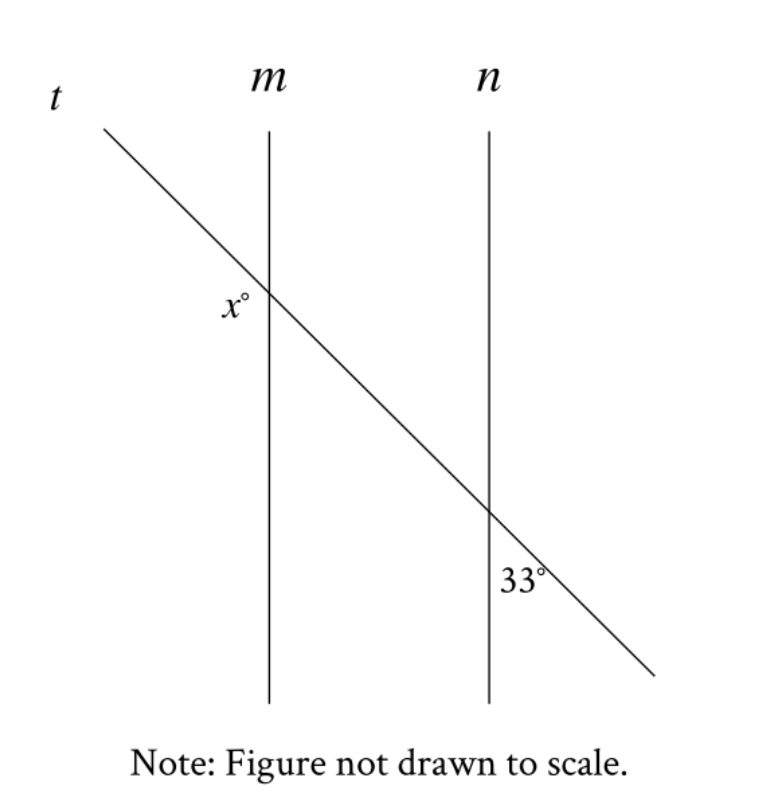
In the figure, line m is parallel to line n, and line t intersects both lines. What is the value of \(\mathrm{x}\)?
Choose 1 answer:
\(\mathrm{33}\)
\(\mathrm{57}\)
\(\mathrm{123}\)
\(\mathrm{147}\)
1. TRANSLATE the problem information
Given:
- Line m is parallel to line n (\(\mathrm{m \parallel n}\))
- Line t intersects both lines (t is a transversal)
- One angle measures \(\mathrm{x°}\) (at line m)
- Another angle measures \(\mathrm{33°}\) (at line n)
Find: The value of x
2. INFER the angle relationship
Look carefully at where the angles are positioned:
- The angle \(\mathrm{x°}\) is formed at the intersection of line t and line m
- The angle \(\mathrm{33°}\) is formed at the intersection of line t and line n
- Both angles are outside (exterior to) the parallel lines
- Both angles are on the same side of the transversal
This means \(\mathrm{x°}\) and \(\mathrm{33°}\) are exterior angles on the same side of the transversal (also called co-exterior angles or consecutive exterior angles).
Key property: When two parallel lines are cut by a transversal, exterior angles on the same side are supplementary—they add up to \(\mathrm{180°}\).
3. TRANSLATE the relationship into an equation
Since the angles are supplementary:
\(\mathrm{x + 33 = 180}\)
4. SIMPLIFY to solve for x
\(\mathrm{x + 33 = 180}\)
\(\mathrm{x = 180 - 33}\)
\(\mathrm{x = 147}\)
Answer: D. 147
Why Students Usually Falter on This Problem
Most Common Error Path:
Weak INFER skill: Misidentifying the angle relationship
Students often confuse the various angle relationships created when a transversal cuts parallel lines. Common misconceptions include:
- Thinking the angles are corresponding or alternate exterior angles (which would be equal): This leads to \(\mathrm{x = 33}\), causing them to select Choice A (33)
- Thinking the angles are complementary (sum to 90° instead of 180°): This leads to the equation \(\mathrm{x + 33 = 90}\), so \(\mathrm{x = 57}\), causing them to select Choice B (57)
Second Most Common Error:
Weak INFER skill: Confusing which angles to work with or applying properties in the wrong order
Some students might correctly recognize that adjacent angles on a line are supplementary, find that the angle adjacent to \(\mathrm{33°}\) is \(\mathrm{147°}\), but then incorrectly apply another angle relationship. Alternatively, students might calculate 57 (from thinking the angles are complementary), then realize they need a supplementary relationship and calculate \(\mathrm{180 - 57 = 123}\), leading them to select Choice C (123).
The Bottom Line:
This problem tests whether you can correctly identify angle relationships when parallel lines are cut by a transversal. The key challenge is recognizing that angles on the exterior of the parallel lines and on the same side of the transversal are supplementary. Many angle pairs are formed in this configuration, and choosing the wrong relationship leads directly to an incorrect answer.
\(\mathrm{33}\)
\(\mathrm{57}\)
\(\mathrm{123}\)
\(\mathrm{147}\)