
In the figure shown, line m is parallel to line n. What is the value of x?Choose 1 answer:
GMAT Geometry & Trigonometry : (Geo_Trig) Questions
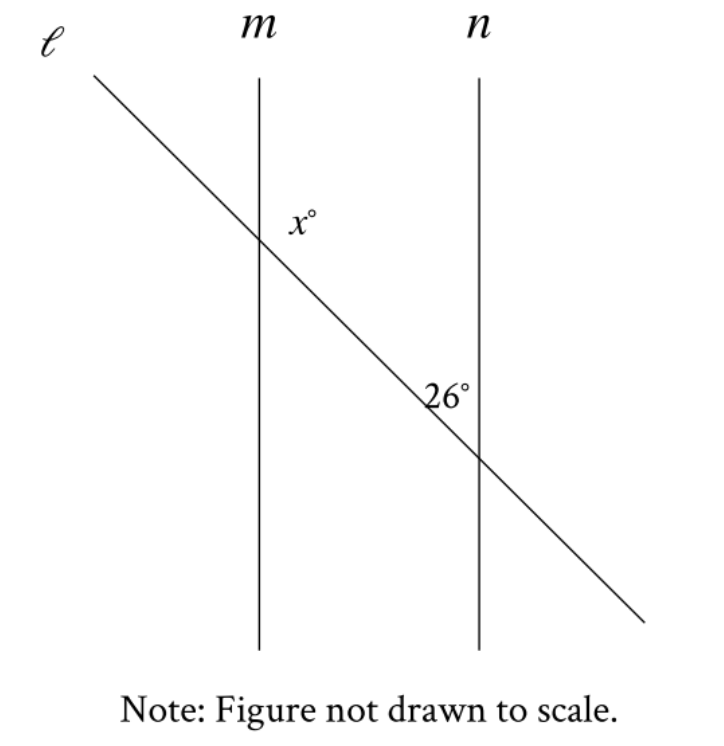
In the figure shown, line m is parallel to line n. What is the value of x?
Choose 1 answer:
13
26
52
154
1. INFER the angle relationship from the diagram
Looking at the figure carefully:
- Line ℓ crosses both parallel lines m and n (making it a transversal)
- Angle \(\mathrm{x°}\) is at the intersection of ℓ and line m
- Angle \(\mathrm{26°}\) is at the intersection of ℓ and line n
- Both angles are between the two parallel lines (interior)
- Both angles are on the same side of the transversal ℓ
What this tells us: These are consecutive interior angles (also called co-interior angles or same-side interior angles).
2. INFER the key property to apply
Since we have consecutive interior angles formed by a transversal crossing parallel lines, we can use this important geometric property:
Consecutive interior angles are supplementary — they add up to \(\mathrm{180°}\).
This is different from alternate interior angles (which are equal) or corresponding angles (which are also equal). The "same side" positioning is the key difference.
3. Set up the equation
Since \(\mathrm{x°}\) and \(\mathrm{26°}\) must sum to \(\mathrm{180°}\):
\(\mathrm{x + 26 = 180}\)
4. SIMPLIFY to solve for x
Subtract 26 from both sides:
\(\mathrm{x = 180 - 26}\)
\(\mathrm{x = 154}\)
Answer: D. 154
Why Students Usually Falter on This Problem
Most Common Error Path:
Weak INFER skill: Confusing angle relationships
Students often mix up the different angle pairs formed by a transversal:
- Alternate interior angles (on opposite sides of the transversal, between the lines) → These are EQUAL
- Consecutive interior angles (on the same side of the transversal, between the lines) → These are SUPPLEMENTARY
- Corresponding angles (same position at each intersection) → These are EQUAL
If a student thinks \(\mathrm{x°}\) and \(\mathrm{26°}\) are alternate interior angles or corresponding angles, they would incorrectly conclude that \(\mathrm{x = 26}\).
This leads them to select Choice B (26).
Second Most Common Error:
Weak INFER skill: Applying the supplementary property but to the wrong angle
Some students correctly identify that angles on a line sum to \(\mathrm{180°}\), but they misinterpret which angles in the diagram form a linear pair. They might think the \(\mathrm{26°}\) angle and another angle at line n sum to \(\mathrm{180°}\), then try to work backwards, getting confused about which angle equals x.
If they incorrectly calculate \(\mathrm{2 \times 26 = 52}\) (perhaps thinking about some relationship with doubling), they might select Choice C (52).
Alternatively, if they take half of \(\mathrm{26°}\) for some confused reason, they select Choice A (13).
The Bottom Line:
This problem tests whether you can correctly identify consecutive interior angles from a diagram and remember that they're supplementary (not equal). The visual interpretation and angle relationship identification is the critical skill — once you know they sum to \(\mathrm{180°}\), the algebra is straightforward.
13
26
52
154