
In the coordinate plane shown, a line decreases from left to right and intersects the y-axis at 9 and the...
GMAT Algebra : (Alg) Questions
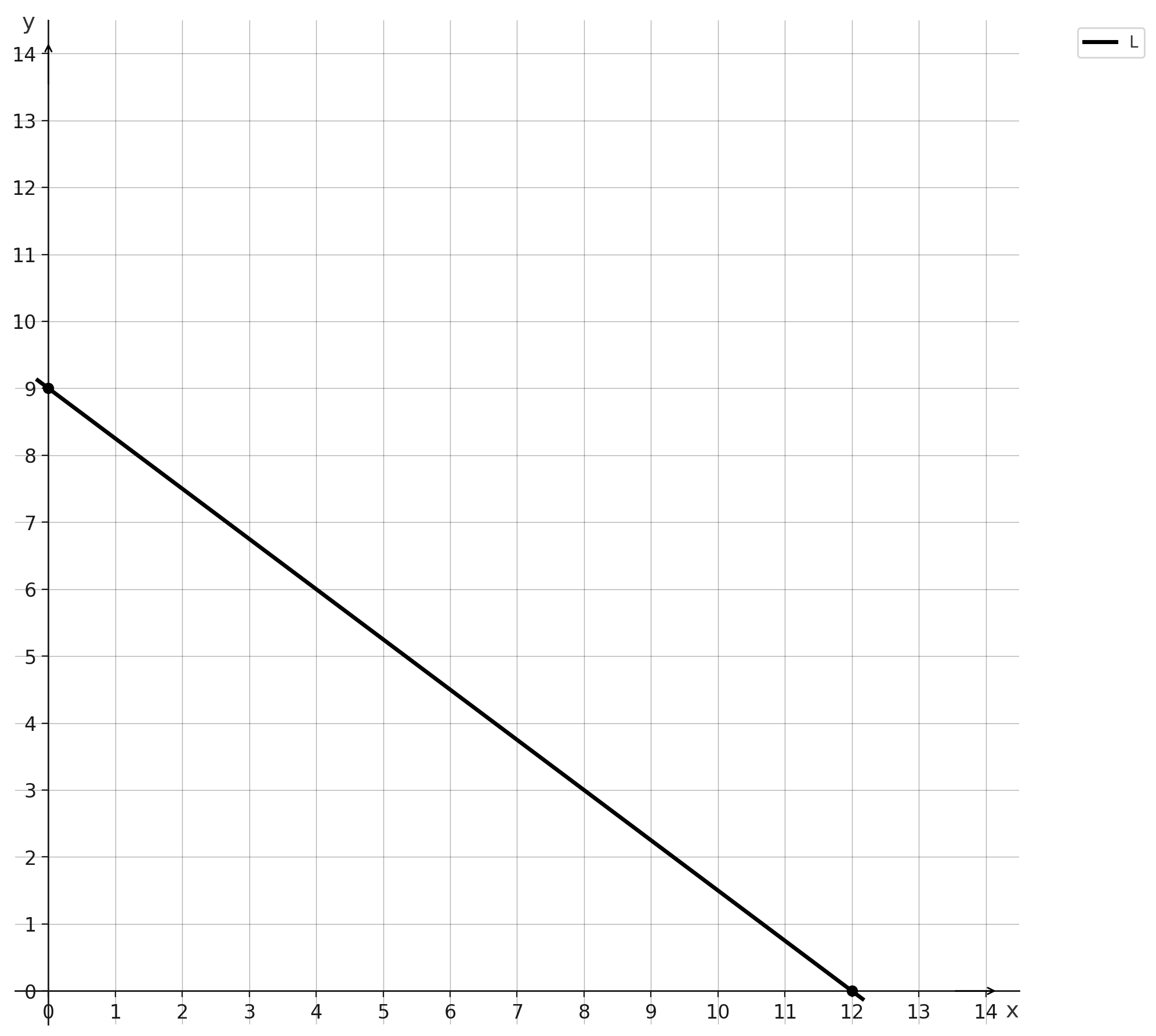
In the coordinate plane shown, a line decreases from left to right and intersects the y-axis at \(\mathrm{9}\) and the x-axis at \(\mathrm{12}\). The point with coordinates \(\mathrm{(k, 5)}\) lies on this line. What is the value of \(\mathrm{k}\)?
1. TRANSLATE the graph information into coordinates
From the problem and graph:
- The line "intersects the y-axis at 9" → Point \((0, 9)\)
- The line "intersects the x-axis at 12" → Point \((12, 0)\)
- The point \((\mathrm{k}, 5)\) "lies on this line" → This point must satisfy the line's equation
2. INFER the solution strategy
We need the equation of the line before we can find k. Since we have two points, we can:
- Calculate the slope
- Write the equation in slope-intercept form
- Use the fact that \((\mathrm{k}, 5)\) satisfies this equation
3. Calculate the slope
SIMPLIFY using the slope formula with \((0, 9)\) and \((12, 0)\):
\(\mathrm{m} = \frac{0 - 9}{12 - 0} = \frac{-9}{12} = \frac{-3}{4}\)
The negative slope makes sense—the line "decreases from left to right" as stated.
4. Write the line equation
Using slope-intercept form \(\mathrm{y} = \mathrm{mx} + \mathrm{b}\):
- We have \(\mathrm{m} = \frac{-3}{4}\)
- The y-intercept \(\mathrm{b} = 9\) (from point \((0, 9)\))
- Therefore: \(\mathrm{y} = \frac{-3}{4}\mathrm{x} + 9\)
5. TRANSLATE the condition that \((\mathrm{k}, 5)\) lies on the line
This means when \(\mathrm{x} = \mathrm{k}\), \(\mathrm{y} = 5\):
\(5 = \frac{-3}{4}\mathrm{k} + 9\)
6. SIMPLIFY to solve for k
Subtract 9 from both sides:
\(5 - 9 = \frac{-3}{4}\mathrm{k}\)
\(-4 = \frac{-3}{4}\mathrm{k}\)
To isolate k, multiply both sides by \(\frac{-4}{3}\) (the reciprocal of \(\frac{-3}{4}\)):
\(\mathrm{k} = -4 \times \left(\frac{-4}{3}\right)\)
\(\mathrm{k} = \frac{16}{3}\)
Answer: \(\frac{16}{3}\) or Choice (B)
Why Students Usually Falter on This Problem
Most Common Error Path:
Weak SIMPLIFY execution: When solving \(-4 = \frac{-3}{4}\mathrm{k}\), students may incorrectly handle the negative signs or fraction manipulation.
Common mistakes include:
- Multiplying by \(\frac{-3}{4}\) instead of its reciprocal \(\frac{-4}{3}\)
- Sign errors: getting \(\mathrm{k} = \frac{-16}{3}\) or \(\mathrm{k} = \frac{16}{3}\) with wrong intermediate steps
- Incorrectly computing \(-4 \div \left(\frac{-3}{4}\right)\) as \(-4 \times \left(\frac{-3}{4}\right) = 3\)
These computational errors lead to incorrect values that may coincidentally match answer choices like Choice (D) \(\left(\frac{20}{3}\right)\) if they made an arithmetic mistake, or they get stuck and guess.
Second Most Common Error:
Incomplete INFER reasoning: Students may jump directly to using the slope formula with points \((\mathrm{k}, 5)\) and one of the given points without first establishing the line equation.
For example, they might write:
\(\frac{-3}{4} = \frac{5 - 9}{\mathrm{k} - 0} = \frac{-4}{\mathrm{k}}\)
This gives \(\mathrm{k} = -4 \times \left(\frac{-4}{3}\right) = \frac{16}{3}\), which happens to work but shows conceptual confusion. More problematically, students might use the wrong point and get:
\(\frac{-3}{4} = \frac{5 - 0}{\mathrm{k} - 12} = \frac{5}{\mathrm{k} - 12}\)
This leads to: \(-3(\mathrm{k} - 12) = 20\), giving \(-3\mathrm{k} + 36 = 20\), so \(\mathrm{k} = \frac{16}{3}\)... wait, this also works! But conceptually, the approach shows weak understanding of the problem structure.
The Bottom Line:
This problem tests whether students can systematically translate graph features into algebraic form and then work with linear equations. The key is recognizing that you need the complete line equation first, then use the condition that the unknown point satisfies that equation. Students who try shortcuts or mishandle fraction arithmetic will struggle to reach the correct answer.