
The graph of the linear function f is shown. What is the y-intercept of the graph of \(\mathrm{y = f(x)}\)?
GMAT Algebra : (Alg) Questions
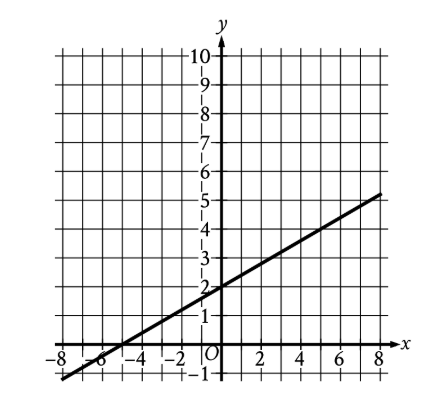
The graph of the linear function f is shown. What is the y-intercept of the graph of \(\mathrm{y = f(x)}\)?
1. TRANSLATE the question
The problem asks: "What is the y-intercept of the graph of \(\mathrm{y = f(x)}\)?"
TRANSLATE this into what you need to find:
- The y-intercept is the point where the graph crosses the y-axis
- The y-axis is the vertical line in the middle of the coordinate plane
- At any point on the y-axis, the x-coordinate is always 0
- So you're looking for a point with coordinates \(\mathrm{(0, y)}\) for some value of y
2. VISUALIZE the y-axis on the graph
Look at the graph provided:
- Locate the y-axis (the vertical line labeled with "y" at the top)
- This is where \(\mathrm{x = 0}\)
- Trace the linear function and see where it crosses this vertical line
3. VISUALIZE the exact intersection point
Following the line from left to right:
- The line passes through the y-axis
- At the intersection point, \(\mathrm{x = 0}\) and \(\mathrm{y = 2}\)
- The point of intersection is \(\mathrm{(0, 2)}\)
Answer: C. \(\mathrm{(0, 2)}\)
Why Students Usually Falter on This Problem
Most Common Error Path:
Weak TRANSLATE skill - Confusing x-intercept with y-intercept:
Students sometimes confuse the definition of x-intercept and y-intercept. They might think "y-intercept" means finding where \(\mathrm{y = 0}\) (which is actually the x-intercept definition). Looking at the graph, they see the line crosses the x-axis at approximately \(\mathrm{(-5, 0)}\) and select that point.
This may lead them to select Choice A (\(\mathrm{(-5, 0)}\))
Second Most Common Error:
Conceptual confusion about ordered pair notation:
Some students correctly identify that they need to find where the graph crosses the y-axis, and they correctly identify that \(\mathrm{y = 2}\) at that point. However, they get confused about ordered pair notation and write \(\mathrm{(2, 0)}\) instead of \(\mathrm{(0, 2)}\), mixing up which value goes first.
This may lead them to select Choice B (\(\mathrm{(2, 0)}\))
The Bottom Line:
This problem tests your understanding of coordinate plane terminology. The key insight is remembering that:
- Y-intercept → crosses the y-axis → \(\mathrm{x = 0}\) → point looks like \(\mathrm{(0, something)}\)
- X-intercept → crosses the x-axis → \(\mathrm{y = 0}\) → point looks like \(\mathrm{(something, 0)}\)
Once you have this straight, reading the correct value from the graph is straightforward.