
The function f is a linear function defined by \(\mathrm{f(x) = mx + b}\), where m and b are constants....
GMAT Algebra : (Alg) Questions
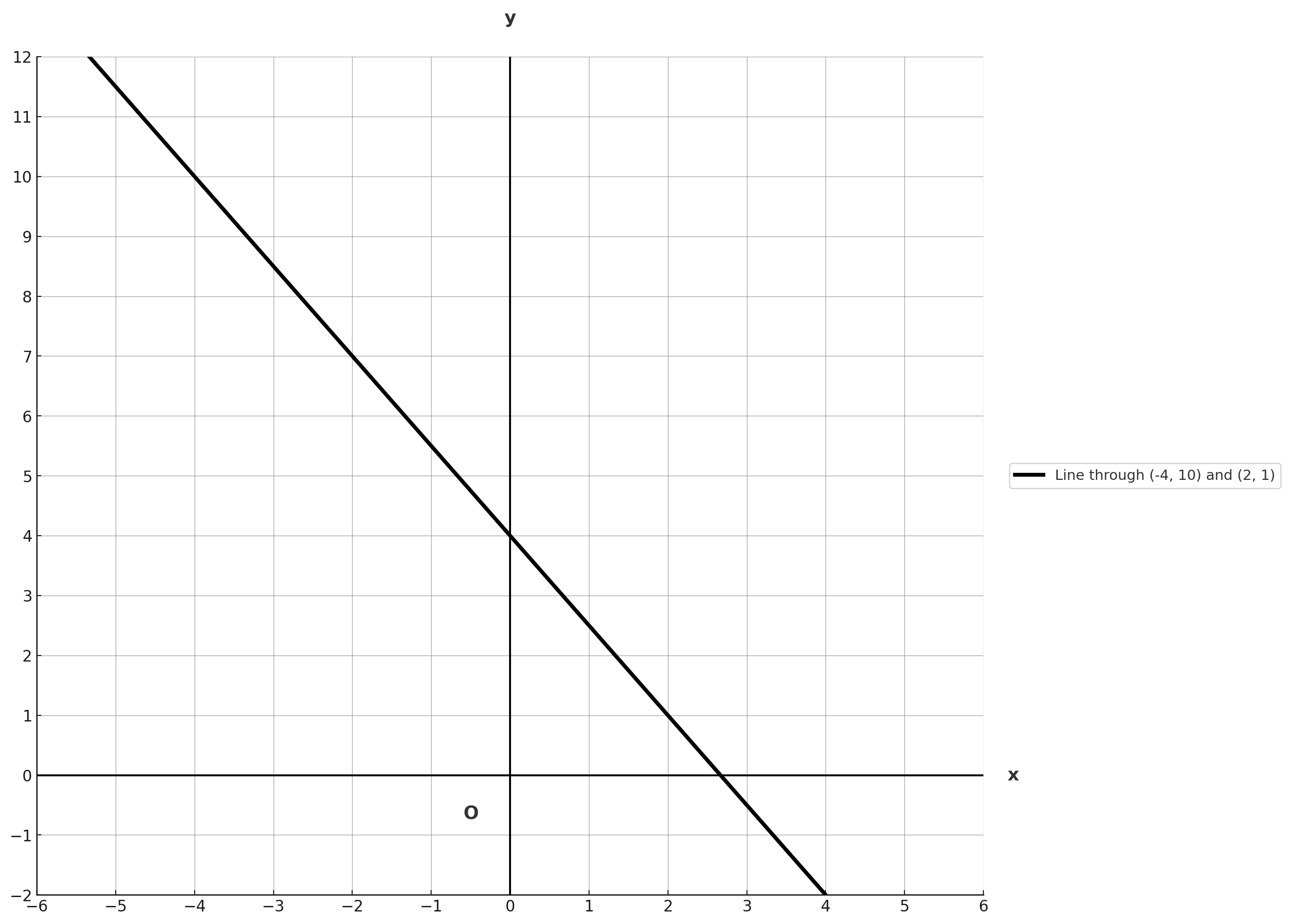
The function \(\mathrm{f}\) is a linear function defined by \(\mathrm{f(x) = mx + b}\), where \(\mathrm{m}\) and \(\mathrm{b}\) are constants. In the xy-plane, the graph of \(\mathrm{y = 5 - f(x)}\) is a line, as shown in the figure.
What is the value of \(\mathrm{b}\)?
1. TRANSLATE the graph information
- Given information:
- The graph shows a line passing through points (-4, 10) and (2, 1)
- The line crosses the y-axis at y = 4
- This graph represents \(\mathrm{y = 5 - f(x)}\), NOT \(\mathrm{f(x)}\) directly
- We know \(\mathrm{f(x) = mx + b}\) and need to find \(\mathrm{b}\)
- Key insight: We're looking at a transformed version of \(\mathrm{f(x)}\), so we need to work backwards.
2. INFER the solution strategy
- Strategic approach:
- First, find the equation of the line shown in the graph
- Then, use the relationship \(\mathrm{y = 5 - f(x)}\) to work backwards and find the original function \(\mathrm{f(x)}\)
- Finally, identify the value of \(\mathrm{b}\) from \(\mathrm{f(x)}\)
- Why this order? We can see the transformed line directly in the graph, but we need to "undo" the transformation to find the original function.
3. SIMPLIFY to find the graphed line's equation
- Calculate the slope:
Using points (-4, 10) and (2, 1):
\(\mathrm{m = \frac{1 - 10}{2 - (-4)}}\)
\(\mathrm{m = \frac{-9}{6}}\)
\(\mathrm{m = -\frac{3}{2}}\)
- Identify the y-intercept:
From the graph: \(\mathrm{b_{graph} = 4}\)
- Equation of graphed line: \(\mathrm{y = -\frac{3}{2}x + 4}\)
4. TRANSLATE the transformation relationship
- Set up the equation:
The graph shows: \(\mathrm{y = 5 - f(x)}\)
Substitute \(\mathrm{f(x) = mx + b}\):
\(\mathrm{y = 5 - (mx + b)}\)
5. SIMPLIFY the transformation equation
- Expand carefully (watch the signs!):
\(\mathrm{y = 5 - (mx + b)}\)
\(\mathrm{y = 5 - mx - b}\)
\(\mathrm{y = -mx + (5 - b)}\)
6. INFER the coefficient matching
- Compare the two equations:
- Graphed line: \(\mathrm{y = -\frac{3}{2}x + 4}\)
- Transformed function: \(\mathrm{y = -mx + (5 - b)}\)
- These must be identical, so:
- Coefficient of x: \(\mathrm{-m = -\frac{3}{2} \rightarrow m = \frac{3}{2}}\)
- Constant term: \(\mathrm{5 - b = 4}\)
7. SIMPLIFY to solve for b
From: \(\mathrm{5 - b = 4}\)
\(\mathrm{-b = -1}\) (Subtract 5 from both sides)
\(\mathrm{b = 1}\) (Multiply by -1)
Answer: B (1)
Why Students Usually Falter on This Problem
Most Common Error Path:
TRANSLATE error—Misunderstanding what the graph represents: Students see the graph and think it shows \(\mathrm{f(x)}\) directly, rather than \(\mathrm{y = 5 - f(x)}\). They might read the y-intercept as 4 and immediately conclude that \(\mathrm{b = 4}\).
This may lead them to select Choice C (4).
Second Most Common Error:
SIMPLIFY error—Sign mistakes during expansion: When expanding \(\mathrm{y = 5 - (mx + b)}\), students might incorrectly write \(\mathrm{y = 5 - mx + b}\) instead of \(\mathrm{y = 5 - mx - b}\). This leads to setting up \(\mathrm{5 + b = 4}\), which gives \(\mathrm{b = -1}\).
This may lead them to select Choice A (-1).
Third Common Error:
INFER confusion—Confusing the transformed value with the original: Students might correctly identify that the constant term in the transformation is 5, and mistakenly think this is the answer without working through the transformation algebra.
This may lead them to select Choice D (5).
The Bottom Line:
This problem requires careful attention to what the graph actually represents (a transformed function, not the original) and meticulous algebraic sign handling. The key conceptual hurdle is recognizing that you're seeing \(\mathrm{5 - f(x)}\), which means you need to work backwards to find \(\mathrm{f(x)}\).