
The graph shows a linear relationship between x and y. Which table gives three values of x and their corresponding...
GMAT Algebra : (Alg) Questions
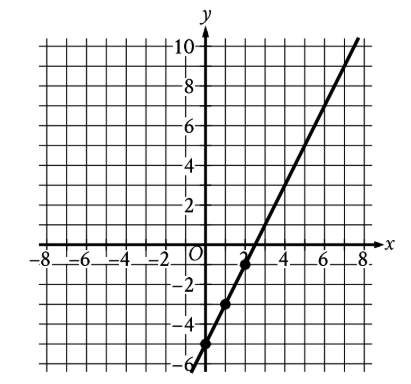
The graph shows a linear relationship between x and y. Which table gives three values of x and their corresponding values of y for this relationship?
| x | y |
|---|---|
| 0 | 0 |
| 1 | -7 |
| 2 | -9 |
| x | y |
|---|---|
| 0 | 0 |
| 1 | -3 |
| 2 | -1 |
| x | y |
|---|---|
| 0 | -5 |
| 1 | -7 |
| 2 | -9 |
| x | y |
|---|---|
| 0 | -5 |
| 1 | -3 |
| 2 | -1 |
1. TRANSLATE the graph information into coordinates
The question asks us to find which table matches the linear relationship shown in the graph. To do this, we need to read specific points from the graph.
- INFER which points to look for: Since all the answer choice tables show x-values of 0, 1, and 2, we should find the y-values that correspond to these x-values on the graph.
2. TRANSLATE the first point \(\mathrm{(x = 0)}\)
- Look at where the line crosses the y-axis (where \(\mathrm{x = 0}\))
- The line crosses at \(\mathrm{y = -5}\)
- First point: \(\mathrm{(0, -5)}\)
Key tip: Make sure you're reading below the x-axis correctly - this is a negative y-value.
3. TRANSLATE the second point \(\mathrm{(x = 1)}\)
- Find \(\mathrm{x = 1}\) on the horizontal axis
- Follow the vertical line up (or down in this case) to where it meets the graphed line
- At \(\mathrm{x = 1}\), the line is at \(\mathrm{y = -3}\)
- Second point: \(\mathrm{(1, -3)}\)
4. TRANSLATE the third point \(\mathrm{(x = 2)}\)
- Find \(\mathrm{x = 2}\) on the horizontal axis
- Follow the vertical line to where it meets the graphed line
- At \(\mathrm{x = 2}\), the line is at \(\mathrm{y = -1}\)
- Third point: \(\mathrm{(2, -1)}\)
5. Match the coordinates to the answer choices
Now we have three coordinate pairs: \(\mathrm{(0, -5), (1, -3), (2, -1)}\)
Let's check each table:
- Choice A: Shows \(\mathrm{(0, 0)}\) - Wrong! The y-intercept should be -5, not 0
- Choice B: Shows \(\mathrm{(0, 0)}\) - Wrong! Same issue as Choice A
- Choice C: Shows \(\mathrm{(0, -5), (1, -7), (2, -9)}\) - The first point is right, but the other points are wrong (and the y-values are going down, not up)
- Choice D: Shows \(\mathrm{(0, -5), (1, -3), (2, -1)}\) - Perfect match! ✓
Answer: D
Why Students Usually Falter on This Problem
Most Common Error Path:
Process Skill Gap - Weak TRANSLATE skill: Misreading the y-intercept (where \(\mathrm{x = 0}\))
Some students struggle to read negative values accurately on the y-axis. They might:
- See the line starting in the lower half of the graph and misread it as starting at \(\mathrm{(0, 0)}\) instead of \(\mathrm{(0, -5)}\)
- Focus on where the line crosses the origin region without carefully counting the grid lines
This may lead them to select Choice A or Choice B (both incorrectly show the y-intercept as 0 instead of -5).
Second Most Common Error:
Process Skill Gap - Poor TRANSLATE execution: Confusing the pattern direction
Students might correctly identify the y-intercept as -5 but then misread whether the y-values are increasing or decreasing. They might think the line is going down (negative slope) instead of up (positive slope).
This may lead them to select Choice C (which shows -5, -7, -9 - a decreasing pattern instead of the correct -5, -3, -1 increasing pattern).
The Bottom Line:
This problem requires careful, precise reading of coordinates from a graph, especially when dealing with negative values. The key is to take your time identifying exactly where the line intersects specific x-values, counting grid lines carefully to avoid off-by-one or sign errors.
| x | y |
|---|---|
| 0 | 0 |
| 1 | -7 |
| 2 | -9 |
| x | y |
|---|---|
| 0 | 0 |
| 1 | -3 |
| 2 | -1 |
| x | y |
|---|---|
| 0 | -5 |
| 1 | -7 |
| 2 | -9 |
| x | y |
|---|---|
| 0 | -5 |
| 1 | -3 |
| 2 | -1 |