
In the figure above, lines AE and BD intersect at C.The measure of angle DCE is 47°.The measure of angle...
GMAT Geometry & Trigonometry : (Geo_Trig) Questions
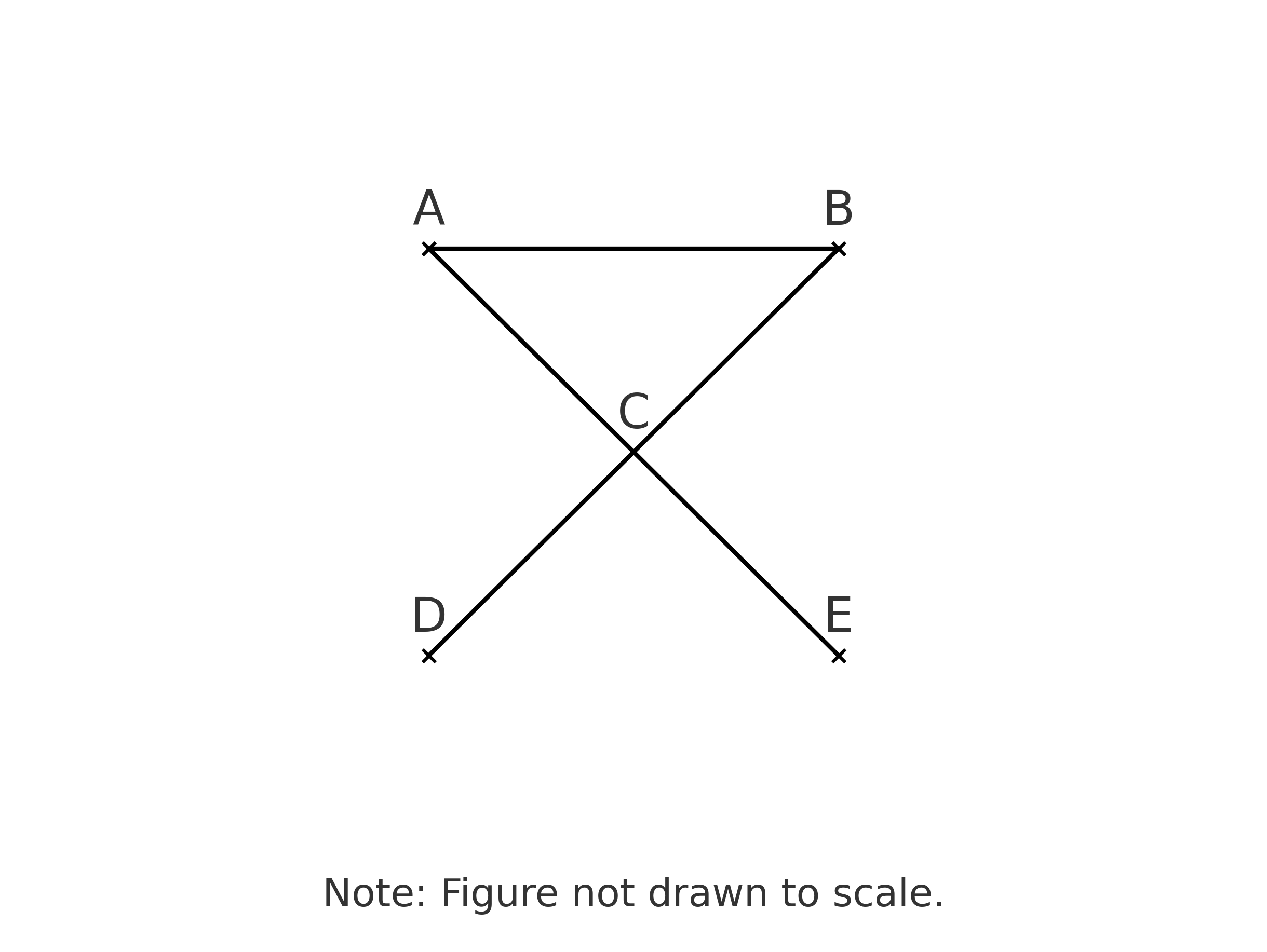
In the figure above, lines AE and BD intersect at C.
The measure of \(\angle \mathrm{DCE}\) is \(47°\).
The measure of \(\angle \mathrm{CAB}\) is \(68°\).
What is the measure, in degrees, of \(\angle \mathrm{ABC}\)?
47
65
68
115
1. TRANSLATE the problem information
Looking at the diagram:
- Given information:
- Lines AE and BD intersect at point C
- \(\mathrm{m∠DCE = 47°}\)
- \(\mathrm{m∠CAB = 68°}\)
- Triangle ABC is formed by points A, B, and C
- Need to find: \(\mathrm{m∠ABC}\)
2. INFER the relationship between given angles and the triangle
Here's the key insight: We need three pieces of information to use the triangle angle sum property, but we only know one angle in triangle ABC (angle CAB = 68°).
However, look at where the lines intersect at point C:
- Angle DCE is formed below point C
- Angle ACB is formed inside triangle ABC
- These two angles are vertical angles (opposite each other when two lines cross)
Since vertical angles are congruent: \(\mathrm{m∠ACB = 47°}\)
Now we have two angles of triangle ABC!
3. INFER which property to apply next
We know two angles of a triangle and need the third. This calls for the triangle angle sum property: all three interior angles of a triangle must sum to 180°.
4. SIMPLIFY to find the unknown angle
Set up the equation:
\(\mathrm{m∠CAB + m∠ABC + m∠ACB = 180°}\)
Substitute known values:
\(\mathrm{68° + m∠ABC + 47° = 180°}\)
Combine like terms:
\(\mathrm{115° + m∠ABC = 180°}\)
Solve for the unknown:
\(\mathrm{m∠ABC = 180° - 115°}\)
\(\mathrm{m∠ABC = 65°}\)
Answer: B (65°)
Why Students Usually Falter on This Problem
Most Common Error Path:
Weak INFER skill: Not recognizing the vertical angle relationship between angle DCE and angle ACB.
Students see angle DCE = 47° but don't realize this angle is relevant to triangle ABC. They may think they don't have enough information since they only explicitly know one angle of the triangle (CAB = 68°). Without identifying that ACB is also 47°, they cannot proceed with the triangle angle sum property. This leads to confusion and guessing among the answer choices.
Second Most Common Error:
Conceptual confusion: Misidentifying which angles are vertical angles or confusing angle relationships.
Some students might incorrectly think that angle DCE equals one of the other angles in the triangle (like angle ABC or angle CAB). For example, they might add 68° + 47° = 115° and select Choice D (115), thinking this is somehow the answer rather than recognizing it's an intermediate step. Or they might assume angle ABC equals angle DCE directly and select Choice A (47), or that it equals angle CAB and select Choice C (68).
The Bottom Line:
This problem tests whether students can bridge between two geometric concepts: the properties of intersecting lines (vertical angles) and the properties of triangles (angle sum). The challenge isn't in the calculation—it's in INFERRING which angles are related and how that relationship helps solve the problem. Miss that connection, and you're stuck before you even begin.
47
65
68
115