
In the figure shown, lines m and n intersect. What is the value of y?
GMAT Geometry & Trigonometry : (Geo_Trig) Questions
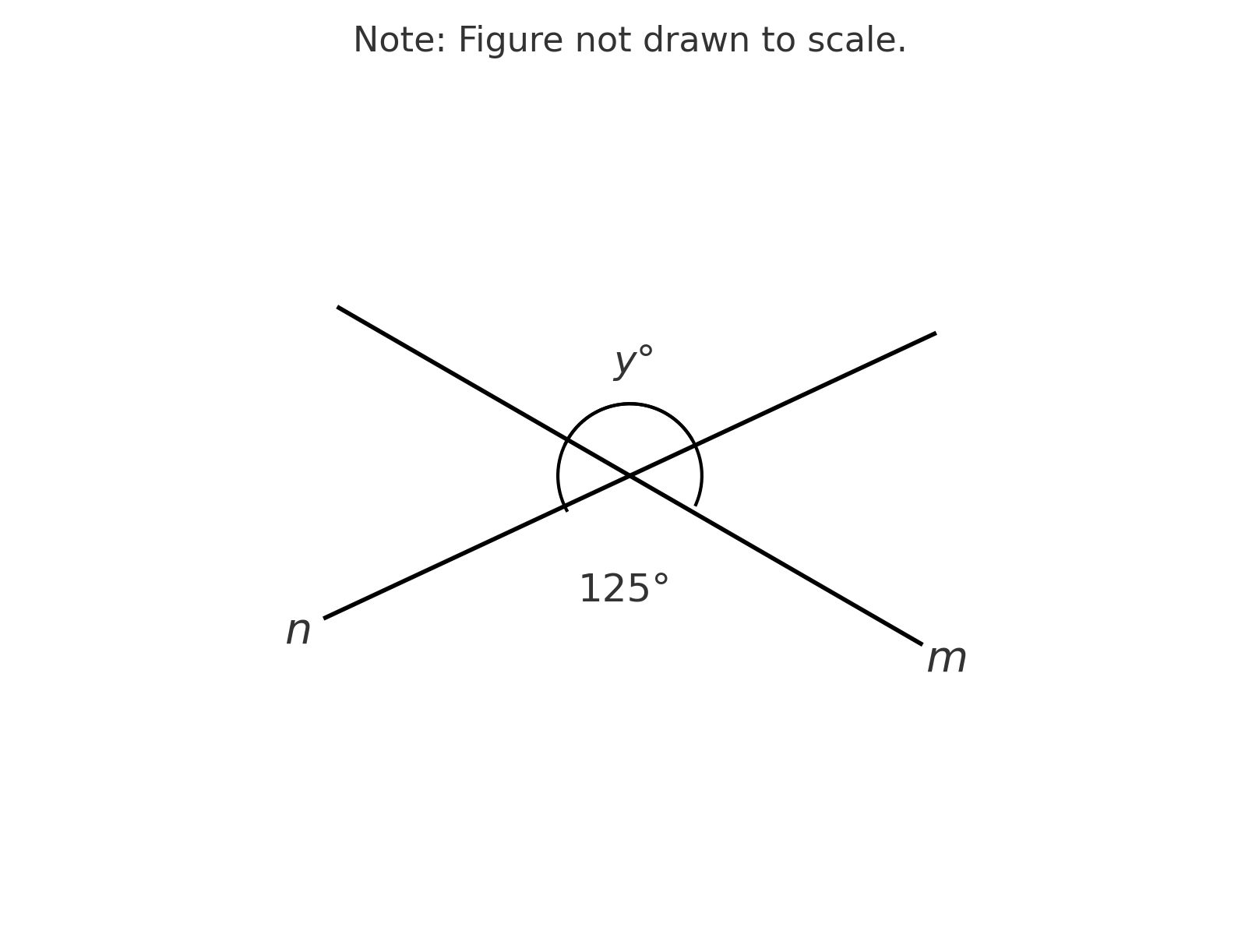
In the figure shown, lines \(\mathrm{m}\) and \(\mathrm{n}\) intersect. What is the value of \(\mathrm{y}\)?
1. TRANSLATE the problem information
- Given information:
- Two lines (m and n) intersect at a point
- One angle measures \(125°\)
- We need to find the measure of angle \(\mathrm{y}°\)
- What we can see in the diagram:
- The \(125°\) angle is positioned at the intersection
- The angle \(\mathrm{y}°\) is also at the intersection
- There's a circle marking the center point where the lines cross
2. INFER the angle relationship
When two lines intersect, they create four angles at the intersection point. These angles have special relationships:
- Vertical angles (opposite angles across from each other) are always equal
- Linear pairs (adjacent angles on the same side) always sum to \(180°\)
The key question: What is the relationship between y and the \(125°\) angle?
Looking at the diagram carefully:
- The angle \(\mathrm{y}°\) is positioned opposite (across from) the \(125°\) angle
- This means they are vertical angles, not adjacent angles
3. Apply the vertical angles property
Since y and \(125°\) are vertical angles, and vertical angles are always congruent (equal in measure):
\(\mathrm{y} = 125°\)
Answer: 125°
Why Students Usually Falter on This Problem
Most Common Error Path:
Weak INFER skill - Misidentifying the angle relationship: Students may look at the diagram too quickly and assume that y and \(125°\) are adjacent angles forming a linear pair, rather than recognizing them as vertical angles.
If they think the angles are adjacent (next to each other on a line), they would incorrectly calculate:
\(\mathrm{y} + 125° = 180°\)
\(\mathrm{y} = 180° - 125° = 55°\)
This leads to the incorrect answer of \(55°\) instead of the correct answer of \(125°\).
Second Most Common Error:
Conceptual confusion about angle relationships: Some students may know that intersecting lines create special angle relationships, but confuse which angles are equal versus which angles are supplementary. They might remember "something adds to \(180°\)" but apply this rule to the wrong pair of angles.
This confusion causes them to second-guess themselves and potentially select an incorrect answer or guess.
The Bottom Line:
The critical skill here is visually identifying vertical angles in a diagram. Vertical angles are always across from each other at an intersection, not next to each other. Once you correctly identify that y and \(125°\) are vertical angles (not a linear pair), the problem becomes straightforward: vertical angles are equal, so \(\mathrm{y} = 125°\).