
The graph of the function f, defined by \(\mathrm{f(x) = -\frac{1}{2}(x - 4)^2 + 10}\), is shown in the xy-plane...
GMAT Advanced Math : (Adv_Math) Questions
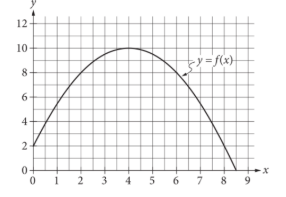
The graph of the function f, defined by \(\mathrm{f(x) = -\frac{1}{2}(x - 4)^2 + 10}\), is shown in the xy-plane above. If the function g (not shown) is defined by \(\mathrm{g(x) = -x + 10}\), what is one possible value of a such that \(\mathrm{f(a) = g(a)}\)?
1. TRANSLATE the problem information
Given information:
- \(\mathrm{f(x) = -\frac{1}{2}(x - 4)^2 + 10}\) (parabola in vertex form)
- \(\mathrm{g(x) = -x + 10}\) (linear function)
- Need to find: value(s) of a where \(\mathrm{f(a) = g(a)}\)
2. INFER what the condition means algebraically
The condition \(\mathrm{f(a) = g(a)}\) means the output values of both functions are equal when the input is a. To find this value:
- Substitute a into both function definitions
- Set them equal: \(\mathrm{-\frac{1}{2}(a - 4)^2 + 10 = -a + 10}\)
- Solve for a
This will give us the x-coordinate(s) where the two graphs intersect.
3. SIMPLIFY to isolate the quadratic term
Starting with: \(\mathrm{-\frac{1}{2}(a - 4)^2 + 10 = -a + 10}\)
Subtract 10 from both sides:
\(\mathrm{-\frac{1}{2}(a - 4)^2 = -a}\)
Multiply both sides by -2 to clear the fraction:
\(\mathrm{(a - 4)^2 = 2a}\)
4. SIMPLIFY by expanding and rearranging
Expand the left side using \(\mathrm{(a - 4)^2 = a^2 - 8a + 16}\):
\(\mathrm{a^2 - 8a + 16 = 2a}\)
Move all terms to one side:
\(\mathrm{a^2 - 8a + 16 - 2a = 0}\)
\(\mathrm{a^2 - 10a + 16 = 0}\)
5. SIMPLIFY by factoring the quadratic
To factor \(\mathrm{a^2 - 10a + 16}\), find two numbers that:
- Multiply to give 16
- Add to give -10
These numbers are -2 and -8:
\(\mathrm{(a - 2)(a - 8) = 0}\)
6. APPLY CONSTRAINTS using the zero product property
If \(\mathrm{(a - 2)(a - 8) = 0}\), then either:
- \(\mathrm{a - 2 = 0}\), so \(\mathrm{a = 2}\), OR
- \(\mathrm{a - 8 = 0}\), so \(\mathrm{a = 8}\)
Answer: 2 or 8 (Either value is acceptable)
You can verify:
- \(\mathrm{f(2) = -\frac{1}{2}(2-4)^2 + 10}\)
\(\mathrm{= -\frac{1}{2}(4) + 10}\)
\(\mathrm{= 8}\), and \(\mathrm{g(2) = -2 + 10 = 8}\) ✓ - \(\mathrm{f(8) = -\frac{1}{2}(8-4)^2 + 10}\)
\(\mathrm{= -\frac{1}{2}(16) + 10}\)
\(\mathrm{= 2}\), and \(\mathrm{g(8) = -8 + 10 = 2}\) ✓
Why Students Usually Falter on This Problem
Most Common Error Path:
Weak SIMPLIFY skill—Sign error when multiplying by -2:
When clearing the fraction in the step \(\mathrm{-\frac{1}{2}(a - 4)^2 = -a}\), students might multiply both sides by -2 incorrectly:
- They might forget to change the sign on the right side
- Writing \(\mathrm{(a - 4)^2 = -2a}\) instead of \(\mathrm{(a - 4)^2 = 2a}\)
This leads to the wrong quadratic equation: \(\mathrm{a^2 - 8a + 16 = -2a}\), which gives \(\mathrm{a^2 - 6a + 16 = 0}\). This doesn't factor nicely with integers, causing confusion and potentially leading to abandoning the systematic solution and guessing.
Second Most Common Error:
Weak SIMPLIFY skill—Incorrect factoring:
Students might correctly arrive at \(\mathrm{a^2 - 10a + 16 = 0}\) but then factor incorrectly:
- Finding factors that multiply to 16 (like -4 and -4) but don't check that they add to -10
- Writing \(\mathrm{(a - 4)(a - 4) = 0}\), which gives only \(\mathrm{a = 4}\)
This leads to the incomplete answer 4, missing the other solution. When students verify and find \(\mathrm{f(4) \neq g(4)}\), they realize something is wrong but may not know how to correct it.
Third Common Error:
Weak SIMPLIFY skill—Expansion error:
When expanding \(\mathrm{(a - 4)^2}\), students might forget the middle term:
- Writing \(\mathrm{(a - 4)^2 = a^2 + 16}\) instead of \(\mathrm{a^2 - 8a + 16}\)
This leads to \(\mathrm{a^2 + 16 = 2a}\), or \(\mathrm{a^2 - 2a + 16 = 0}\), which doesn't factor and has no real solutions, causing them to get stuck and randomly select an answer.
The Bottom Line:
This problem requires careful algebraic manipulation through multiple steps. Each transformation must preserve equality and maintain correct signs. The most vulnerable points are when multiplying by negative numbers and when expanding binomial squares—both require attention to detail and systematic checking.