
In triangle ABC, points M and N lie on sides AB and AC, respectively.Segment MN is drawn parallel to BC,...
GMAT Geometry & Trigonometry : (Geo_Trig) Questions
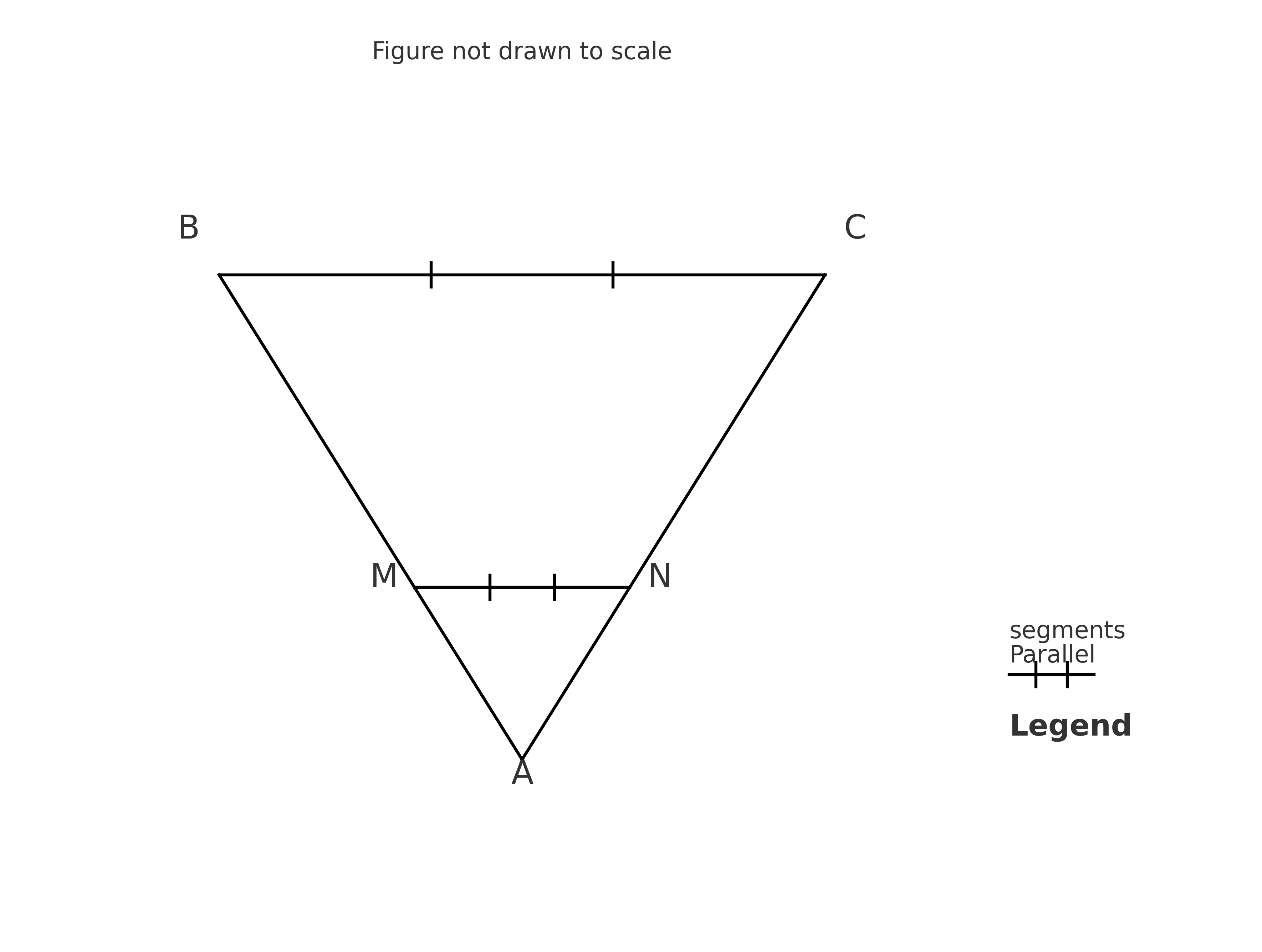
- In triangle \(\mathrm{ABC}\), points \(\mathrm{M}\) and \(\mathrm{N}\) lie on sides \(\mathrm{AB}\) and \(\mathrm{AC}\), respectively.
- Segment \(\mathrm{MN}\) is drawn parallel to \(\mathrm{BC}\), as shown in the figure.
- If \(\mathrm{AM = 8}\), \(\mathrm{MB = 14.5}\), and \(\mathrm{AN = 10}\), what is the length of \(\mathrm{NC}\), to the nearest tenth?
17.9
18.1
18.7
19.3
1. TRANSLATE the problem information
Looking at the diagram and problem:
- Given:
- Point M lies on side AB with \(\mathrm{AM = 8}\) and \(\mathrm{MB = 14.5}\)
- Point N lies on side AC with \(\mathrm{AN = 10}\)
- Segment MN is drawn parallel to BC (\(\mathrm{MN ∥ BC}\))
- Find: Length of NC, rounded to nearest tenth
2. INFER the relationship created by the parallel line
The key insight: When a line is drawn parallel to one side of a triangle, it creates a special proportional relationship.
Since \(\mathrm{MN ∥ BC}\), the Basic Proportionality Theorem (Side-Splitter Theorem) applies:
- The parallel line divides the two sides proportionally
- This means: \(\frac{\mathrm{AM}}{\mathrm{MB}} = \frac{\mathrm{AN}}{\mathrm{NC}}\)
This is the critical proportion to set up. Notice:
- AM and MB are the two parts of side AB
- AN and NC are the two parts of side AC
- The ratios of corresponding segments are equal
3. TRANSLATE the proportion into an equation
Substitute the known values into the proportion:
\(\frac{8}{14.5} = \frac{10}{\mathrm{NC}}\)
4. SIMPLIFY to solve for NC
Cross multiply:
\(8 \times \mathrm{NC} = 14.5 \times 10\)
\(8 \times \mathrm{NC} = 145\)
Divide both sides by 8:
\(\mathrm{NC} = \frac{145}{8}\)
\(\mathrm{NC} = 18.125\)
5. APPLY CONSTRAINTS for final answer
The problem asks for the answer "to the nearest tenth":
18.125 rounds to 18.1
Answer: 18.1 (Choice B)
Why Students Usually Falter on This Problem
Most Common Error Path:
Weak INFER skill: Setting up an incorrect proportion by confusing which segments correspond to each other.
Some students might incorrectly think:
- "The two given segments on different sides should form one ratio: \(\frac{\mathrm{AM}}{\mathrm{AN}}\)"
- They set up: \(\frac{\mathrm{AM}}{\mathrm{AN}} = \frac{\mathrm{MB}}{\mathrm{NC}}\), which gives \(\frac{8}{10} = \frac{14.5}{\mathrm{NC}}\)
This actually yields \(\mathrm{NC = 18.125}\) (which happens to be correct by coincidence!), but the reasoning is wrong. However, other incorrect proportions lead to wrong answers:
- Using \(\frac{\mathrm{AM}}{\mathrm{AM+MB}} = \frac{\mathrm{AN}}{\mathrm{AN+NC}}\): \(\frac{8}{22.5} = \frac{10}{10+\mathrm{NC}}\)
- This gives \(8(10+\mathrm{NC}) = 225\), so \(80 + 8\mathrm{NC} = 225\), thus \(\mathrm{NC = 18.125}\) (again coincidentally correct!)
A more damaging error: Thinking the parallel line means equal ratios but setting them up backwards:
- Using \(\frac{\mathrm{MB}}{\mathrm{AM}} = \frac{\mathrm{AN}}{\mathrm{NC}}\): \(\frac{14.5}{8} = \frac{10}{\mathrm{NC}}\)
- This gives \(\mathrm{NC} = \frac{80}{14.5} ≈ 5.5\) (not matching any choice)
When students set up proportions incorrectly and get answers that don't match the choices, this leads to confusion and guessing.
Second Most Common Error:
Weak SIMPLIFY skill: Making arithmetic errors during cross multiplication or division.
Common calculation mistakes:
- Multiplying \(14.5 \times 10\) incorrectly (getting 140 instead of 145)
- Dividing \(\frac{145}{8}\) incorrectly
- Forgetting to round or rounding to the wrong decimal place (18 instead of 18.1)
For example, if a student calculates \(14.5 \times 10 = 140\) (instead of 145):
- They get \(\mathrm{NC} = \frac{140}{8} = 17.5\)
- This doesn't match any answer choice exactly, but they might misread and select Choice A (17.9) as the closest value
The Bottom Line:
This problem tests whether students can recognize the geometric relationship created by a parallel line and translate it into the correct algebraic proportion. The theorem itself is straightforward, but students must carefully identify which segments go together in the ratio—AM goes with MB (parts of AB), and AN goes with NC (parts of AC). Mixing up these relationships or making calculation errors are the two main stumbling blocks.
17.9
18.1
18.7
19.3